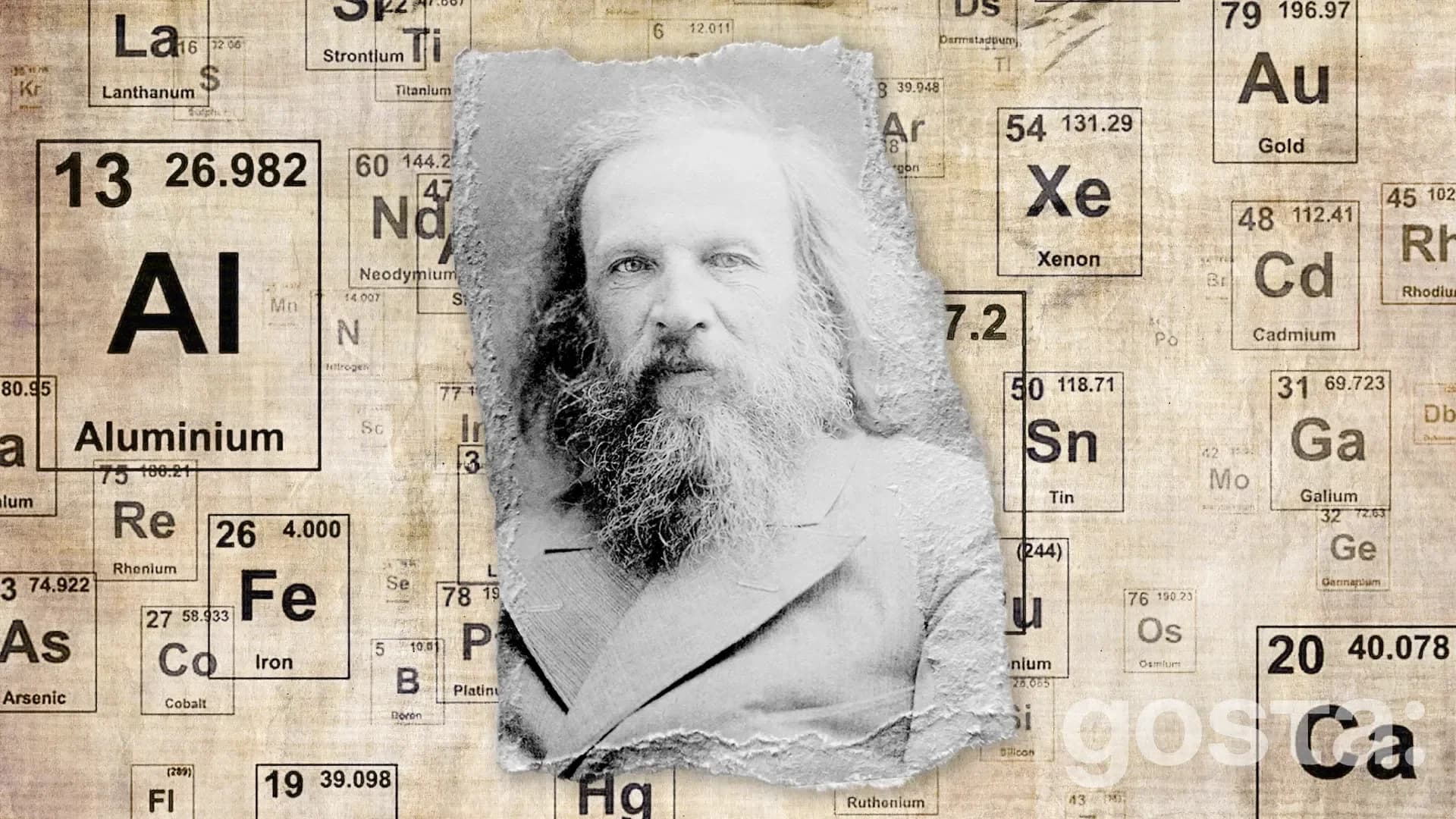
Today, the periodic table feels like something obvious – it's in every textbook and hangs in classrooms and labs. But in the past, there was no single standard or common agreement on how to organize chemical elements. Mendeleev's table changed that. It turned scattered facts about substances into a logical system. The periodic approach showed that elemental properties change in a predictable pattern rather than randomly, and that is what made it the basis of modern chemistry.
Why the Periodic Table Was Needed in the First Place
Before the periodic table existed, chemists already knew several dozen elements, but they still lacked a coherent picture. Some properties were described and compound formulas were known, but the connections between elements remained unclear. Every new element felt like adding another "brick" to a wall no one could fully see. Science needed a system to move forward.
In the first half of the 19th century, many researchers proposed their own classifications. Some focused on atomic mass, others on similarities in properties, and some tried combining both approaches. But none of the schemes explained all known exceptions. That's why Mendeleev's table became a turning point: it didn't reject earlier ideas but united their strongest parts into one coherent system.
To understand why this table was needed, look at the problems chemists faced before it appeared:
- Different textbooks offered different groupings of elements.
- Similar properties didn't always correspond to similar atomic masses.
- No one knew whether all elements had already been discovered.
- Discoveries often "broke" previous classification systems.
- The lack of a unified system made chemistry harder to teach and study.
Eventually, it became clear: without stable logic and structure, progress would stall. Mendeleev's future table aimed to combine atomic masses, properties, and sequence into a system that wouldn't collapse every time a new element was found. The need for a reliable "map" of elements served as the starting point for developing the periodic system.
How Elements Were Organized Before Mendeleev
Mendeleev's table did not appear out of nowhere. Earlier attempts already suggested that chemical properties follow certain repeating patterns. Three approaches are especially important – they helped pave the way for Mendeleev's idea.
- Dobereiner's Triads. In the early 19th century, Johann Döbereiner grouped some elements into sets of three. The atomic mass of the middle element was close to the average of the other two, and their properties were similar. A classic example is the chlorine–bromine–iodine triad.
- De Chancourtois' Telluric Helix. In 1862, French geologist Alexandre-Émile Béguyer de Chancourtois arranged elements in a spiral around a cylinder based on atomic mass, placing elements with similar properties in vertical alignment.
- Newlands' Law of Octaves. In the 1860s, English chemist John Newlands arranged elements by atomic mass and noticed that every eighth element had similar properties – like musical octaves.
These attempts showed that periodicity existed, but none offered a complete picture. They worked only for part of the known elements or were too impractical to use widely. Mendeleev's table became the next step: it kept the idea of repeating properties but presented it as a simple, flat scheme that made sense to both teachers and researchers. Unlike its predecessors, it combined clarity with deep internal logic.
How Mendeleev Built the Periodic Table – From Cards to the Periodic Law
While writing a textbook on inorganic chemistry, Dmitri Mendeleev needed more than a list of elements – he needed to show how they were related. He began organizing information on separate cards: atomic masses, formulas of oxides and hydrides, density, melting point, and typical reactions. These cards slowly evolved into the periodic table.
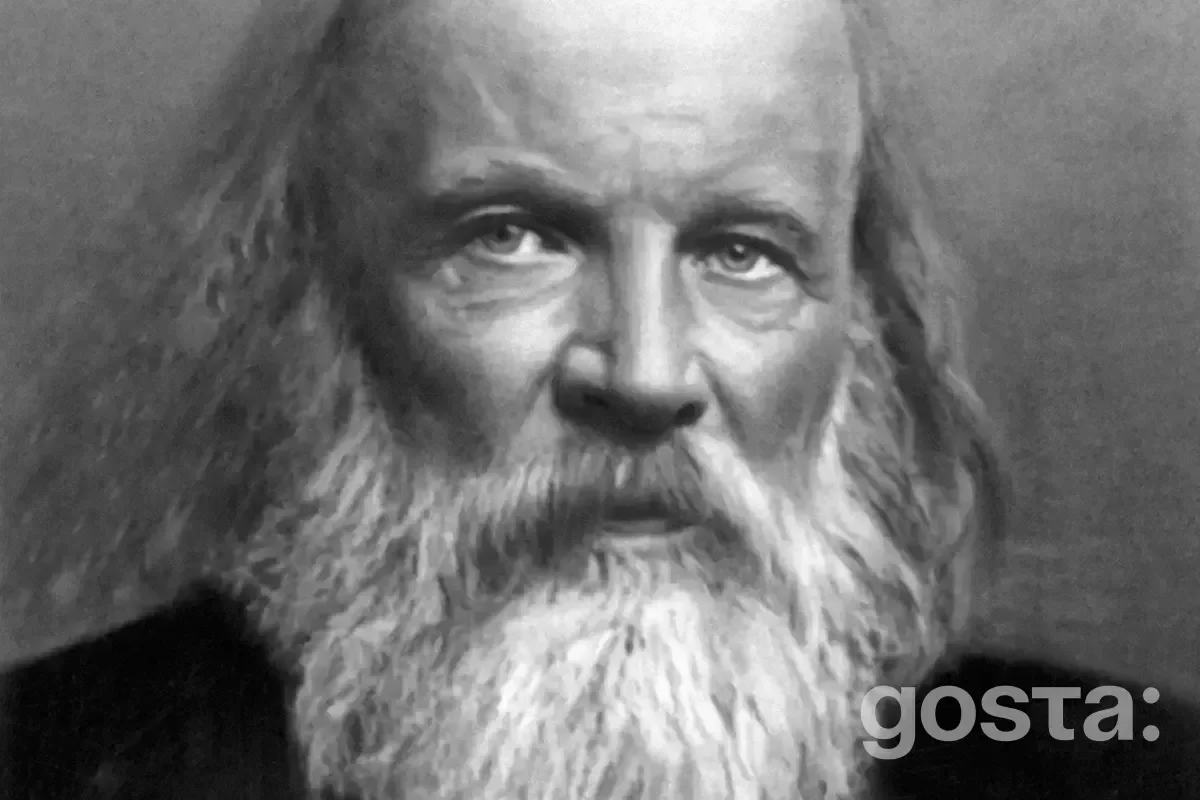
He arranged the cards in order of increasing atomic mass and examined how properties changed. Similar elements are repeated periodically. He formulated this pattern as the periodic law: the properties of elements depend on their atomic mass and repeat periodically. Later, in the 20th century, scientists found that the key parameter is atomic number, not mass, but the logic of repeating properties stayed the same.
One of the most remarkable features of Mendeleev's first table was its empty spaces. Where an element should logically be, but no data existed, he left a gap and described what that element should look like. That's how he predicted "eka-aluminium," "eka-boron," "eka-silicon," and "eka-manganese."
To see how accurate these predictions were, here are several examples.
Predicted Elements and Their Modern Names
These matches were not accidents. The real elements had densities, oxide types, and compound formulas very close to Mendeleev's descriptions. The confirmations of gallium and germanium especially impressed his contemporaries – they showed that the table wasn't just a convenient chart but a tool for prediction.
What the Periodic Table Shows – Periods, Groups, and Key Patterns
The modern periodic table is organized by atomic number – the number of protons in the nucleus. This is the main factor that defines how an atom behaves. Mendeleev's ordering by mass was close enough to reveal the same logic.
Periods are horizontal rows. Within a single period, elements shift from reactive metals on the left to noble gases on the right. Groups are vertical columns. Elements in the same group share the same number of valence electrons and form similar compounds.
To "read" any element in the periodic table, it helps to understand a few key terms:
- Atomic number – defines the position in the table.
- Relative atomic mass – linked to the total number of protons and neutrons.
- Period – a horizontal row with gradual changes in properties.
- Group – a vertical column with similar chemical behavior.
- Valence electrons – the electrons involved in bonding.
- Electronegativity, atomic radius, ionization energy – values that change in predictable directions across the table.
The periodic table is not just a reference book, but a map. It brings together data that allows us to predict the behaviour of elements in reactions, their activity and role in compounds. The periodic table allows you to quickly find the neighbours of an element, assess how properties will change across a group or period, and see the overall logic of chemistry in a compact form.
How Key Properties Change Across the Periodic Table
Such patterns help to use Mendeleev's table as a tool for explaining the behaviour of elements without memorising each case separately. A pupil or student can see which period and group an element belongs to and can predict how active it is, whether it is more like a metal or a non-metal, and how it will react with other substances. This is the power of the periodic table: it reduces the number of facts that need to be kept in mind and replaces them with logic.
Which Elements Were Added to the Table After Mendeleev
When Mendeleev published his first version, many elements now in the table were still unknown, poorly studied, or too unstable to exist for long. The history of chemistry since then is a story of continuous additions.
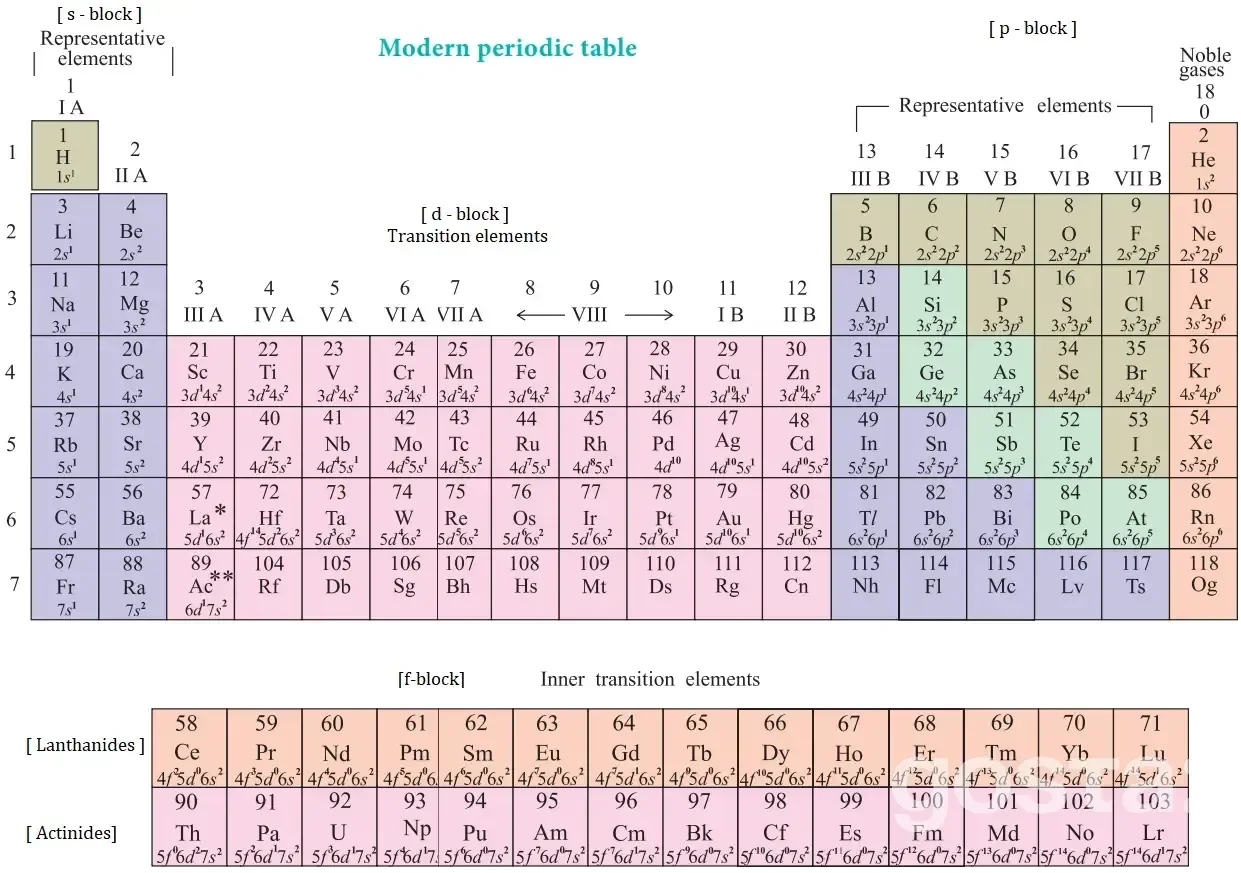
By the end of the 19th century, his predictions had been confirmed: gallium (eka-aluminium) was discovered in 1875, scandium (eka-boron) in 1879, and germanium (eka-silicon) in 1886. Later, in 1937, the existence of technetium, the first artificial element, was confirmed in Italy, filling the 'hole' for eka-manganese in Mendeleev's table.
The 20th century brought another important group of discoveries: radioactive and artificially created elements. Promethium, for example, was isolated in 1945 during the analysis of uranium fission products in a nuclear reactor, and its name refers to the mythological Prometheus. Later, superheavy elements appeared – those that exist for a very short time and are formed in particle accelerators.
Examples of Elements Added in the 20th–21st Centuries
These discoveries show that Mendeleev's table is a living structure. It did not remain in the 19th century, but adapted to new realities: from classical chemistry to nuclear physics. Superheavy elements exist for a very short time, but even these seconds are enough to determine their atomic number and enter it in the appropriate cell. The periodic table has stood the test of time: instead of changing radically, it is simply supplemented with new 'bricks'.
Myths and Facts About the Periodic Table
Popularity brought myths, and many stories about how the periodic table was created sound dramatic but don't match reality.
Common myths include:
- Mendeleev supposedly saw the entire table in a dream.
- He "invented" vodka.
- Some elements like nebulium or coronium were real but didn't fit the table.
- The system was supposedly complete from the start.
In fact, Mendeleev spent years developing the periodic system and didn't take the dream story seriously. The vodka myth appeared because of his work on alcohol–water mixtures, not because he invented the drink.
Nebulium and coronium were misinterpretations of spectral lines – later shown to belong to known elements like oxygen and highly ionized iron. These cases don't disprove the table; they highlight its value in filtering doubtful discoveries.
Why the Periodic Table Still Matters in Schools, Science, and Technology
Today the periodic table is far more than a classroom poster. It remains a practical tool used across many fields – from basic science to advanced technologies. While data about elements is refined over time, the principles behind the table are still relevant.
How the periodic table is used today:
- In schools: to explain the structure of matter, types of chemical bonding, and elemental behavior.
- In universities and research: to identify patterns between structure and properties of new compounds.
- In materials science: to choose elements for alloys, semiconductors, and specialized materials.
- In pharmaceuticals and medical tech: to understand how metallic ions behave in the body and in diagnostics.
- In nuclear energy: to describe radioactive elements, isotopes, and decay products.
For students, the periodic table offers a quick way to understand an element's behavior without constantly checking reference books. For researchers, it's a foundation for building models and hypotheses. For engineers, it's a tool for selecting the right materials for specific tasks. That is why the periodic table remains not just a historical artifact but a working instrument that connects school, academia, and advanced labs.
Frequently Asked Questions About the Periodic Table
Why is the table named after Mendeleev if others had created schemes before him?
Earlier classifications revealed some patterns but didn't produce a complete system. Mendeleev proposed the periodic law, built a table around it, and predicted the properties of elements that hadn't yet been discovered. That predictive power made his system the foundation of the modern table.
Was Mendeleev's first table the same as the modern one?
No. The original version looked different and arranged some elements differently. Over time, the table was updated: atomic masses were refined, the concept of atomic number was introduced, and some elements changed position. But the core idea of periodicity remained unchanged.
Why do we now organize elements by atomic number instead of atomic mass?
Further research showed that the number of protons determines an element's chemical behavior. Arranging elements by atomic number makes periodic trends clearer, so the modern system uses this parameter even though the historical versions relied on mass.
Why include elements that exist for fractions of a second?
Even extremely unstable elements expand our understanding of how nuclei behave under extreme conditions. Their existence confirms or adjusts theories about atomic structure and nuclear stability. This data is crucial for both fundamental physics and nuclear technologies.
Can you learn the periodic table without memorizing every element?
Yes. The key is understanding the main trends: how atomic radius, electronegativity, and metallic properties change across periods and groups. Once you know the logic, the table becomes a tool for making predictions rather than a list to memorize. New information falls naturally into place.