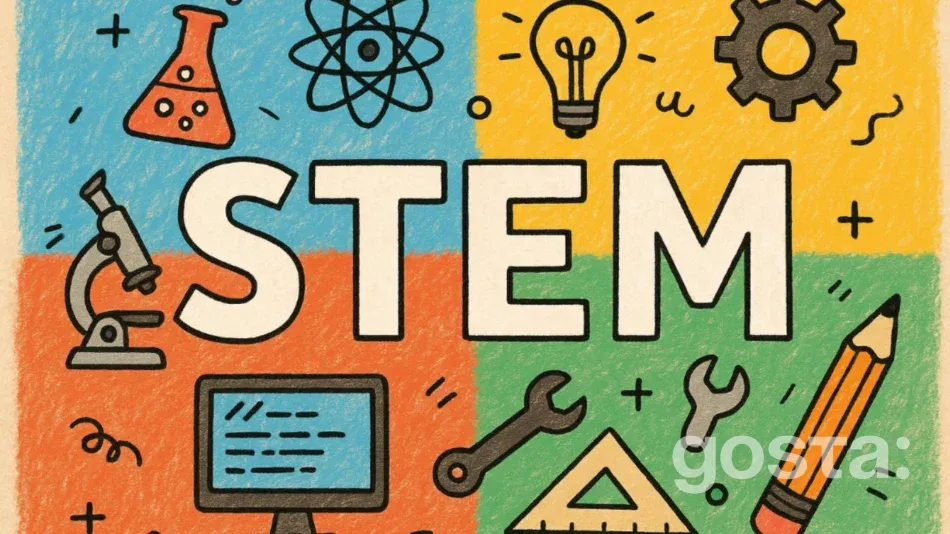
STEM education is a modern way of learning that brings together science, technology, engineering, and math. It’s all about hands-on, cross-subject learning. And it couldn’t be more relevant today. Kids are growing up in a fast-changing, tech-driven world. Knowledge evolves faster than school curriculums can keep up. That’s why education needs new ideas — and STEM is one of the most popular. STEM isn’t just a trend. It’s a way to prepare kids for real life. It’s not about memorizing facts — it’s about learning to think, explore, and create.
What Is STEM Education and Why Is Everyone Talking About It?
STEM stands for Science, Technology, Engineering, and Math. But it’s not only about numbers or hard sciences.
The whole point of STEM is to stop treating school subjects as separate. Instead, they’re combined and used in real-life tasks. Say a child is learning physics, math, and coding. With STEM, they’ll use all three in a project. The tasks are creative and practical, so the knowledge turns into real skills — not just theory.
STEM helps kids solve real-world problems. It turns them into active learners and curious thinkers. That’s why more and more schools are adopting it.
How STEM Changes School: Real-World Examples
In a traditional classroom, a teacher explains, and students listen and do exercises. In a STEM class, the student gets a task — and the teacher guides them through solving it. Along the way, they pick up both knowledge and the skills to use it. One common task? Build a bridge from paper. But not just any bridge — one that can actually hold weight. To succeed, students need to apply math, physics, and design thinking.
Another example: making a mobile app. That means learning to code, do calculations, think like an engineer, and collaborate with others.
STEM lessons often include:
Group work that builds communication skills.
Hands-on experiments instead of just theory.
Real problems that feel meaningful beyond school.
Tech tools that kids will use in everyday life.
No more rote tests — now it’s about presentations. No more strict rules — now it’s about exploring solutions. STEM classrooms are safe spaces to make mistakes and grow from them.
What Skills Does STEM Education Build?
STEM isn’t just about what kids learn — it’s about how they learn. Here are six essential skills it helps develop:
Critical Thinking. Kids learn to question, analyze, and think deeply. They don’t just accept facts — they explore them.
Creativity. STEM encourages kids to come up with fresh ideas and see problems from new angles. It’s all about thinking outside the box.
Teamwork. Projects are done in groups. Kids learn to listen, share ideas, and find common ground — building key social skills.
Communication. Explaining your thinking, presenting projects, backing up your opinions — these are all part of STEM learning.
Tech Literacy. From microcontrollers to 3D printers, kids get hands-on with modern tools. They don’t just use tech — they understand it.
Independence. In a STEM classroom, there’s no one “right answer” handed to you. Kids learn to explore, make choices, and take responsibility.
Is STEM Right for Every Child? Pros and Challenges
STEM has a lot going for it: it’s current, hands-on, and exciting. But does it suit every child? The short answer: yes — but with flexibility. STEM can benefit all kids, no matter their interests or strengths. But kids are unique. Some love numbers. Others are drawn to art or language. That’s okay.
Here’s how STEM can support different kids:
Problem-solvers get to tackle fun, real challenges.
Creative kids can shine in design and innovation.
Hands-on learners love the chance to build and experiment.
STEM projects take time — not every student is used to long-term work.
That’s why good STEM programs are flexible. Teachers need to support different learning styles, help each child find their role, and offer encouragement when things get tough.
How Parents Can Support a Child in STEM Learning
STEM is a team sport — and parents are part of the team. Your support can make a huge difference. Here’s what helps:
Ask questions, don’t give answers. Help your child think it through: “Why do you think the bridge collapsed?” or “What else could you try?”
Encourage exploration at home. Show that mistakes are part of learning. A simple chemistry set or LEGO kit can spark curiosity.
Play together. Even video games can be educational — especially ones that involve building, coding, or solving problems.
Visit science museums, exhibits, and festivals. It’s inspiring and opens up new interests.
Praise the effort, not just the outcome. Say, “You worked hard to solve that,” instead of just “Good job for winning.”
Be open to new passions. If your child gets excited about robots or game design — support that interest.
STEM isn’t just about future jobs. It’s about preparing kids for life — to learn, adapt, and face challenges head-on.
What Is STEM? — Watch the Video
Many educators are confident that STEM is the future. Parents and kids still have questions, though — and this video answers many of them:
Conclusion
STEM education helps kids think in new ways. It brings science, tech, engineering, and math to life through real-world tasks. It moves beyond memorizing to help students understand. They learn to ask questions, solve problems, and collaborate. They learn not to give up. And that’s exactly what today’s kids need.
Frequently Asked Questions
What is STEM education?
STEM stands for Science, Technology, Engineering, and Math. It’s a learning approach based on curiosity, trial-and-error, and hands-on discovery.
STEM isn’t just school subjects. It often includes robotics, programming, and design. Students create, experiment, and work on real challenges.
What matters most in STEM learning?
The key is applying knowledge — not just memorizing. STEM builds critical thinking, teamwork, and the drive to figure things out through doing.
Information
Explore Expert Insights on the Fascinating World of Children
Welcome to Gosta Media, an informational hub that caters to your curiosity about the enchanting world of children. If it's accurate and insightful data you're after, rest assured that our content not only nurtures your interest, but also guides you through the complex yet enjoyable journey of understanding children better.…
Subscribe to the monthly news digest from Gosta Media
The main news and updates from the team about gadgets, sports, cars, health, and lifestyle.
Get Your Personalized Synastry Chart (PDF)
We’ll email your full compatibility reading as a beautifully designed PDF. Just enter your email below and proceed to secure checkout.
One-time payment – just $9.99
Warning:
Access only for persons over 21 years of age
This section contains information about gambling and is available only to persons who are 21 years of age or older in accordance with the applicable laws of Ukraine. Please confirm that you are 21 years of age or older.
This platform does not have a Ukrainian license. The link is provided for informational purposes only. Participation in games on such sites may violate Ukrainian law.