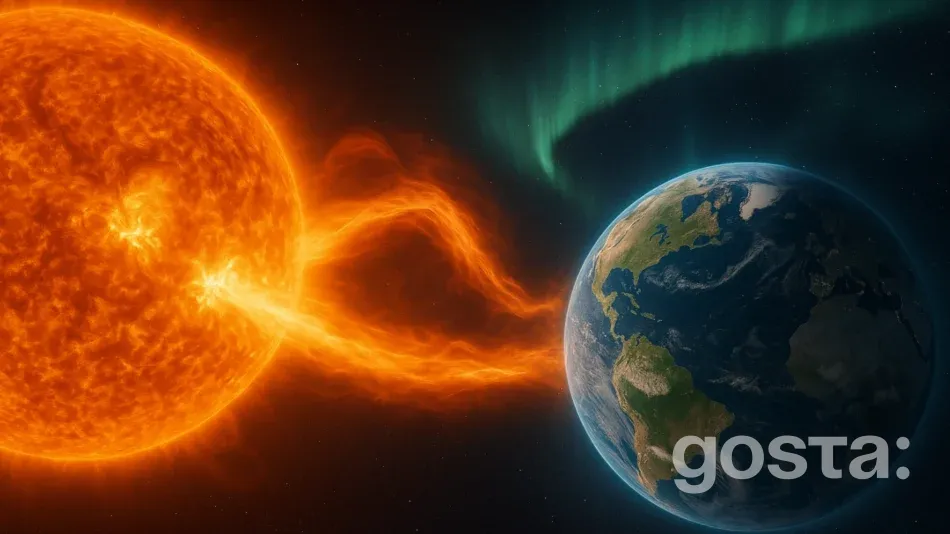
Magnetic storms are disturbances in Earth’s magnetic field. They happen when streams of solar wind hit our planet. These streams come from solar flares and coronal mass ejections. They occur regularly. Most are weak and hardly noticeable. But sometimes they affect technology and human health. The year 2025 marks the peak of Solar Cycle 25. The Sun is now very active. This means magnetic storms in October 2025 are expected, and there will be quite a few of them.
Forecast for October 2025
Magnetic storms happen when solar wind interacts with Earth’s magnetic field. Plasma streams escape the Sun during flares and coronal mass ejections. Another source is coronal holes—dark areas on the Sun where the field is open and plasma flows out into space at high speed. When such a stream reaches Earth, it compresses the magnetosphere and causes disturbances. The strength depends on the stream’s speed and the direction of its magnetic field.
Forecasting uses two methods. The first is direct measurement. Satellites record solar wind speed and density a few hours before it reaches Earth. The second is studying coronal holes and the rotation of the Sun and Earth. This allows predictions weeks ahead, though accuracy is limited since new flares appear suddenly.
Likely dates of higher activity in October 2025:
- October 6. Expected to be the strongest storm of the month. Kp index may reach 6, equal to a G2-level storm. Radio and satellite issues are possible.
- October 16–17. Second risk period. Likely G1–G2 storms, with Kp between 5 and 6. May affect navigation systems and polar flights.
- October 25. A short wave of activity. Kp up to 4. Not dangerous but noticeable.
Other days will mostly stay calm with Kp at 2–3, meaning normal conditions. Still, the Sun can surprise us. A sudden flare may trigger disturbances even during quiet times.
So October 2025 looks moderately active, with the first ten days and mid-month being most important.
Impact on Technology
Magnetic storms directly affect modern infrastructure, both in space and on Earth.
- Satellites. Charged particles damage electronics and sensors. Changes in atmospheric density create drag, causing satellites to shift from orbit.
- Communication. Shortwave radio becomes unstable, disrupting sea and air transport, especially at high latitudes.
- Navigation. GPS and similar systems lose accuracy during solar activity. Ordinary users barely notice, but for aviation and military this is serious.
- Power grids. Stronger geomagnetic activity can damage transformers and cause outages.
Magnetic storms in October 2025 are expected to stay within G1–G2 levels. Major accidents are unlikely, but local issues with communication and navigation are possible.

Impact on Health
People also react to magnetic changes. Studies show more cardiovascular issues on days of solar activity. These include hypertensive crises, heart attacks, and arrhythmias. Magnetic storms in October 2025 may bother weather-sensitive people. Common symptoms are headaches, fatigue, insomnia, irritability, mood swings, and poor focus.
Science has no final answer here, and results remain debated. Still, doctors advise people with chronic heart problems to be especially careful on active days.
The strongest storms are expected on October 6 and October 16–17, when risks are highest.
Practical Tips for Staying Comfortable
October’s storms are unlikely to be very strong. But some preparation helps.
- Follow forecasts. NOAA, ESA, and national observatories update data regularly.
- Use an app. Many mobile apps show the current Kp index.
- Plan ahead. Airlines and energy companies need to account for activity. For ordinary people, it means paying attention to your health on “critical” days.
- Take care of yourself. On active days, drink more water, avoid overwork, and monitor blood pressure.
These simple steps make it easier to get through the storms of October 2025 without harm.
The years 2024–2025 mark the peak of Solar Cycle 25. Activity is rising, and storms are becoming more frequent. This is both a challenge and an opportunity. Astronomers gain new insights into the Sun. Satellites record details of flares and ejections. Energy and transport sectors face new tests. Each storm reminds us how vulnerable modern systems are—but also pushes forward protective technology.

Read also: Magnetic storms: forecast for January 2026
Conclusions
October 2025 brings several days of increased geomagnetic activity. The main storms are expected on October 6, 16–17, and 25. The strongest will likely be October 6, with a Kp index up to 6. Other days should stay calm, so most of the month will pass without major events.
Still, the Sun can surprise us. Daily updates are worth checking. For most people, the key is to watch your health and stay calm. For specialists, it means managing risks for technology and infrastructure.
Magnetic storms are part of Earth’s natural environment. They remind us of the Sun’s power and our place in space. October 2025 will be another example of this interaction.
FAQ
When Are the Magnetic Storms in October 2025?
The biggest ones are expected on October 6, 16–17, and 25. The strongest will likely be on October 6. Other days should be calm or with only minor changes.
Will There Be Strong Storms in October 2025?
Forecasts point to G1–G2 storms. These are moderate and may affect satellites and communication. Very strong G4–G5 storms are not expected.

How Do People Feel Magnetic Storms?
Some people get headaches, feel tired, or have sleep problems. Symptoms usually affect those sensitive to weather changes.
How Can I Feel Better During a Storm?
Doctors recommend more rest, enough water, less stress, and avoiding overwork. People with chronic heart issues should monitor blood pressure and take prescribed medicine