
How to Make the Sign of the Cross: Which Hand, Finger Position, and Direction
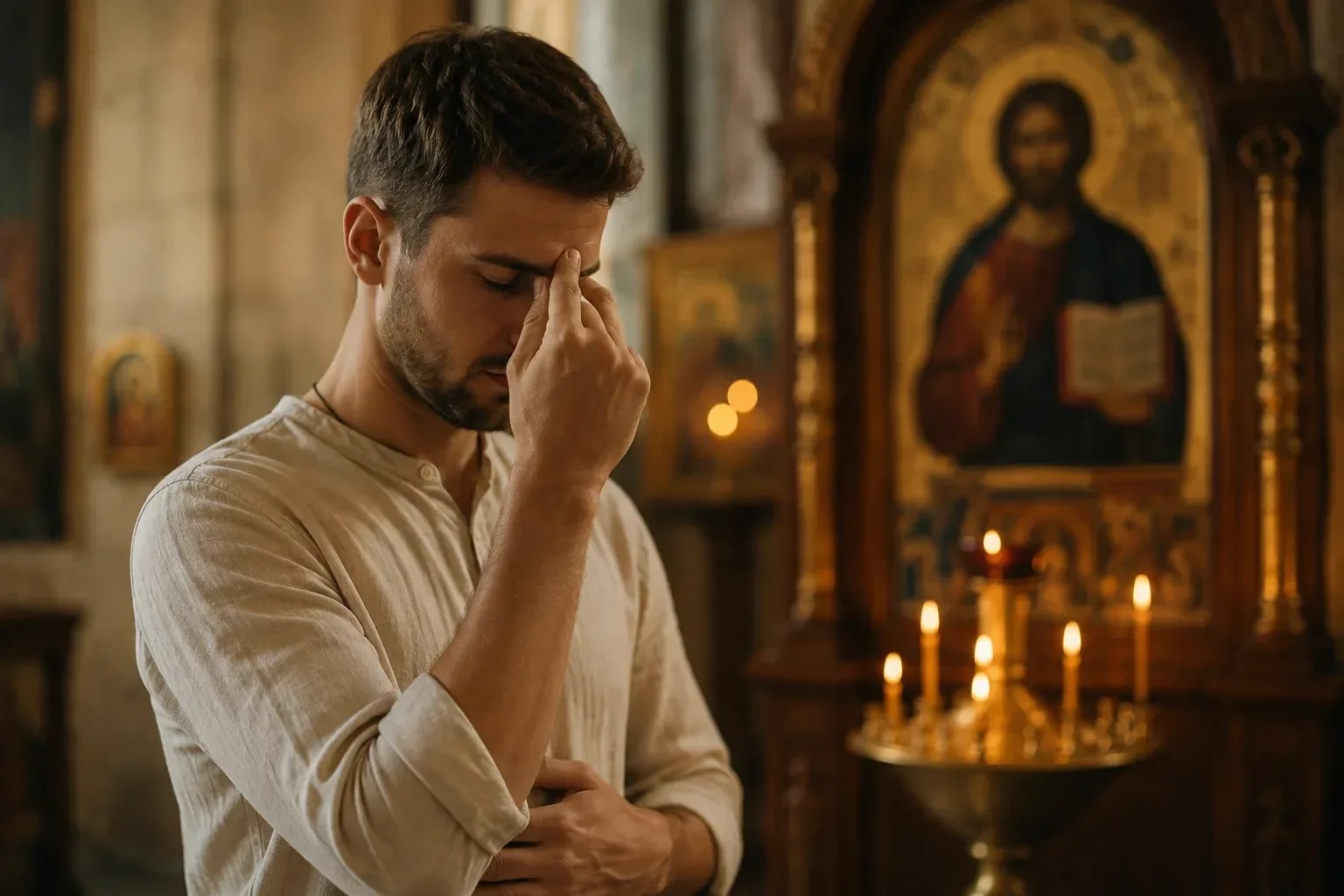
If you want to know how to make the sign of the cross, the basic movement is simple, but the direction and finger position differ between Christian traditions. In the Eastern Orthodox tradition, a person normally uses the right hand, joins the thumb, index, and middle finger, touches the forehead, then the lower chest, then the right shoulder and the left. In the Roman Catholic tradition, the movement is commonly forehead, chest, left shoulder, then right shoulder. Greek Catholics generally foll
Contents14
- How to Make the Sign of the Cross in the Orthodox Tradition: Step by Step
- How to Fold Your Fingers When You Cross Yourself
- Which Hand Should You Use?
- From Which Shoulder Do Orthodox Christians Start?
- Where Exactly to Touch: Chest or Stomach?
- What to Say When You Make the Sign of the Cross
- What Does the Sign of the Cross Mean?
- Why Do Orthodox Christians Use Three Fingers?
- Why Do Orthodox Christians Cross From Right to Left?
- How Greek Catholics Make the Sign of the Cross
- How Roman Catholics Make the Sign of the Cross
- Orthodox and Catholics Cross Themselves Differently — Who Is Right?
- Do Catholics Also Use Three Fingers?
- When to Make the Sign of the Cross in Church
If you want to know how to make the sign of the cross, the basic movement is simple, but the direction and finger position differ between Christian traditions. In the Eastern Orthodox tradition, a person normally uses the right hand, joins the thumb, index, and middle finger, touches the forehead, then the lower chest, then the right shoulder and the left. In the Roman Catholic tradition, the movement is commonly forehead, chest, left shoulder, then right shoulder. Greek Catholics generally follow the Eastern form used in their Byzantine tradition.
The gesture is not a test you must pass before entering a church. It is a prayerful sign, and exact local practice can vary.
How to Make the Sign of the Cross in the Orthodox Tradition: Step by Step
Use your right hand.
Join the thumb, index finger, and middle finger together.
Fold the ring finger and little finger toward the palm.
Touch your forehead.
Move your hand down to the chest or upper abdomen.
Touch the right shoulder.
Touch the left shoulder.
Lower your hand calmly; a small bow may follow according to the prayer or local custom.
Do not rush the movement. The point is not speed but attention.
How to Fold Your Fingers When You Cross Yourself
In common Eastern Orthodox practice, the thumb and first two fingers are joined at their tips. They symbolize the Holy Trinity: Father, Son, and Holy Spirit. The remaining two fingers are folded toward the palm and traditionally symbolize the divine and human natures of Christ.
You may see small differences in how tightly the fingers are held or where the two folded fingers rest. Those details do not change the basic meaning.
Which Hand Should You Use?
Orthodox and Catholic Christians normally make the sign with the right hand. The right hand is the standard liturgical practice taught in these traditions.
If someone cannot use the right hand because of injury, disability, or another physical limitation, the purpose of the gesture is not cancelled. A priest from the person's own church can advise on local practice if that matters to them.
From Which Shoulder Do Orthodox Christians Start?
Orthodox Christians normally touch the right shoulder first and then the left. The Orthodox Church in America describes the movement as head to breast and then shoulder to shoulder, right to left.
This direction is one of the most visible differences between the Eastern Orthodox and common Western Catholic form.
Where Exactly to Touch: Chest or Stomach?
After the forehead, the hand moves downward to the chest or upper abdomen. You will see both depending on local custom, body proportions, and how people were taught.
The important point is a clear vertical movement from the forehead downward before moving to the shoulders. You do not need to search for one exact centimeter on the body.
What to Say When You Make the Sign of the Cross
A common formula is: "In the name of the Father, and of the Son, and of the Holy Spirit. Amen." In personal prayer, the sign may also be made silently or during another prayer.
In Orthodox worship, people may cross themselves at different moments without repeating the full formula aloud each time.
What Does the Sign of the Cross Mean?
The sign of the cross is a compact confession of Christian faith. It recalls Christ's Cross and is used as an act of prayer, blessing, remembrance, and dedication to God.
The movement over the body is not intended as a magical gesture. Its meaning comes from the faith and prayer connected with it.
Why Do Orthodox Christians Use Three Fingers?
The three joined fingers traditionally represent the Trinity. The two fingers folded toward the palm represent the two natures of Christ, divine and human.
This symbolism turns the hand position itself into a short statement of doctrine. That is why Orthodox guides often teach the finger position together with the movement.
Why Do Orthodox Christians Cross From Right to Left?
Right-to-left is the established Eastern practice. Historical explanations are more complicated than a single universally proven story, so it is better not to present a folk explanation as fact.
One traditional explanation noted in Orthodox teaching is that when a priest facing the congregation blesses from his left to his right, the faithful mirror the movement on themselves from their right to left.
How Greek Catholics Make the Sign of the Cross
Greek Catholics belong to the Catholic Church but follow the Byzantine liturgical tradition. In Ukrainian Greek Catholic practice, the sign is generally made in the Eastern manner:
Join the thumb, index, and middle finger of the right hand.
Touch the forehead.
Touch the chest or upper abdomen.
Touch the right shoulder.
Touch the left shoulder.
This is why "Catholic" does not always mean left-to-right; Eastern Catholic churches retain Eastern liturgical customs.
How Roman Catholics Make the Sign of the Cross
In the Roman Catholic tradition, the common form is:
Touch the forehead.
Touch the chest.
Touch the left shoulder.
Touch the right shoulder.
Say or pray, "In the name of the Father, and of the Son, and of the Holy Spirit. Amen."
Finger position is usually less standardized for laypeople than in Eastern Orthodoxy.
Orthodox and Catholics Cross Themselves Differently — Who Is Right?
The two directions reflect different liturgical traditions. It is not useful to treat the movement as a competition where one side can be declared mechanically correct for every Christian.
If you are participating in a particular church, follow that church's practice respectfully. Orthodox Christians normally go right to left; Roman Catholics normally go left to right; Byzantine Catholics generally use the Eastern direction.
Do Catholics Also Use Three Fingers?
Some Catholics do, especially in Eastern Catholic traditions, but Roman Catholic lay practice does not normally require the same three-finger configuration used in Orthodoxy.
Historically, finger positions have changed over centuries in both East and West. For a modern practical guide, follow the custom of the church you attend rather than trying to reconstruct every historical variation.
When to Make the Sign of the Cross in Church
Common moments in Orthodox worship include entering or leaving the church, before icons, at mentions of the Trinity, during certain prayers, and before or after personal prayer. Exact practice can vary by service and local custom.
Watch respectfully rather than trying to copy every movement instantly. If you are new, nobody should expect you to know every liturgical cue.
Is It Necessary to Cross Yourself Before Entering the Church?
Many Orthodox Christians make the sign as they approach or enter a church as an act of reverence. It is a common custom, not a barrier to entry.
If you forgot, entered with your hands full, or simply did not know, you have not invalidated your visit. The church is not a place reserved for people who already know every gesture.
Is It Necessary to Cross Yourself While Passing a Church?
Some believers do this as a personal expression of reverence. It is not a universal civil rule and should not be treated as compulsory for every passerby.
If you choose to do it, do so safely. Do not make a gesture that distracts you while driving, cycling, or crossing a road.
When to Make the Sign of the Cross at Home
At home it can be made when beginning or ending prayer, before meals, before sleep, on waking, before an important task, or whenever you want to turn your attention toward prayer.
There is no need to convert ordinary life into a rigid count of gestures. The sign should support prayer, not become a source of anxiety about whether you performed enough repetitions.
How Many Times Do You Need to Cross Yourself?
There is no single number for every situation. Certain prayers and local customs involve repeated signs, including groups of three, while other moments call for one sign.
Follow the prayer or service you are using. In personal prayer, one attentive sign can be more meaningful than many hurried repetitions.
Is It Necessary to Bow After the Sign of the Cross?
A bow often accompanies the sign in Orthodox practice, but not every sign is followed by the same type of bow. Liturgical context matters.
A small bow from the waist is common in many situations. Full prostrations belong to particular services and seasons and are not simply a stronger version you need to add every time.
Do You Need to Cross Yourself Three Times in Front of an Icon?
You may see people make the sign multiple times with bows when venerating an icon, but exact patterns can vary. There is no need to imitate a sequence you do not understand simply to avoid looking inexperienced.
If you attend regularly, ask a priest or knowledgeable parishioner how icon veneration is practiced in that community.
Can You Make the Sign of the Cross Sitting or Lying Down?
Yes when circumstances require it. Illness, disability, travel, or confined space can make standing impossible. Christian prayer is not limited to one posture.
When you are physically able and the service expects standing, follow the local practice. When you are not able, do not treat physical limitation as a spiritual failure.
Is It Possible to Cross Yourself With the Left Hand?
The established practice uses the right hand. A person who is physically unable to use it may adapt. The sign's purpose is prayer, not punishment for a medical or physical limitation.
If this is personally important, a clergy member can give guidance appropriate to the person's condition and tradition.
Are Men and Women Crossed the Same Way?
Yes. The basic sign is not different for men and women. The same hand, direction, and finger position are used within the same liturgical tradition.
Differences you may notice usually come from local habit, speed, or individual style rather than gender.
How to Teach a Child to Make the Sign of the Cross Correctly
Demonstrate slowly while standing next to the child.
Teach the four points first: forehead, down, right shoulder, left shoulder in Orthodox practice.
Add the three-finger position once the child can follow the movement.
Explain the meaning in simple language rather than correcting only mechanics.
Practice during a short family prayer instead of turning it into a drill.
Correct gently and consistently.
Children learn gestures through repetition and observation, so a calm example works better than constant criticism.
Do You Need to Hurry When You Cross Yourself?
No. A rushed movement can turn into an automatic flick of the hand with little attention. Make the sign clearly enough that you know what you are doing.
Slow does not mean theatrical. A natural, deliberate pace is enough.
Typical Mistakes When a Person Crosses Themself
Common practical mistakes include:
confusing the Orthodox and Roman Catholic shoulder direction;
making a tiny, hurried gesture without attention;
treating the exact motion as superstition rather than prayer;
criticizing visitors who do not know the local custom;
assuming every Catholic uses the Roman form;
obsessing over tiny differences in where the chest is touched;
copying someone else's repeated gestures without understanding the context.
The easiest correction is to slow down and follow your own tradition consistently.
Is the Sign of the Cross a Prayer?
It can be both a physical prayer and a gesture that accompanies spoken prayer. When used with the Trinitarian formula, the words and movement form one short act of prayer.
It can also be made silently during worship. The gesture does not need to be loud or visible to everyone around you.
What Is the Difference Between the Sign of the Cross and Baptism?
They are completely different. Baptism is a Christian sacrament or mystery of initiation involving water and the Trinitarian formula. Making the sign of the cross is a prayer gesture a baptized or unbaptized person can physically make.
The confusion often comes from literal translation: in Ukrainian, everyday wording for "to cross oneself" can look like "to baptize oneself" when translated mechanically into English.
Why You Should Not Be Afraid to Enter a Church If You Do Not Know All the Rules
A first visit can feel intimidating because other people seem to know when to stand, bow, cross themselves, or move. You do not need to master all of that in advance.
Stand respectfully, observe, and participate only as much as you are comfortable. If the church has specific communion rules, ask before receiving Communion; otherwise, being unfamiliar with gestures is not a reason to stay away.
How to Make the Sign of the Cross Correctly: A Short Cheat Sheet
For the common Orthodox form:
Right hand.
Thumb, index, and middle finger together.
Forehead.
Chest or upper abdomen.
Right shoulder.
Left shoulder.
Pray deliberately, often with the words "In the name of the Father, and of the Son, and of the Holy Spirit. Amen."
For the common Roman Catholic form, the principal change is the shoulder direction: left, then right.
A useful distinction for visitors is between personal devotion and fixed liturgical instructions. You may see one Orthodox parish make the sign at moments when another parish does not, or people may bow differently depending on the service, season, health, and local custom. That does not mean one person has necessarily made a mistake. The core Orthodox form—right hand, three fingers joined, forehead, chest, right shoulder, left shoulder—is much more stable than the exact number of repetitions in every part of worship.
The same caution applies when comparing churches online. Short videos often reduce the subject to "Orthodox do this, Catholics do that," but Christianity includes several liturgical families. Ukrainian Greek Catholics are Catholic while using the Byzantine rite, so their bodily prayer commonly resembles Orthodox practice more closely than the Roman Catholic form. Eastern Christians can also have local customs that do not fit a simple East-versus-West diagram.
If you are attending an Orthodox or Catholic service for the first time, the most respectful approach is uncomplicated: arrive quietly, dress appropriately for the community, stand or sit where visitors are permitted, and observe before copying unfamiliar actions. Do not receive Communion unless you know you are eligible under that church's rules. For the sign of the cross itself, a calm and sincere gesture is more appropriate than trying to perform every movement at exactly the same moment as the people around you.
It is also worth separating precision from scrupulosity. Learning the traditional finger position and direction is worthwhile when you belong to or regularly visit a church that uses them. Repeating the gesture because you fear that a slightly misplaced hand movement "did not count" is a different issue. Christian teachers generally present the sign as an expression of faith and prayer, not as a mechanical formula that becomes meaningless because the hand touched a point a few centimeters too high or low.
For people learning the Orthodox form, a simple practice method is to separate the movement from the words at first. Learn the sequence slowly—forehead, chest, right shoulder, left shoulder—then add the Trinitarian formula once the motion feels natural. After that, practice the finger position. Trying to memorize hand shape, wording, shoulder direction, bowing, and liturgical timing all at once creates confusion unnecessarily.
When you see someone make the sign differently, avoid correcting them unless you are responsible for teaching in that setting. They may belong to another Christian tradition, have a physical limitation, or simply be new. If you need certainty about a parish's custom, ask its clergy rather than relying on comments under a video or a diagram with no denominational context.
The gesture is also commonly used at the beginning and end of private prayer, before meals, and at other devotional moments, but exact frequency is personal and traditional rather than a universal numerical rule. If you are learning within a parish, consistency with that community is more useful than collecting contradictory instructions from several traditions at once. The practical priority is to know which tradition you are following, make the movement deliberately, and understand the faith it expresses.
In every case, reverence matters more than perfect choreography.
Learn the tradition calmly, then let the gesture support prayer rather than distract from it.
FAQ
How Do Orthodox Christians Make the Sign of the Cross?
With the right hand, three fingers joined, moving forehead, chest, right shoulder, then left shoulder.
Which Hand Should You Use?
The right hand is standard in Orthodox and Catholic practice. Physical disability can require adaptation.
From Which Shoulder Do Orthodox Christians Begin?
The right shoulder, followed by the left.
Do Orthodox Christians Cross From Right to Left or Left to Right?
From right to left. Roman Catholics commonly use left to right.
How Do You Fold Your Fingers Correctly When You Cross Yourself?
In Orthodox practice, join the thumb, index, and middle fingers; fold the remaining two toward the palm.
What Do Three Fingers Mean in the Sign of the Cross?
They traditionally symbolize the Holy Trinity.
What Do the Two Fingers Pressed to the Palm Mean?
They traditionally symbolize the two natures of Christ: divine and human.
Where Do You Put Your Hand First When You Cross Yourself?
On the forehead.
What Do You Say When You Cross Yourself?
A common formula is "In the name of the Father, and of the Son, and of the Holy Spirit. Amen."
How Are Greek Catholics and Roman Catholics Different Here?
Greek Catholics usually follow the Eastern right-to-left form; Roman Catholics commonly go left to right.
Best of the week — in your inbox
No spam. Only top Gosta stories. Unsubscribe in one click.
Comments