
ORCL Stock: Revenue, Cloud Backlog and Cash Flow Explained
ORCL stock sits at the intersection of an established enterprise-software business and large-scale cloud investment.


Contents8
- What has Oracle actually reported for ORCL stock readers?
- What does cloud growth mean for ORCL stock?
- Is the backlog behind ORCL stock already revenue?
- Why cash flow is central to an ORCL stock assessment
- What financing questions should ORCL stock readers ask?
- How to compare ORCL stock with other technology investments
- A practical ORCL stock reading routine
- FAQ
ORCL stock sits at the intersection of an established enterprise-software business and large-scale cloud investment. That combination makes a single headline an incomplete guide. Revenue growth, contract commitments, capital requirements, and cash generation need to be read together.
If you are looking at ORCL stock because of artificial-intelligence infrastructure demand, start by separating what Oracle has already delivered from what it has contracted to deliver later. A large backlog is meaningful information, but it is not the same thing as revenue already earned or cash available to shareholders.
What has Oracle actually reported for ORCL stock readers?
The latest full quarterly context used here for ORCL stock is Oracle's September 10, 2026 fiscal first-quarter release. Oracle reported revenue of $19.3 billion, cloud revenue of $11.6 billion, cloud-infrastructure revenue of $7.4 billion, and remaining performance obligations of $664 billion.
The same release reported $23 billion in quarterly operating cash flow and negative $5 billion in free cash flow while the company invested in cloud infrastructure. These measures describe different parts of the financial picture. ORCL stock analysis becomes more useful when it keeps those distinctions visible instead of choosing whichever number looks strongest.
What does cloud growth mean for ORCL stock?
Cloud growth matters for ORCL stock because it can change both the mix of revenue and the resources needed to deliver services. Infrastructure and applications are separate categories in Oracle's reporting. Reading them separately helps you see where expansion is happening rather than treating all cloud sales as one identical business.
Ask what customers are buying, how quickly capacity can be delivered, and what investment supports that growth. For an ORCL stock reader, a faster-growing segment can be important without making slower-growing or declining parts of the business irrelevant.
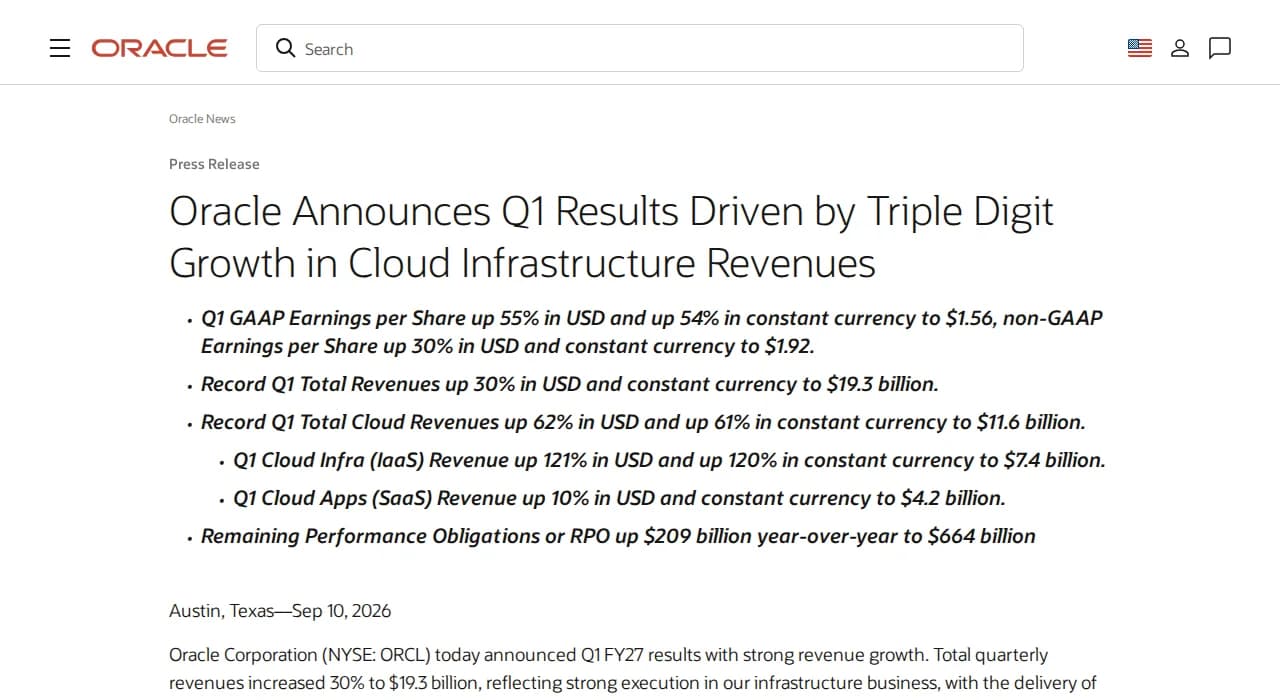
Compare the same categories across periods. If a headline uses a growth rate from one segment and a revenue total from another, go back to the source table. A clear ORCL stock note should state the metric, period, and comparison basis before offering an interpretation.
Is the backlog behind ORCL stock already revenue?
Oracle's backlog is not the same thing as revenue already recognized, an important distinction for ORCL stock. Remaining performance obligations describe contractual commitments under the company's reporting framework. Timing, delivery, and the relevant contract terms affect how those commitments translate into recognized revenue.
Think of the difference as a sequence: a customer commitment can support planning, but the company still has to provide what the agreement requires. ORCL stock commentary that treats the entire backlog as next year's sales skips the question of when the work is expected to be delivered.
ORCL stock metric | What you are looking at | What to ask next |
|---|---|---|
Recognized revenue in ORCL stock research | Sales recorded for a specific period | Which segments produced the growth? |
Remaining performance obligations | Contracted commitments under the reporting definition | When could they become revenue? |
Operating cash flow in ORCL stock research | Cash generated by operating activity | Which timing effects influenced it? |
Free cash flow in ORCL stock research | The company's cash-flow measure after relevant investment | How large are the infrastructure requirements? |
That table is a reading framework, not a valuation formula. It helps prevent an ORCL stock argument from switching between commitments, accounting profit, and cash as if they were the same thing.
Why cash flow is central to an ORCL stock assessment
Cash flow is central to an ORCL stock assessment because a business can report growth while investing heavily to support it. Look at operating cash generation and the investment required to maintain and expand the operation. Then read how management defines and reconciles any non-GAAP measure.
A negative free-cash-flow period does not automatically mean that expansion is failing. Equally, a positive operating-cash-flow figure does not remove the cost of building capacity. ORCL stock research should ask whether the investment plan, funding, and expected business opportunities fit together.
Use a simple personal research worksheet: operating cash flow, investment spending, financing changes, and the explanation for each. The purpose is not to invent a precise return forecast. It is to make the assumptions behind your view of ORCL stock explicit enough to revisit later.
What financing questions should ORCL stock readers ask?
ORCL stock readers should ask how the company finances its plans and what that means for existing shareholders. Debt, equity issuance, leases, and internally generated cash can have different effects on financial flexibility and per-share outcomes.
Read the latest Oracle financial materials rather than assuming that a funding announcement is either automatically reassuring or automatically alarming. The amount raised is only part of the story; terms, timing, obligations, and the use of proceeds also matter.
For ORCL stock, distinguish growth in the overall business from growth on a per-share basis. An expanding company can issue more shares or take on additional obligations. That does not settle the investment case either way, but it does mean that a larger revenue total is not the only number to follow.
How to compare ORCL stock with other technology investments
Compare ORCL stock with other technology investments by looking at business models and financial requirements, not simply attaching an AI label to every ticker. Software subscriptions, advertising platforms, semiconductor manufacturing, and cloud infrastructure can respond differently to the same broad trend.
Choose comparable periods and definitions for ORCL stock research. A margin from one company may not be directly comparable with an adjusted margin from another. A backlog measure can also mean different things depending on contract terms and accounting definitions. A careful ORCL stock comparison names those differences before discussing which business appears stronger.
It is also worth considering the exposure you already own through funds or other companies. ORCL stock may add a new name while increasing a theme that is already prominent in your portfolio.
A practical ORCL stock reading routine
A practical ORCL stock routine begins with the earnings release, continues through the cash-flow statement and relevant filings, and ends with your own written assumptions. Keep the document date beside every number so an older quarter does not quietly become a current claim.
Identify the fiscal period and reporting currency in the ORCL stock report.
Separate infrastructure, applications, and other revenue categories.
Read backlog information without treating it as immediate sales.
Compare operating cash flow with investment requirements.
Review funding, obligations, and per-share effects for ORCL stock.
Write down what evidence would change your view.
ORCL stock questions
Does a larger backlog make ORCL stock automatically cheap?
No. Backlog is one measure relevant to ORCL stock. Valuation, delivery timing, costs, financing, and expectations still matter.
Can ORCL stock rise when free cash flow is negative?
ORCL stock can move for many reasons. The useful question is whether your interpretation of future outcomes is supported by the disclosures, not whether one metric predicts a price move.
Is this a live ORCL stock quote?
No. This guide explains how to research ORCL stock. Confirm the timestamp, exchange, and session on any quote before using it. Keep your research notes separate from the market screen so their different purposes remain clear.
Best of the week — in your inbox
No spam. Only top Gosta stories. Unsubscribe in one click.
Comments