
Which instax Camera to Buy: mini 13 vs mini Evo 2 vs WIDE 400
Compare instax mini 13, mini Evo 2 and WIDE 400: US MSRP, mini vs WIDE film, analog vs hybrid shooting, running costs and gift bundles.

Contents9
- Which instax camera should you choose?
- How much do these instax cameras cost in the US?
- instax mini 13: a straightforward analog starting point
- instax mini Evo 2: choose your pictures before printing
- instax WIDE 400: choose it for the larger film format
- What is the difference between mini and WIDE film?
- How do you compare film cost and gift bundles?
- What should you check before giving an instax camera as a gift?
- Is an instant camera or a phone printer the better purchase?
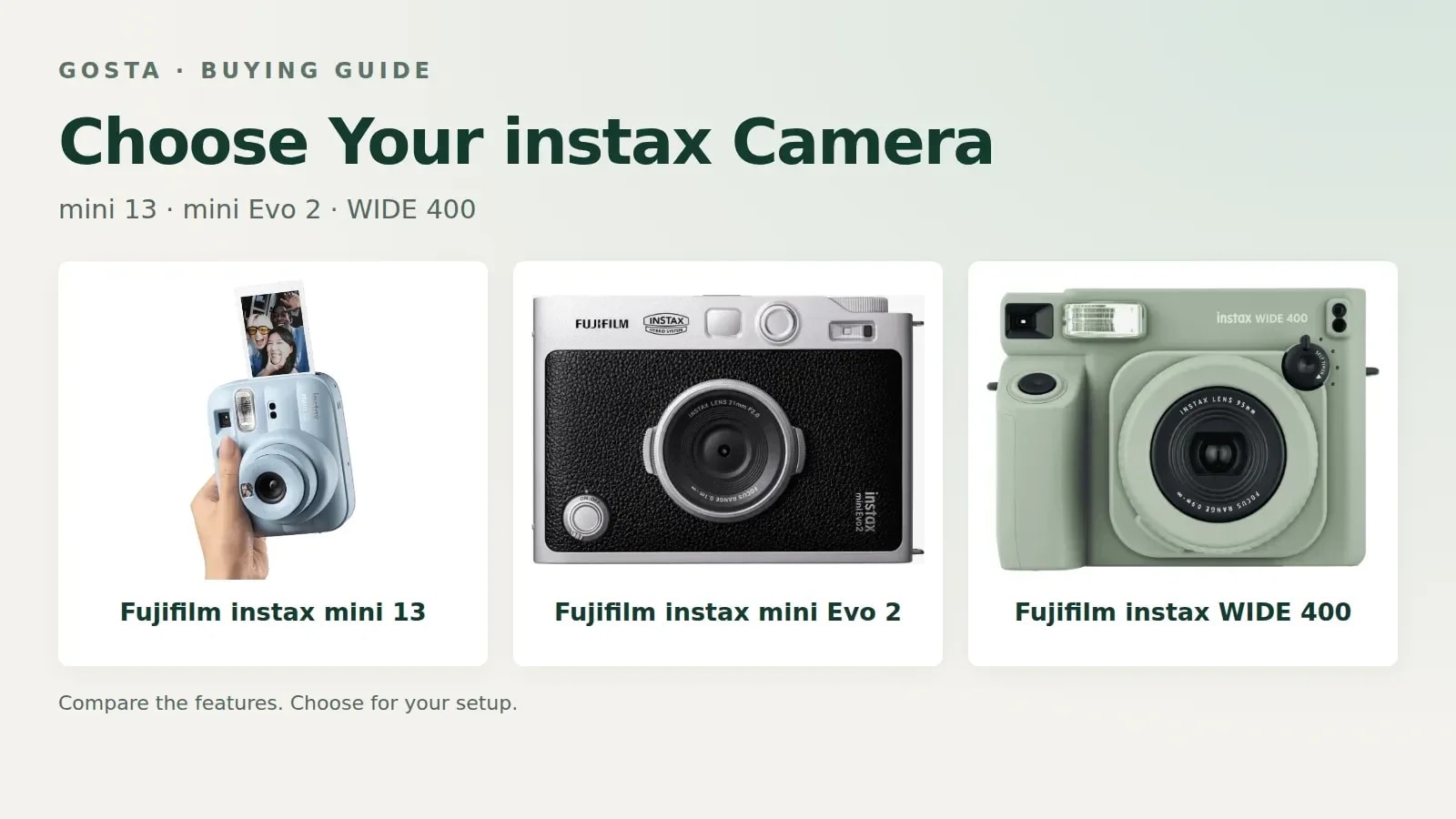
Choose an instax camera by film size and shooting style before comparing colors or gift bundles. The instax mini 13 is a simple analog option using mini film, the mini Evo 2 is a hybrid camera that lets you choose images before printing, and the WIDE 400 makes larger-format analog prints. Those differences affect both the experience and the ongoing cost.
This guide compares these three specific Fujifilm models for US shoppers. Prices below are the manufacturer's listed US MSRPs, clearly separated from retailer discounts or bundle prices. The recommendations use documented features, not a claim that we photographed a test scene or measured image quality ourselves.
Which instax camera should you choose?
Choose the instax mini 13 for straightforward shoot-and-print photography, the mini Evo 2 for a hybrid workflow with print selection, or the WIDE 400 when a larger physical print is your priority.
For a first instant camera: compare the mini 13's simple controls and mini-film format with the recipient's expectations.
For selective printing: consider the mini Evo 2 if you want to review pictures and decide which ones deserve a physical print.
For larger keepsakes and group pictures: consider WIDE 400, while checking that you are comfortable carrying a larger camera.
There is no single winner for every buyer. Someone who enjoys the surprise of an analog print may not want a screen-driven experience. Someone who wants to avoid printing unwanted pictures may prefer the hybrid model even though it costs more initially.
How much do these instax cameras cost in the US?
Fujifilm's US pages list an MSRP of $89.95 for the mini 13, $289.95 for the mini Evo 2, and $175.95 for the WIDE 400.
Manufacturer pages were checked on November 22, 2026. These are reference MSRPs, not a claim that a particular retailer currently has stock at that price. Retail offers, colors, film bundles, sales tax, and delivery may change the checkout total. The buttons below open the relevant manufacturer model pages, where you can review the camera and retailer options.
Model | Price / reference | Offer details | Key features |
|---|---|---|---|
Fujifilm instax mini 13 | $89.95 | Fujifilm US MSRP; not a live retailer checkout price | Analog; instax mini film; self-timer |
Fujifilm instax mini Evo 2 | $289.95 | Fujifilm US MSRP; retailer price and stock vary | Hybrid camera; instax mini film; screen; select before printing |
Fujifilm instax WIDE 400 | $175.95 | Fujifilm US MSRP; retailer price and stock vary | Analog; instax WIDE film; self-timer; close-up attachment |
A camera-only MSRP should not be compared directly with a gift bundle that includes film, a case, and an album. Build the same basket for each option before deciding which offer costs less. Check the exact generation too: mini Evo 2 is not the original mini Evo, and WIDE 400 is not the hybrid WIDE Evo.
instax mini 13: a straightforward analog starting point
The instax mini 13 is the choice to consider when you want a simple analog camera that creates a mini-film print when you take a picture.

Fujifilm highlights simple operation, selfie use, and a self-timer. That can make the camera appealing for casual pictures with friends or a gift recipient who prefers taking a picture to navigating a settings menu. The important limitation is the analog workflow: you do not review a digital gallery and selectively print the best frame afterward.
Budget for learning shots. Framing, distance, light, and the use of flash can affect the result, especially when someone is new to instant photography. A low purchase price does not remove the recurring cost of film.
Choose it if you want the spontaneous instant-camera experience and the mini print size suits you. Before buying, look at a physical example of mini film or its documented dimensions rather than relying on a large product photograph on a screen.
instax mini Evo 2: choose your pictures before printing
The instax mini Evo 2 is the option to consider when you want a hybrid camera with a screen and the ability to choose which captured images to print on mini film.
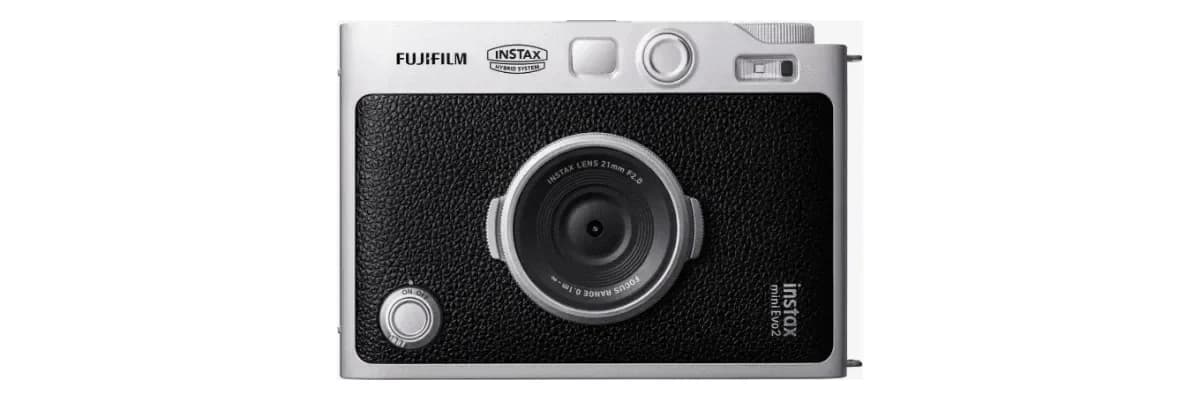
That workflow changes the buying decision. You can experiment with composition and select a preferred picture instead of committing a film sheet to every shutter press. It does not make printing free, but it can make the cost easier to control when the user values reviewing and curating pictures.
Fujifilm lists touchscreen operation and creative features for this generation. Check the full current specification if phone connectivity, image transfer, storage, or a particular creative mode is important. Do not assume a feature described for the original mini Evo or WIDE Evo applies identically to mini Evo 2.
Choose it if you enjoy editing and selecting, and will actually use the hybrid workflow. If your main reason for buying an instant camera is the screen-free surprise of an analog photograph, compare that preference honestly before spending more.
instax WIDE 400: choose it for the larger film format
The instax WIDE 400 is the option to consider when you want larger WIDE-format prints and prefer an analog camera rather than a hybrid model.
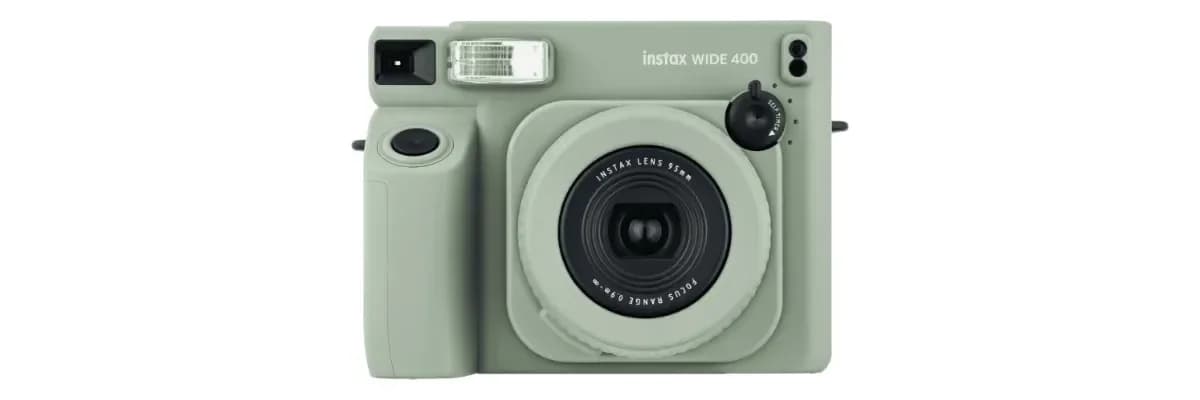
The larger format is useful to compare for group photographs, parties, and keepsakes where a small mini print feels limiting. Fujifilm lists a self-timer, camera-angle adjustment, and a close-up attachment. Those features should be judged alongside the camera's physical size and how you plan to carry it.
WIDE 400 uses WIDE film, not mini film. Buying a discounted mini-film multipack will not reduce its running cost because the formats are not interchangeable. Keep that distinction clear when comparing gift bundles.
Choose it if print size matters more than the smallest camera body or digital review. Do not confuse it with WIDE Evo: the shared WIDE film name does not mean the cameras have the same shooting and printing workflow.
What is the difference between mini and WIDE film?
Mini and WIDE are different instax film formats with different physical sizes, and each camera requires its specified format.
Mini film has a full sheet size of 86×54 mm, with a smaller image area inside its border. WIDE film has a full sheet size of 108×86 mm, again with its own image area. Compare the image area as well as the overall border when deciding what looks good in an album or on a display.
Camera | Film | Print workflow |
|---|---|---|
mini 13 | instax mini | Analog: a photograph uses a film sheet |
mini Evo 2 | instax mini | Hybrid: select images before printing |
WIDE 400 | instax WIDE | Analog: larger-format film prints |
Film marketed for another instant-camera system is not interchangeable simply because the photographs look similar. When ordering online, confirm the format printed on the pack, not just a search result that says "instant film."
How do you compare film cost and gift bundles?
Compare instax film cost by dividing the pack price by its number of exposures, then add that running cost to the camera and accessories you actually need.
For example, a hypothetical $20 pack containing 20 exposures costs $1 per exposure before tax and delivery. That is an illustration of the calculation, not a verified current price for any specific film pack. Apply the same calculation to the live offer you are considering.
For a fair gift-bundle comparison, check the number of exposures, frame design, camera generation, and included accessories. A decorative case or album may be useful, but it should not hide a smaller film allowance or an older camera sold under a vague title. A hybrid camera may reduce unwanted printing, but its higher initial price still belongs in the overall comparison.
What should you check before giving an instax camera as a gift?
Before giving an instax camera as a gift, check that the recipient will have compatible film, the required power or charging equipment, and clear instructions for loading and using it.
Confirm the complete camera model and generation.
Add the correct film format and check the exposure count.
Verify which power equipment is included and what must be supplied separately.
Check storage guidance and the expiry information on film.
Keep the receipt and understand the retailer's return conditions.
Follow the manufacturer's film-loading and development instructions. Avoid opening a loaded film compartment just to check what is inside. If the gift is for a child, consider whether an adult will help with film handling and the continuing cost of refills.
Is an instant camera or a phone printer the better purchase?
An instant camera is the better fit when taking pictures with a dedicated camera is part of the appeal, while a phone printer is worth comparing if you mainly want physical copies of photographs already on your phone.
The mini 13 and WIDE 400 prioritize an analog camera experience. Mini Evo 2 combines capturing and selective printing in a hybrid device. A separate phone printer is another category with its own format, app, and compatibility requirements, so do not assume it creates identical results or includes the same features.
Start with how you want to make and keep pictures. Then choose the film size, calculate the ongoing cost, and compare the current retailer packages. That sequence is more useful than buying whichever color or bundle happens to appear first in a sale.
Best of the week — in your inbox
No spam. Only top Gosta stories. Unsubscribe in one click.
Comments