
ZZ Plant Care: Watering, Repotting, and What Yellow Leaves Really Mean
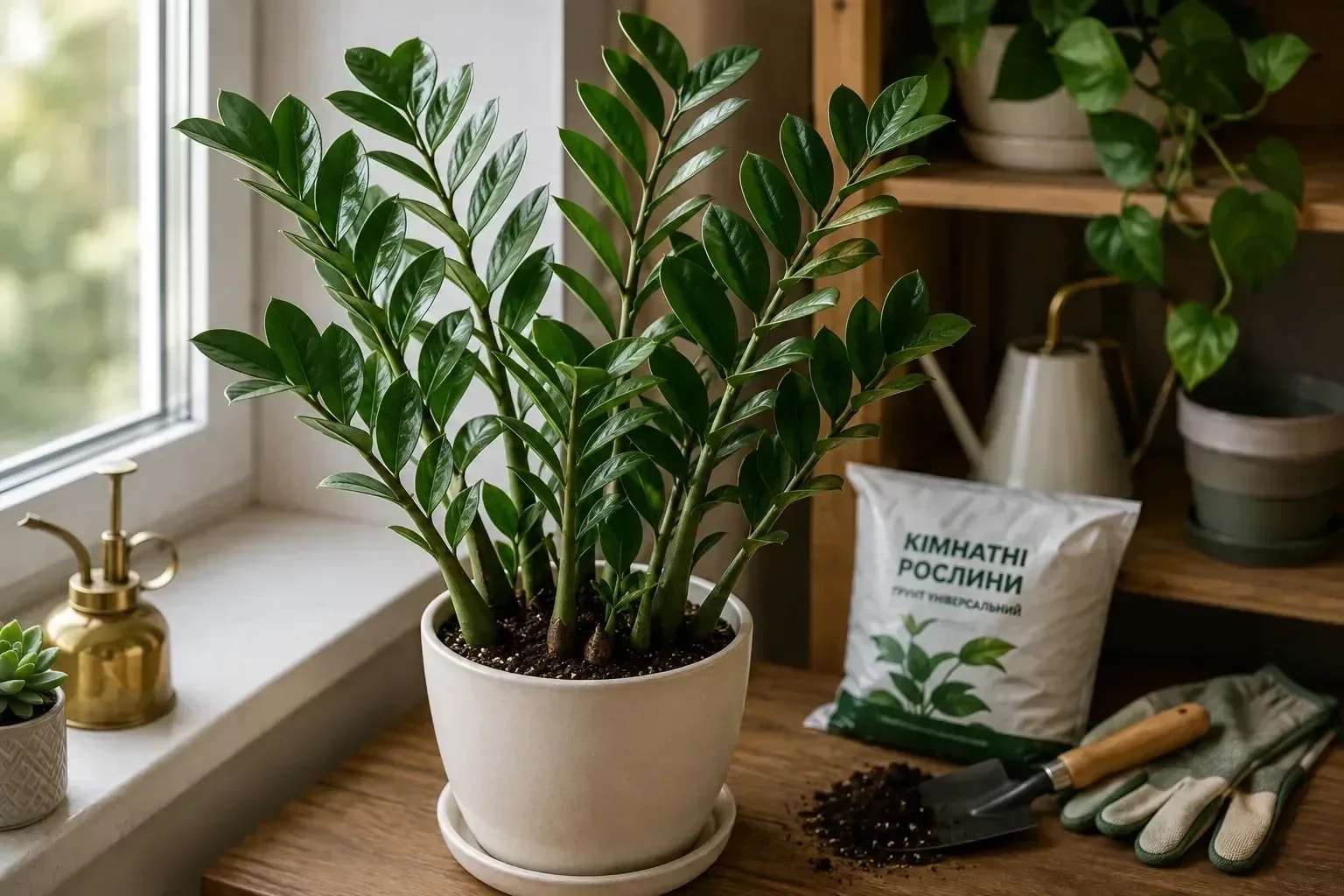
Good ZZ plant care is mostly about doing less, but doing the important things correctly. The ZZ plant, or *Zamioculcas zamiifolia*, stores water in thick underground rhizomes and fleshy leaf stalks, so it usually tolerates a short dry spell better than soil that stays wet for too long. That is why many of the most common problems—yellow leaves, soft stems, and root or rhizome rot—start with overwatering rather than neglect.

Contents14
- What Is a ZZ Plant?
- ZZ Plant Care Basics Indoors
- Best Light for a ZZ Plant
- How to Water a ZZ Plant the Right Way
- How Often to Water a ZZ Plant
- Signs You're Overwatering a ZZ Plant
- What to Do If You Overwatered Your ZZ Plant
- Why ZZ Plant Leaves Turn Yellow
- Yellow Leaves After Repotting: Normal or Not?
- Best Soil for ZZ Plants
- Choosing the Right Pot and Drainage
- When to Repot a ZZ Plant
- How to Repot a ZZ Plant Step by Step
- Do ZZ Plants Need Fertilizer?
Good ZZ plant care is mostly about doing less, but doing the important things correctly. The ZZ plant, or Zamioculcas zamiifolia, stores water in thick underground rhizomes and fleshy leaf stalks, so it usually tolerates a short dry spell better than soil that stays wet for too long. That is why many of the most common problems—yellow leaves, soft stems, and root or rhizome rot—start with overwatering rather than neglect.
The plant is also known by the nickname "dollar tree" in parts of Eastern Europe, although it is not a true tree. Indoors, it is valued for glossy dark-green foliage, slow steady growth, and its ability to cope with ordinary household conditions. It can survive in lower light, but it grows best in brighter indirect light, a free-draining potting mix, and a container with drainage holes.
This guide covers light, watering, seasonal care, soil, repotting, fertilizer, yellow leaves, propagation, pet safety, and the mistakes that cause most ZZ plant problems.
What Is a ZZ Plant?
The ZZ plant is Zamioculcas zamiifolia, an aroid native to parts of eastern Africa. What many people call its "stems" are actually compound leaves that rise from underground rhizomes. Those rhizomes act as storage organs, holding both water and energy.
That storage system explains much of zamioculcas zamiifolia care. The plant is adapted to periods when water is not constantly available. Indoors, it therefore benefits from a wet-dry rhythm: water thoroughly, then allow a substantial part of the potting mix to dry before watering again.
A healthy ZZ plant usually has firm upright or gently arching leaf stalks, smooth glossy leaflets, and gradual new growth from the base. It is not a fast-growing houseplant, especially in lower light.
ZZ Plant Care Basics Indoors
For reliable zz plant care indoors, focus on five things:
Light | Bright indirect light; tolerates lower light |
|---|---|
Water | Water thoroughly, then let the mix dry substantially |
Soil | Loose, airy, fast-draining |
Pot | Drainage holes; not dramatically oversized |
Temperature | Normal indoor temperatures; avoid cold drafts |
Humidity | Average household humidity is usually enough |
Feeding | Light feeding during active growth |
Repotting | When rhizomes and roots clearly fill the pot |
The biggest mistake is treating the plant like something that needs frequent attention. A ZZ plant does not need daily watering, constant misting, or regular homemade "tonics." Stable conditions are more useful than intensive care.
Best Light for a ZZ Plant
A zz plant indoor setup works best in bright, filtered light. Near an east- or west-facing window is often ideal, or a little farther back from a bright south-facing window where harsh midday sun does not hit the foliage directly.
ZZ plants tolerate lower light better than many houseplants, which is why they are often recommended for offices and apartments. "Tolerates" does not mean "prefers darkness," however. In a dim corner the plant may grow very slowly, produce smaller new leaves, or lean toward the nearest window.
Strong direct sun can scorch foliage, particularly if a plant has been kept in shade and is suddenly moved into intense light. If you want to increase light, do it gradually over a week or two.
Rotate the pot every few weeks if the plant is leaning strongly toward one side. This helps keep the growth more even.
How to Water a ZZ Plant the Right Way
The safest method is a full watering followed by a real drying period.
Check the potting mix several centimeters below the surface.
If the upper layer is dry but the lower mix still feels clearly damp, wait.
When much of the mix has dried, take the plant to a sink or use a saucer.
Water evenly across the surface until water begins to drain from the bottom.
Let the pot drain completely.
Empty any water left in the saucer or decorative cachepot.
Do not add small daily amounts of water between full waterings.
Small frequent sips can keep the center of the root ball permanently damp even when the top looks dry. A thorough watering followed by drying gives roots both moisture and air.
If you are unsure whether to water today or in two days, waiting is usually safer for a healthy ZZ plant than watering early.
How Often to Water a ZZ Plant
There is no correct universal schedule such as "every seven days" or "every two weeks." Drying speed changes with season, light, pot size, room temperature, plant size, pot material, and soil structure.
Use this watering cheat sheet as a starting point, not a rigid calendar:
Bright room, active growth | Soil dries faster | Check more often; water after substantial drying |
|---|---|---|
Low-light room | Soil dries slowly | Extend the interval |
Warm summer period | More evaporation and growth | Monitor soil regularly |
Cool winter period | Slower growth and drying | Water less often |
Large plastic pot | Holds moisture longer | Be especially cautious |
Terracotta pot | Dries faster | Check a little sooner |
Freshly repotted plant | New mix may behave differently | Judge by moisture, not the old schedule |
A moisture meter can be useful, but a wooden skewer or finger test plus the weight of the pot is often enough. Over time, you learn how light the pot feels when the mix is dry.
Signs You're Overwatering a ZZ Plant
Possible signs include:
Several leaves yellowing over a short period
Potting mix staying wet for many days
Soft or mushy leaf stalks near the base
A sour or rotten smell from the soil
Darkened, soft roots or rhizomes
Leaves dropping while the soil is still wet
Fungus gnats becoming persistent in constantly moist mix
One yellow leaflet is not automatically an emergency. Older leaves eventually age. The pattern matters: rapid yellowing combined with wet soil is far more suspicious than one old leaf changing color.
What to Do If You Overwatered Your ZZ Plant
If the plant has been watered too often but the stalks are still firm, the first step is simply to stop watering and allow the pot to dry. Move the plant to brighter indirect light if it has been sitting in deep shade, and make sure the drainage holes are not blocked.
If the plant smells rotten, the stalk bases are soft, or the soil stays saturated despite waiting, inspect the root system.
Remove the plant from the pot carefully.
Brush or rinse away enough soil to see the roots and rhizomes.
Look for firm, pale-to-tan roots and solid rhizomes.
Remove only clearly black, mushy, collapsing tissue with a clean tool.
Let very wet roots air briefly while you prepare fresh mix.
Repot into an airy, fast-draining substrate in a pot with drainage.
Do not use an oversized replacement pot.
Resume watering only after the mix has had time to dry appropriately.
Do not compensate for overwatering by putting the plant in harsh direct sun or applying strong fertilizer. The stressed root system needs stable conditions, not more stress.
Why ZZ Plant Leaves Turn Yellow
Yellow leaves are a symptom, not a diagnosis. The five most common causes are:
Too much water. This is the first thing to check, especially when several leaves yellow together and the mix remains damp.
Normal aging. An older outer leaf can yellow and die while the rest of the plant stays healthy.
Sudden environmental change. Moving, repotting, cold drafts, or a sharp change in light can temporarily stress the plant.
Too little light combined with wet soil. Low light slows water use and makes overwatering easier.
Root problems. Compacted soil, a pot without drainage, or rot can prevent roots from functioning normally.
Start diagnosis with the soil. If it is wet, wait before adding more water. If it is bone-dry and the plant has been neglected for a long period, a normal thorough watering may be needed.
Do not remove every yellowing leaf immediately if you are still trying to understand the pattern. A few days of observation can show whether the problem is isolated or spreading.
Yellow Leaves After Repotting: Normal or Not?
One or two older leaves may yellow after repotting because the root system has been disturbed and the plant is adjusting. This can be temporary.
Rapid yellowing across multiple stalks is different. Check whether the new pot is much larger than the old one, whether the new mix holds too much water, and whether you watered repeatedly "to help it settle."
After repotting, avoid changing everything at once. Keep the plant in stable indirect light, do not begin heavy feeding, and do not water again until the mix actually needs it.
Best Soil for ZZ Plants
The best soil for ZZ plant roots is not one magical commercial brand. The important property is drainage and air space.
A practical mix can be built from:
2 parts quality indoor potting mix
1 part perlite or pumice
1 part fine orchid bark or another coarse, airy amendment
The exact ratio can vary. If your home is cool and dim, use a mix that drains more quickly. In a warm bright room, a slightly more moisture-retentive mix may be acceptable as long as it still drains freely.
A cactus or succulent mix can also work, particularly if it is not extremely fine or compacted. Whatever zz plant soil you use, water should move through it and exit the pot rather than sitting around the rhizomes for days.
Choosing the Right Pot and Drainage
Drainage holes are essential. A decorative cachepot is fine only if the inner nursery pot drains and you remove any collected water after watering.
Choose a pot only slightly larger than the current root mass. A very large container contains much more wet soil than the plant can use quickly, increasing the risk of rot.
Plastic pots stay damp longer. Terracotta breathes and tends to dry faster. Neither is automatically better; the right choice depends on your watering habits and indoor conditions.
Heavy mature ZZ plants can become top-heavy, so stability also matters. If the plant tips easily, choose a wider, heavier outer pot while keeping the draining inner pot.
When to Repot a ZZ Plant
ZZ plants generally do not need annual repotting. Repot when:
Rhizomes visibly crowd the pot
Roots are circling densely or emerging from drainage holes
The container is distorted by the expanding rhizomes
Water runs through strangely because the mix has broken down
The plant becomes unstable in a pot that is too small
For many indoor plants, this may be every two or three years rather than every spring.
Spring and early summer are convenient because the plant is entering or already in active growth, but an unhealthy plant with failing soil or rot should be addressed when the problem is found.
How to Repot a ZZ Plant Step by Step
Choose a pot with drainage holes only a little larger than the current pot.
Prepare a loose, well-drained potting mix.
Water several days beforehand only if the old mix is extremely dry and hard to remove.
Slide the plant out while supporting the base rather than pulling hard on the leaves.
Inspect the rhizomes and roots; remove only clearly damaged or rotten tissue.
Place a small layer of mix in the new pot and position the plant at roughly the same depth as before.
Fill around the root ball without packing the soil tightly.
Water according to the moisture level and condition of the roots rather than automatically soaking an already-wet plant.
Afterward, give the plant bright indirect light and time. New growth may pause while the roots settle.
Do ZZ Plants Need Fertilizer?
A zz plant fertilizer routine should be light. During active growth in spring and summer, a balanced houseplant fertilizer can be used at a reduced or label-recommended dilution, depending on the product and your potting mix.
Do not fertilize dry roots with a strong solution. Do not feed heavily in an attempt to make a slow ZZ plant grow fast. Excess fertilizer can damage roots and leave mineral salts in the soil.
If you use a nutrient-rich fresh potting mix, the plant may not need immediate feeding after repotting. In winter, when growth is minimal, many indoor ZZ plants need little or no fertilizer.
Should You Mist a ZZ Plant?
Usually, no. Average household humidity is sufficient for most ZZ plants.
Misting does not replace watering and does not solve root problems. It can also leave mineral marks on glossy leaves if your tap water is hard.
A better routine is to wipe dust from the leaflets with a soft damp cloth every so often. Clean leaves look better and make it easier to spot pests or discoloration.
Avoid food-based "leaf shine" tricks involving milk, mayonnaise, oils, or similar products. Plain water is enough.
Why Your ZZ Plant Won't Grow
Slow growth is normal, especially in low light or during cooler months. If the plant has not produced a new shoot for a long time, check:
Is the light extremely low?
Is the potting mix constantly wet?
Is the plant rootbound enough to deform the pot?
Has it been cold or exposed to drafts?
Is it winter or another naturally slow period?
Has it recently been divided or repotted?
Move a healthy plant to brighter indirect light before reaching for more fertilizer. Light is often the limiting factor.
A ZZ plant can look unchanged for weeks, then push a new shoot quickly. Patience is part of the care routine.
Leggy or Drooping Stems: Causes and Fixes
Long, leaning growth often indicates insufficient light. Move the plant gradually closer to a brighter window and rotate the pot periodically.
Drooping can also happen when a heavy mature leaf naturally arches outward. That is not necessarily a problem.
If a stalk suddenly collapses and feels soft at the base, inspect the soil for overwatering and possible rot. If the whole plant is limp after an extended dry period and the potting mix is completely dry, it may need a thorough watering.
Support stakes can hold a healthy heavy leaf temporarily, but they do not fix low light or root problems.
Brown Leaf Tips on a ZZ Plant
Brown tips can develop from several causes, including very dry conditions, physical damage, accumulated fertilizer salts, or irregular watering. They are less diagnostic than widespread yellowing.
Check the overall plant rather than treating the tip alone. If roots are healthy, soil drainage is good, and new growth looks normal, a small brown tip may be mostly cosmetic.
Trim only the dead brown tissue if you dislike the appearance, following the natural shape of the leaflet.
Does the ZZ Plant Flower Indoors?
Yes, but indoor flowering is uncommon and not the main ornamental feature. Like other aroids, ZZ plants can produce a small spadix-and-spathe inflorescence near the base.
A flower does not mean you need to change the care routine. Continue providing stable light, appropriate watering, and good drainage.
Most growers value the plant for its foliage, and a healthy non-flowering ZZ plant is entirely normal.
How to Propagate a ZZ Plant
ZZ plants can be propagated by division or from leaf material. Division is faster because each section already has roots and rhizomes.
Propagation by division
Remove a mature plant from its pot.
Identify natural clusters of rhizomes with their own roots and leaves.
Separate them gently by hand where possible.
Use a clean tool only if the rhizomes cannot be separated without damage.
Pot each division in a small container with draining mix.
Keep conditions stable while roots recover.
Propagation from leaf cuttings
Leaflet propagation is much slower. Individual leaflets or sections can form small rhizomes and roots, but this can take months.
Insert the cut end into a light, barely moist propagation medium and keep it warm with indirect light. Avoid keeping the medium soggy. New shoots appear only after the underground structures have developed enough to support them.
Is the ZZ Plant Safe for Pets and Kids?
ZZ plant tissue contains calcium oxalate crystals and should not be eaten. Chewing the plant can irritate the mouth and digestive tract.
Keep the plant out of reach of pets and young children who might chew leaves. Wear gloves if your skin is sensitive, especially when dividing or pruning, and wash your hands after handling cut tissue.
If a person or pet has eaten part of the plant and develops symptoms, contact an appropriate medical or veterinary professional for advice.
ZZ Plant Care When You're on Vacation
A healthy ZZ plant is well suited to short trips because it stores water.
Before leaving:
Check the soil rather than watering automatically.
If the mix is still damp, do not "top it up."
Keep the plant in its normal bright indirect light.
Do not move it into deep darkness just to reduce drying.
Empty standing water from the cachepot.
Skip fertilizer until you return.
For a trip of a week or two, many established ZZ plants need no special watering arrangement if they were properly watered beforehand and the room is not unusually hot.
8 ZZ Plant Care Mistakes Beginners Make
Watering on a fixed weekly schedule without checking the soil
Keeping the nursery pot inside a cachepot full of drained water
Assuming low-light tolerance means the plant likes a dark corner
Repotting into a container several sizes too large
Using dense soil that stays wet for weeks
Feeding heavily to force faster growth
Misting constantly while ignoring root-zone moisture
Treating every yellow leaf as a need for more water
Most of these mistakes come from overcare. The plant usually performs better when you observe it and respond to actual conditions.
FAQ
How often should I water a ZZ plant?
Water when a substantial part of the potting mix has dried, not according to a fixed number of days. In bright warm conditions that may happen faster; in lower light or winter it can take much longer.
Why are my ZZ plant leaves turning yellow?
Overwatering is a common cause, especially when several leaves yellow while the soil remains wet. Normal aging, repotting stress, low light, and root problems can also cause yellowing.
Can a ZZ plant live in low light?
Yes, it can tolerate low light, but growth is usually slower. Bright indirect light generally produces stronger, more balanced growth.
What is the best soil for a ZZ plant?
Use a loose, airy mix that drains freely. Indoor potting soil amended with perlite or pumice and coarse bark is a practical option.
When should I repot my ZZ plant?
Repot when rhizomes and roots clearly crowd the container, distort the pot, or when the old mix has broken down and no longer drains well.
Does a ZZ plant like direct sun?
Some gentle early or late sun may be tolerated, but intense direct sun can scorch leaves, especially if the plant has been grown in shade. Bright indirect light is the safest general recommendation.
Is a ZZ plant toxic to cats and dogs?
It should not be eaten. The plant contains irritating calcium oxalate crystals, so keep it where pets cannot chew it.
Can I keep a ZZ plant in a bedroom?
Yes, if the room provides enough light and normal indoor temperatures. The care requirements are the same as in any other room.
Should I cut yellow leaves off a ZZ plant?
You can remove a fully yellow or dead leaf at the base with a clean tool, but first identify why it yellowed. Cutting the leaf does not fix overwatering or root problems.
Why is my ZZ plant not growing new shoots?
It may simply be in a slow period. Low light, cool temperatures, recent repotting, or root stress can also delay new growth. Improve conditions gradually rather than adding extra water or fertilizer.
Good ZZ plant care comes down to three priorities: enough indirect light, a pot and soil that drain well, and the patience to let the root zone dry before the next thorough watering. Get those right, and most other care decisions become much easier.
Best of the week — in your inbox
No spam. Only top Gosta stories. Unsubscribe in one click.
Comments