
How to Use Mirrors in Decorating 2026: Where They Work and Where to Stop
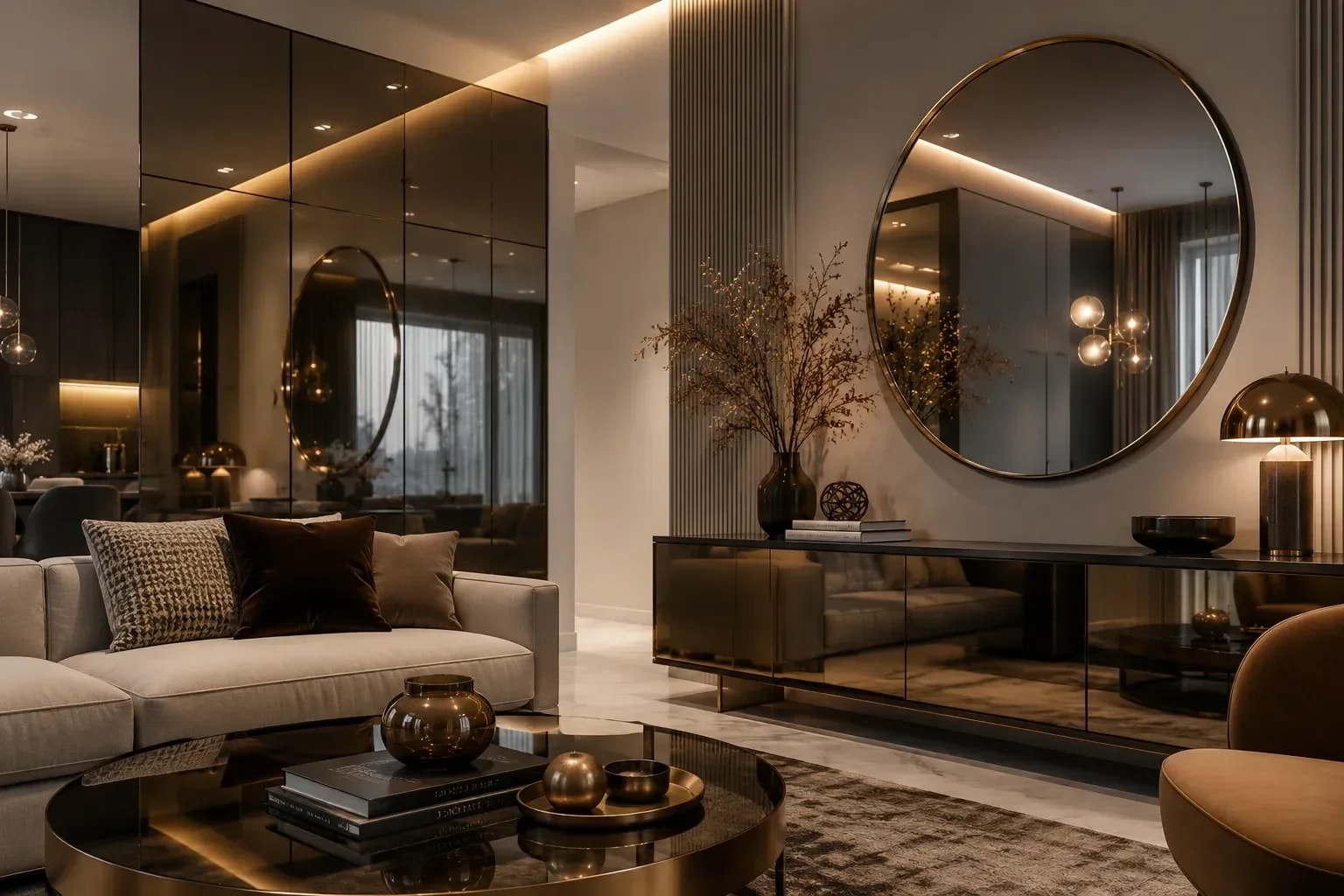
If you are deciding how to use mirrors in decorating in 2026, the main shift is away from using a mirror only as a practical object above a sink or dresser. Mirrors are increasingly treated as architectural surfaces, light-control tools, and wall decor. Bronze-tinted glass, smoky finishes, convex forms, large wall panels, mirrored cabinet fronts, and glossy surfaces are all part of the current direction. At the same time, the most successful interiors avoid turning every wall into a reflective s

Contents14
- How to Use Mirrors in Decorating: What Exactly Became a Trend in 2026
- Mirrors in the Interior With a Bronze Shade
- Mirrors in the Interior With a Smoky Effect
- Mirrors in the Interior and the Return of Convex Mirrors
- Mirrors in the Interior Instead of Pictures and Wall Decor
- Mirrors on the Entire Wall: When It Is a Good Idea
- Mirrors in the Interior of a Small Room
- Mirrors in the Interior of the Hall
- Mirrors in the Interior of the Living Room
- Mirrors in the Bedroom Interior
- Mirrors in the Dining Room Interior
- Mirrors in the Interior of the Bathroom
- Mirrors in the Interior on Cabinet Fronts
- Interior Mirrors and Glossy Surfaces
If you are deciding how to use mirrors in decorating in 2026, the main shift is away from using a mirror only as a practical object above a sink or dresser. Mirrors are increasingly treated as architectural surfaces, light-control tools, and wall decor. Bronze-tinted glass, smoky finishes, convex forms, large wall panels, mirrored cabinet fronts, and glossy surfaces are all part of the current direction. At the same time, the most successful interiors avoid turning every wall into a reflective surface.
A mirror works best when it has a clear job: improve light, correct proportion, create depth, frame a view, or add one deliberate decorative accent. Before choosing size or shape, first decide what the mirror will reflect.
How to Use Mirrors in Decorating: What Exactly Became a Trend in 2026
Current 2026 interiors use reflective surfaces in a more layered way. Designers are pairing darker woods, stone, textured plaster, metal, and soft fabrics with reflective glass instead of building rooms around a single shiny focal wall. Bronze mirrors and glossy finishes are being used specifically to manipulate light and perception, while warmer woods and patinated materials keep the room from feeling sterile.
The important change is contrast. A mirror no longer needs a decorative frame to make a statement. It can be an entire cabinet front, an aged or tinted panel, a small convex object among paintings, or a large quiet rectangle that reflects a strong architectural feature.
Mirrors in the Interior With a Bronze Shade
A bronze mirror has a warm brown-gold tint rather than the cool neutrality of standard silver-backed glass. It reduces glare, softens reflections, and works especially well with walnut, oak, travertine, beige stone, brass, chocolate textiles, and warm white walls.
Use bronze mirror when you want atmosphere more than perfect color accuracy. It is excellent in a dining room, hallway, bar cabinet, living room, or decorative wall panel. It is less practical as the only mirror used for makeup or tasks where true skin and clothing color matters.
To keep bronze glass contemporary, use large simple planes or clean frames. Too many ornate gold details around it can push the room toward a themed, overly decorative look.
Mirrors in the Interior With a Smoky Effect
Smoky gray mirror creates a cooler, more restrained reflection. It pairs naturally with black metal, graphite, gray stone, dark oak, stainless steel, and muted blue or green.
Because the reflection is darker, smoky mirror is useful when a standard mirror would create too much visual noise. It can make a built-in cabinet disappear into a dark wall or add depth behind shelving without doubling every bright object in the room.
Use it carefully in a small dark hallway. A smoke tint does not create light by itself; it only reflects what is already there, and it reflects less brightly than clear mirror.
Mirrors in the Interior and the Return of Convex Mirrors
Convex mirrors curve outward, so they show a wide, distorted view. Their purpose is decorative rather than practical. In 2026 they fit the broader return of character pieces, vintage references, and objects that look collected rather than mass-matched.
A single convex mirror can replace a small artwork above a console, fill a gap in a gallery wall, or create a sculptural point in a hallway. Because the reflection is visually active, one good piece is usually stronger than a wall covered with many random convex mirrors.
Look for a frame that connects with another material in the room—dark wood, aged brass, black metal, plaster, or lacquer—so the piece belongs to the interior rather than floating as an isolated trend.
Mirrors in the Interior Instead of Pictures and Wall Decor
A mirror can work as wall decor when its proportions and placement are strong enough to stand on their own. Above a console, sideboard, fireplace, bench, or sofa, think of the mirror as a composition rather than just a functional rectangle.
A useful rule is to relate its width to the furniture below it. A very small mirror over a long sideboard can look accidental. A mirror that is roughly half to three-quarters of the furniture width often feels more deliberate, although asymmetrical layouts can break that rule successfully.
If the wall already contains patterned wallpaper, strong art, shelving, and decorative lighting, another statement mirror may be too much. Let one element lead.
Mirrors on the Entire Wall: When It Is a Good Idea
A full mirrored wall can be effective when it solves a real spatial problem. It can visually widen a narrow dining area, add depth to an entry, reflect a garden view, or brighten a room where windows sit on only one side.
The safest approach is to integrate the mirror into architecture. Use large panels aligned with wall joints, molding, cabinetry, or ceiling lines rather than covering a random rectangle from edge to edge.
Before installation, stand where people usually sit and walk. Check whether the wall will reflect a beautiful view or simply double a television, doorway, cluttered worktop, or bathroom entrance.
Full-height mirror also shows fingerprints, dust, socket cutouts, uneven walls, and installation errors clearly. Large panels need professional measurement and safe mounting.
Mirrors in the Interior of a Small Room
Mirrors can make a small room feel larger because they extend sightlines and bounce light, but placement matters more than quantity. One well-positioned large mirror often works better than five small ones.
Try these strategies:
Put a tall mirror near a window so it catches daylight without creating harsh glare.
Use a mirror opposite an attractive open view, not opposite storage clutter.
Choose a simple frame close to the wall color if you want the mirror to visually disappear.
Extend a mirror close to the floor when you want to emphasize height.
Avoid reflecting two or three other mirrors unless the repeated image is intentional.
A small room needs visual calm. Reflection can enlarge space, but it can also multiply every object left in view.
Before choosing a mirror for a small room, test the effect with a temporary stand-in. A large sheet of cardboard or painter's tape shows the scale; a portable mirror lets you test the reflection. Check the room in morning daylight, afternoon light, and after the lamps are on. A position that looks excellent at noon may create a direct view of an exposed bulb at night. This simple test is especially valuable before ordering custom glass, because wall-to-wall mirror is difficult and expensive to change after installation.
Pay attention to visual doubling. A mirror opposite a shelf does not merely create depth—it doubles every book, cable, souvenir, and decorative object on that shelf. In a small room, the easiest way to make a mirror feel calm is to simplify the zone directly opposite it. One plant and one lamp can become a rich reflected composition; ten small objects can become twenty.
Mirrors in the Interior of the Hall
In an entry or hall, a mirror has a clear practical function: a final check before leaving. Full-length is ideal if space allows. A narrow vertical mirror can also make a low or tight corridor feel more open.
Place it where the person can step back far enough to see the desired amount of their body. If a mirror sits immediately behind a door or directly where coats block it, its nominal size does not matter.
Pair it with one practical surface—a console, bench, shoe cabinet, or shelf—rather than surrounding it with multiple reflective accessories. Good side lighting is more flattering than a single ceiling fixture directly overhead.
For hallways, think about circulation before symmetry. A beautiful floor mirror leaning into a narrow passage can become an obstacle. Wall-mounted full-length mirrors are safer where people carry bags, umbrellas, shopping, or children's equipment. If the hall is very narrow, a frameless or slim-framed vertical mirror generally occupies less visual space than a deep decorative frame.
Lighting is part of the design. A mirror near a warm wall sconce can make an entry feel twice as bright, but the sconce should not sit exactly where its bulb reflects at eye level. When possible, place light slightly to the side or use diffused shades. In a windowless entry, a mirror cannot manufacture daylight, but it can distribute the light you already provide more efficiently.
Mirrors in the Interior of the Living Room
The living room gives you the most freedom because a mirror can be functional, decorative, or architectural. Strong locations include above a fireplace, behind a console, between windows, above a low cabinet, or on a wall perpendicular to the main window.
Do not automatically put the largest mirror opposite the sofa. First check what someone seated on the sofa will see in it. A reflection of the ceiling light, television, or busy kitchen may be more distracting than helpful.
For a calmer 2026 look, combine one substantial mirror with tactile materials: boucle or wool upholstery, dark wood, stone, linen curtains, ceramic lamps, or aged metal. Reflection becomes more interesting when it is surrounded by matte surfaces.
In a living room with a television, test the mirror from the main seating positions. Large mirrors placed opposite the screen can create a second moving image that becomes distracting in the evening. If that is the only available wall, a darker bronze or smoky mirror, a narrower vertical format, or a position shifted away from the direct TV axis may solve the problem.
Above a fireplace, check heat and mounting requirements before installing a heavy mirror. Masonry, drywall, and decorative cladding require different fixings. A large mirror should be anchored to structure suitable for its weight; adhesive alone is not the default answer for every wall. If children play in the room, secure leaning mirrors rather than assuming their weight will keep them stable.
Mirrors in the Bedroom Interior
A bedroom mirror should support getting dressed without making the room feel restless. A full-length mirror near the wardrobe is the most practical choice. Mirrored wardrobe doors can work in a small bedroom, but use them deliberately; an entire wall of bright mirror can feel more like a showroom than a place to rest.
If you dislike seeing the bed reflected, place the mirror on a side wall or inside a wardrobe door. There is no universal design law that forbids a mirror opposite the bed, but personal comfort matters.
Warm or dimmable lighting, a wood frame, fabric nearby, and a limited number of glossy surfaces keep the bedroom softer.
Mirrors in the Dining Room Interior
Dining rooms are especially good for decorative mirrors because candles, pendant lights, table settings, flowers, and glassware create attractive reflections. Bronze or lightly aged mirror can make evening light feel warmer and more layered.
A mirror behind a sideboard or bar cabinet also creates depth without taking floor space. Avoid placing a very bright mirror where it reflects a bare bulb directly into seated guests' eyes.
If the dining area is compact, a wide horizontal mirror can visually extend the wall. Keep the table itself relatively edited so the reflection does not double visual clutter.
In the dining room, the mirror can also control the perceived width of the space. A wide horizontal mirror behind a sideboard makes a narrow dining zone feel broader, while a tall vertical mirror can emphasize ceiling height. The reflection should contain something worth seeing at seated eye level. If it captures only the underside of a pendant or a blank ceiling, adjust the height before drilling.
For evening use, dimmable light works particularly well with bronze mirror because the tint creates a softer atmosphere. Clear mirror makes candlelight and glassware feel brighter and sharper. Neither is universally better; choose according to whether the dining room is intended to feel airy or intimate.
Mirrors in the Interior of the Bathroom
Bathroom mirrors in 2026 are often larger, cleaner, and more integrated with lighting. Full-width vanity mirrors, mirrored medicine cabinets, backlit edges, and simple rounded forms are more useful than tiny decorative mirrors that force people to lean forward.
Prioritize function:
sufficient width for the users;
lighting from the front or sides;
safe electrical installation;
moisture-resistant backing and edges;
enough clearance for taps and wall-mounted fixtures;
easy access to storage if the mirror is a cabinet.
Tinted bronze or smoky mirror can be decorative in a bathroom, but use clear mirror at the main grooming zone if accurate reflection matters.
Mirrors in the Interior on Cabinet Fronts
Mirrored cabinet fronts can make wardrobes, bars, and storage walls feel lighter. The strongest current approach is often partial rather than total: mirror some doors, use tinted mirror, or divide the surface with slim framing.
In a hallway, mirrored wardrobe fronts solve two problems at once by providing storage and a full-length reflection. In a living room, bronze mirrored cabinets can read almost like lacquer or glass rather than a dressing mirror.
Check hardware carefully. Push-to-open fronts create a clean plane but collect fingerprints. Handles reduce touching but become part of the composition.
Mirrored cabinetry needs the same planning discipline as ordinary cabinetry. Large uninterrupted doors may look elegant but can be heavy, so hinge quality and manufacturer limits matter. Vertical divisions can reduce individual panel size and make replacement easier if one piece is damaged. In a wardrobe, consider whether the mirror needs to be on every door or only on the central panel. Partial use often gives enough light and function without creating a wall of repeated reflections.
Think about maintenance before choosing a finish. Clear mirror shows fingerprints strongly in high-touch zones. Bronze and smoky glass can disguise some marks but still need regular cleaning. Deep bevels, decorative grooves, and tiny divided panes collect dust at their edges. A simple panel is usually easier to maintain in a busy family hallway or kitchen-adjacent space.
Interior Mirrors and Glossy Surfaces
Mirror, high-gloss lacquer, polished stone, metal, glazed tile, and glass all reflect light differently. Combining them can create depth, but too many shiny materials compete.
A practical balance is to pair one dominant reflective surface with several matte or textured ones. For example: bronze mirror + dark walnut + honed stone + wool. Or clear mirror + plaster wall + linen + brushed metal.
If every element is glossy, the room can feel visually noisy even when the color palette is neutral.
How to Combine Mirrors in the Interior With Wood
Wood is one of the easiest materials to pair with mirror because it adds warmth and texture.
Match warm bronze mirror with walnut, smoked oak, or medium warm oak.
Pair clear mirror with pale oak when you want a lighter Scandinavian-style effect.
Use blackened or dark wood beside smoky mirror for a quieter, more dramatic room.
Repeat the wood tone in one other object—table, shelf, frame, or cabinet—to make the combination intentional.
Avoid trying to match every wood grain exactly; related undertones are enough.
The current 2026 shift toward deeper woods makes mirror especially useful because it prevents dark cabinetry from becoming visually heavy.
Mirrors in the Interior and Indoor Plants
A mirror can double the visual effect of plants without requiring more floor space. Place it where it reflects one strong plant or a small composition rather than a dense shelf of pots.
This works well near a bright window, in a dining room, or behind a console. Be careful with direct sun: a mirror can redirect intense light and create glare or unwanted heat on nearby surfaces. Check the reflection at several times of day before fixing a large panel permanently.
Plants also soften the hard edges of glass and metal, which is why the combination feels balanced.
How to Choose the Size of the Mirror in the Interior
Decide whether the mirror is for the face, full body, furniture composition, or architectural effect.
Measure the wall and the furniture below it.
Mark the proposed outline with painter's tape.
Check the reflection from normal standing and seated positions.
Confirm that doors, switches, sockets, lamps, and curtains have enough clearance.
For full-length use, prioritize height and viewing distance rather than decorative frame thickness.
For a mirror over furniture, choose a size that visually relates to the furniture rather than floating as a tiny object.
Bigger often works better in small rooms, but only if the reflection is worth enlarging.
For size, viewing distance is just as important as wall dimensions. A full-length mirror does not have to be as tall as the person using it, but it needs enough distance and correct angle to show the body comfortably. A small mirror placed too close to furniture can technically fit the wall while still failing in daily use. Tape the outline first, then stand where you will actually use it.
When the mirror sits over a vanity, console, or sideboard, also check the vertical gap. Too much empty wall between furniture and mirror makes the two elements feel unrelated; too little can interfere with lamps, flowers, or objects placed on the top. There is no universal centimeter rule because furniture height varies, but the composition should read as one group when viewed from the main entrance to the room.
Round, Rectangular or Asymmetrical Mirror
Choose the shape based on what the room already contains. A round mirror softens straight cabinetry, rectangular tile, and boxy furniture. A rectangular mirror reinforces architecture and is easiest for full-length use. An asymmetrical mirror adds movement and works best when the rest of the composition is relatively simple.
Do not choose an organic shape solely because it appears in trend photos. If the room already has curved sofa lines, arched openings, rounded tables, and sculptural lighting, another irregular mirror can make the design feel overly themed.
What the Mirror in the Interior Should Reflect
This is the most important placement question. A mirror should ideally reflect:
daylight or a pleasant window view;
art;
a plant;
an architectural feature;
a pendant light or chandelier;
an uncluttered part of the room;
an attractive material such as stone or wood.
Try not to make the main reflection a bin, open bathroom door, work mess, television back, exposed cables, or crowded storage. A mirror is effectively a second picture of whatever faces it.
A useful 2026 approach is to treat the mirror frame as part of the material palette. Dark timber frames echo the return of deeper woods; brushed metal connects to lighting; plaster or painted frames can disappear into the wall; frameless panels feel more architectural. The frame does not have to match door handles or every metal finish exactly. Repeating an undertone or material family once elsewhere is enough.
Asymmetrical mirrors are strongest when they have breathing room. If you place an irregular mirror in the middle of patterned wallpaper, beside sculptural shelves, under a complex pendant, and over a heavily veined stone console, every element competes. Put the unusual shape against a quieter background so its outline can be read clearly.
Mirrors in the Interior: How Not to Overdo It With Shine
Pick one dominant reflective feature per visual zone.
Surround it with matte materials.
Use tinted mirror where clear reflection would be too bright.
Avoid placing mirrors directly opposite each other unless an infinity effect is intentional.
Limit highly polished metal if you already have large mirror panels.
Check nighttime reflections, not only daytime light.
Edit objects that will be doubled in the reflection.
If you notice the mirrors before you notice the room, you may have crossed the line.
Nighttime is the best moment to audit shine. Turn on the lamps you actually use, sit in the normal seats, and look around the room rather than standing directly in front of the mirror. If you see several bright points reflected repeatedly, reduce one source: dim a lamp, change its angle, use a diffused shade, or replace one high-gloss accessory with a matte surface. This is often more effective than removing the mirror itself.
The same test reveals privacy issues. A mirror near a window can expose parts of a room to a different outdoor viewing angle after dark. Before fixing a large panel, check the reflection from outside or from neighboring spaces where appropriate. Curtains, blinds, or a small shift in angle may solve the problem without changing the design.
What Mirrors in the Interior Can Quickly Become Outdated
The riskiest choices are not specific shapes but highly recognizable formulas used without context. Examples include tiny mirrored mosaic tiles over a huge wall, decorative mirror sets placed only to fill space, aggressively distressed "antique" glass in every room, LED shapes chosen for novelty rather than function, and mirrored furniture combined with multiple crystal and chrome pieces.
A trend ages more slowly when it is integrated into architecture or tied to a clear function. A simple large mirror in the right location is less likely to date than a collection of five fashionable shapes bought together.
Also be careful with cheap adhesive mirror tiles on uneven walls. Distorted reflections, visible joints, and misalignment can make the installation look temporary.
Longevity comes from choosing a mirror because it improves the room, not because a particular shape is circulating on social media. A bronze panel integrated into a walnut cabinet can remain convincing after the bronze-mirror trend cools because the material relationship still works. A convex mirror inherited, found vintage, or chosen for a specific wall can feel personal rather than seasonal. By contrast, a set of identical trendy mirrors spread across several rooms dates faster because the motif becomes obvious.
If you rent, prioritize reversible solutions: securely hung framed mirrors, standing mirrors that are anchored against tipping, or mirrored furniture you can take with you. Avoid large adhesive mirror tiles on finished walls unless you know how the adhesive will be removed. For permanent renovations, spend more attention on safety glass, edge finishing, substrate flatness, and professional mounting than on the exact shape of the frame.
Mirrors in the Interior of 2026: The Main Thing to Remember
The 2026 direction is reflective but not sterile. Bronze mirror, smoky glass, convex pieces, glossy surfaces, and mirrored cabinetry are all current, especially alongside darker wood, stone, tactile fabric, and objects with patina. The trend is less about "more mirrors" and more about using reflection as another material.
Before buying anything, answer three questions: What will it reflect? What problem will it solve? What matte material will balance it? If those answers are clear, the mirror is likely to work beyond one trend cycle.
A final buying check can save expensive mistakes. Photograph the wall straight on, note the wall width, furniture width, ceiling height, nearby doors, sockets, and light fixtures, then mark the proposed mirror size with tape. Live with that outline for a day. If you keep wishing it were larger, adjust before ordering. If it dominates the room before glass is even installed, scale it back.
For custom mirror, ask the fabricator about glass thickness, edge finish, safety backing, mounting system, and whether the chosen tint changes color rendering. In wet rooms, confirm that the product and adhesive are suitable for moisture. For large panels, professional installation is not cosmetic; it is part of the safety plan.
The simplest rule remains the most reliable: use fewer mirrors, but make each one earn its place. A mirror that improves light, view, proportion, or daily function will stay useful after the specific 2026 trend language changes.
Cleaning should be part of the design decision too. Large frameless panels look minimal but expose every streak, while deeply beveled or segmented mirrors create more edges to maintain. In homes with children, pets, or a busy entryway, a slightly tinted mirror or a frame that keeps hands away from the glass can be more practical than a flawless showroom surface. Good design includes how the object looks on an ordinary Tuesday, not only in a styled photograph.
Maintenance is part of the aesthetic.
Practicality is what keeps the trend looking convincing.
FAQ
Are Mirrors Fashionable in the Interior in 2026?
Yes. Reflective surfaces remain important in 2026, including bronze mirrors, glossy finishes, large integrated panels, and decorative convex forms. The look is strongest when balanced with darker woods and tactile materials.
What Mirror in the Interior Looks Modern?
A modern mirror usually has a clear scale and purpose: a large simple rectangle, an integrated cabinet front, a warm tinted panel, or one sculptural shape. It does not need an elaborate frame.
Do Mirrors in the Interior Enlarge a Small Room?
Visually, yes. They can extend sightlines and bounce light, but they also multiply clutter. One large, well-positioned mirror is often more effective than many small ones.
Where Is the Best Place to Put a Mirror in the Living Room?
Place it where it reflects daylight, art, a plant, or another attractive feature. Above a console, fireplace, or low cabinet often works well.
Is the Mirror Cabinet Relevant in 2026?
Yes. Mirrored wardrobe and cabinet fronts remain useful, especially when integrated cleanly into built-ins. Bronze or smoky finishes can make them feel less utilitarian.
Which Is Better — Bronze or Smoky Mirror?
Bronze feels warmer and works with brown, beige, brass, and warm wood. Smoky gray feels cooler and works with black, graphite, steel, and dark contemporary palettes.
What Is a Convex Mirror and Why Is It Used?
It curves outward and shows a wide, distorted reflection. In interiors it is mainly a decorative, sculptural object rather than a practical grooming mirror.
Is It Possible to Put a Mirror Opposite the Window?
Yes, but check glare and the exact reflected view at different times of day. A slight offset may work better than a perfectly direct reflection.
Is It Possible to Combine Several Mirrors in One Room?
Yes, if they have different functions or belong to one coherent composition. Avoid scattering unrelated mirrors on every wall.
How Do You Know There Are Too Many Mirrors in the Interior?
If reflections compete, glare becomes distracting, every object appears doubled, or the room feels colder and busier rather than more spacious, reduce the reflective surfaces.
Best of the week — in your inbox
No spam. Only top Gosta stories. Unsubscribe in one click.
Comments