
Fall Living Room Decor: 15 Easy Changes That Skip the Renovation
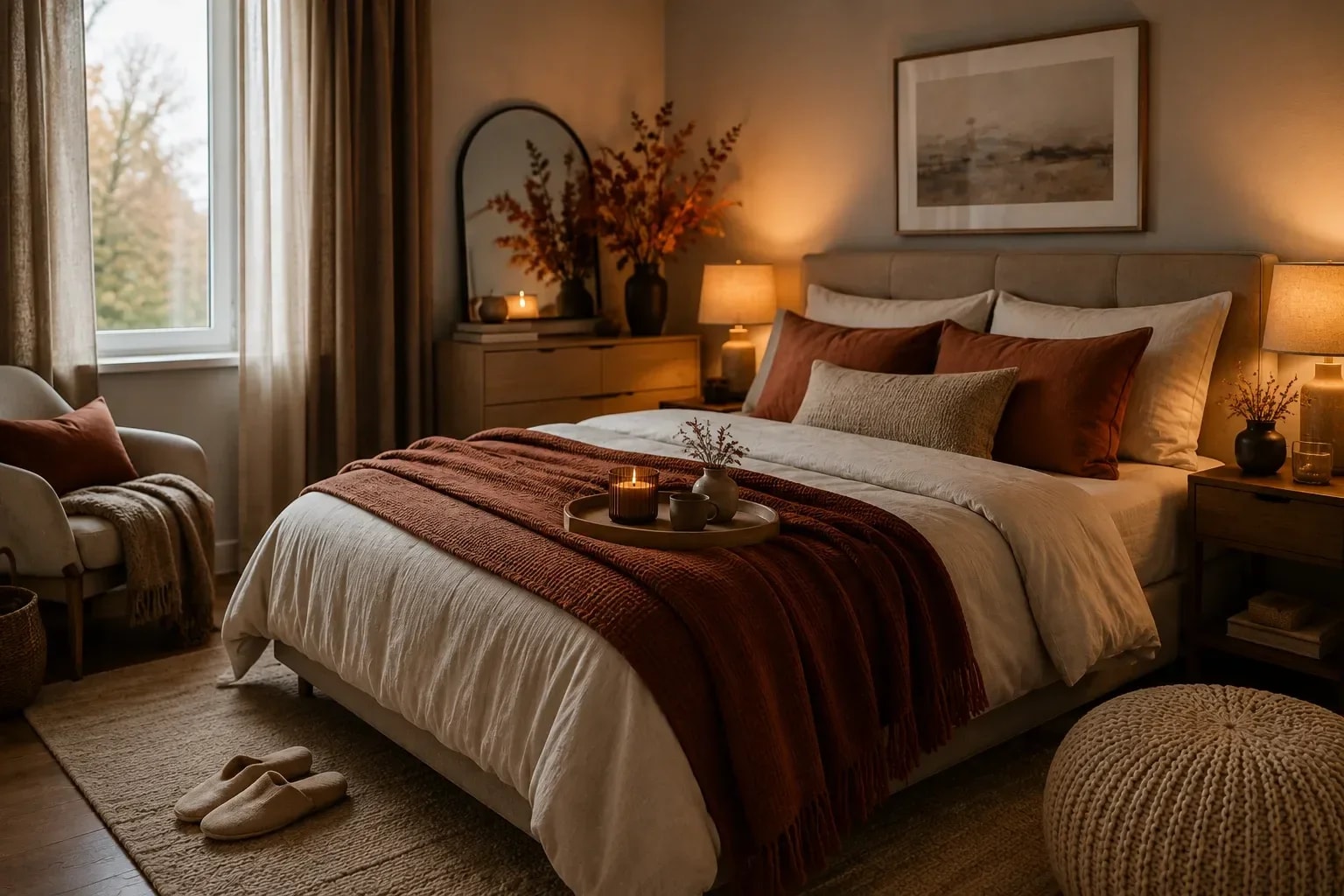
Good fall living room decor does not require orange walls, themed signs, or a full furniture replacement. The easiest 2026 update is quieter: warmer textiles, more deliberate lighting, one or two deeper colors, darker wood, metal accents, natural branches, and less visual clutter. The room should feel warmer and more layered, not transformed into a seasonal display.

Contents14
- 1. Add a large throw that works as part of the interior
- 2. Replace pillowcases, not all decorative pillows
- 3. Turn the carpet or change its location
- 4. Place a floor lamp near the sofa or chair
- 5. Add a small lamp to a dresser or shelf
- 6. Replace one bright summer accent with a deeper color
- 7. Add dark wood as a small accent
- 8. Make one shelf less crowded
- 9. Place one large vase with branches
- 10. Add brass or dark metal
- 11. Rearrange the decor on the coffee table
- 12. Add a plant with rich or glossy leaves
- 13. Add one checkered or striped print
- 14. Change the curtains only when you really need to
Good fall living room decor does not require orange walls, themed signs, or a full furniture replacement. The easiest 2026 update is quieter: warmer textiles, more deliberate lighting, one or two deeper colors, darker wood, metal accents, natural branches, and less visual clutter. The room should feel warmer and more layered, not transformed into a seasonal display.
The 15 changes below are intentionally small. Most can be done with things you already own, and several are simply about moving or removing objects rather than buying anything new.
1. Add a large throw that works as part of the interior
A throw is useful only if it belongs in the room even when nobody is wrapped in it. Choose a fabric and color that connect the sofa with the rest of the palette: oatmeal, camel, olive, chocolate, burgundy, charcoal, or a restrained check.
Instead of folding it into a tiny decorative rectangle, let it drape naturally over one arm or the back of the sofa. A larger throw creates a stronger block of texture and makes the seating area look more inviting.
For a modern result, avoid piling three or four unrelated blankets on one sofa. One generous throw is often enough.
2. Replace pillowcases, not all decorative pillows
Seasonal pillow covers are cheaper and easier to store than complete cushions. Keep the inserts and replace only two or three covers.
Useful autumn textures include wool blends, brushed cotton, velvet, boucle, heavy linen, and textured weaves. You do not need every cushion to be "fall colored." A cream sofa can work with one chocolate cover, one muted rust or plum cover, and one existing neutral.
The goal is depth through texture, not a row of matching novelty pillows.
3. Turn the carpet or change its location
Before buying a rug, test the one you already have. Rotating it 180 degrees can place a worn or darker section in a better position. Moving it farther under the sofa can also make a small rug look more intentional.
A living-room rug usually works best when at least the front legs of the main seating pieces sit on it. If the rug floats in the middle of the floor, the room can feel disconnected.
In autumn, a denser rug also adds physical warmth underfoot, which can change how cozy the room feels more than another decorative object would.
4. Place a floor lamp near the sofa or chair
Autumn changes the light before it changes the temperature. A floor lamp beside the place where you actually read, talk, or relax makes the room functional in darker evenings.
Use warm-white light rather than a harsh cool bulb. Position the shade so it illuminates the book or seating area without shining directly into the eyes.
One useful lamp can improve the room more than several decorative lamps that are never switched on.
5. Add a small lamp to a dresser or shelf
A second, lower light source makes the room feel layered. Put a compact table lamp on a console, sideboard, or wide shelf where it can create a pool of light away from the ceiling fixture.
This works especially well in small living rooms because it adds depth without taking floor space. Choose a lamp with a simple base and a shade that diffuses light rather than a highly sculptural object that competes with everything around it.
The room will feel warmer when light comes from two or three heights instead of only one central ceiling lamp.
Before changing color, look at the undertone of the fixed elements you cannot easily replace: flooring, sofa, large rug, stone, and wall paint. A room with warm oak and creamy walls usually accepts rust, olive, burgundy, and chocolate naturally. A cooler gray room may look better with plum, deep blue, charcoal, or a cooler wine red. Matching the undertone is more important than copying a seasonal palette from a photograph.
You can test a color without buying decor by placing a sweater, scarf, book, or piece of fabric in the room for a day. Check it in daylight and with evening lamps. Colors that look sophisticated in a shop can become muddy or overly saturated under warm home lighting.
If you already have one strong permanent color — for example a green sofa or blue rug — treat that as part of the autumn palette instead of adding three more competing shades. Deepen the room around what exists rather than trying to cover it up.
6. Replace one bright summer accent with a deeper color
You do not need to recolor the whole room. Replace one very bright summer accent — perhaps a lemon-yellow cushion, turquoise vase, or pale blue throw — with a deeper shade.
Good 2026-friendly options include chocolate, oxblood, burgundy, forest green, aubergine, smoky blue, and dark olive. Use the new color once in a noticeable item and repeat it once in a smaller detail if the room needs connection.
A single deeper tone can shift the season without making the space dark.
7. Add dark wood as a small accent
Dark wood immediately introduces warmth and visual weight. You do not need a new dining table or cabinet; try a tray, picture frame, side table, box, or bowl.
Walnut, smoked oak, and other rich brown finishes work especially well with cream upholstery, beige walls, gray stone, and light wood floors. Mixing wood tones is acceptable when the pieces share a similar level of warmth.
One dark wood accent often looks more sophisticated than several small "autumn" objects.
8. Make one shelf less crowded
Seasonal decorating is often improved by removing things first. Choose one shelf or section of a bookcase and reduce the number of objects by about a third.
Keep a small group with different heights: perhaps books, one ceramic object, and a framed photo. Empty space makes the remaining items look more deliberate and allows darker autumn accents to stand out.
If every shelf already contains books, candles, vases, pumpkins, plants, and souvenirs, adding anything else will usually make the room feel busier rather than cozier.
9. Place one large vase with branches
Branches create height and seasonal movement without looking like themed decor. Use pruned garden branches, dried grasses, or leafy stems that are safe and suitable for indoor use.
A large vase works best on a dining table, console, floor, or sturdy sideboard where the arrangement has breathing room. Avoid placing tall branches where they block the television or sightlines between people.
One substantial arrangement usually looks more modern than several tiny seasonal bouquets scattered around the room.
10. Add brass or dark metal
Metal adds contrast to soft textiles and wood. Brass, aged bronze, blackened steel, or dark iron can appear in a lamp, candleholder, tray, frame, or small side table.
Keep the finish limited. If the room already has black metal in lighting or furniture legs, repeating black may be enough. If the palette is warm and neutral, one brass object can add richness without becoming flashy.
You do not need every metal finish in the room to match exactly, but repeating one finish two or three times creates coherence.
11. Rearrange the decor on the coffee table
A coffee table should still function. Clear the surface, then rebuild it with fewer pieces:
one tray or stack of books;
one low decorative object;
one candle or small lamp if safe and practical;
one bowl or vase;
enough empty space for cups, a laptop, or everyday use.
For fall coffee table decor, texture matters more than obvious symbols. A dark wooden tray, stone bowl, amber glass, or a small arrangement of branches can look seasonal without pumpkins or printed slogans.
12. Add a plant with rich or glossy leaves
A healthy green plant can make an autumn room feel more alive, especially when outdoor greenery is fading. Choose a plant suited to the light level rather than buying purely for leaf shape.
Deep green or glossy foliage provides useful contrast with brown, burgundy, and warm neutral textiles. Use one medium plant instead of many tiny pots if the room already has a lot of visual detail.
If you have pets or young children, check whether a plant is safe for your household before bringing it home.
13. Add one checkered or striped print
Checks and stripes bring structure to a room full of solid fabrics. Use them in one cushion, throw, or upholstered stool rather than across every textile.
For a subtle effect, choose a low-contrast pattern such as cream and brown, gray and black, or olive and beige. A stronger tartan or wide stripe can work as the only patterned element in a minimalist room.
The print should connect with colors already present so it feels integrated rather than added for one season.
14. Change the curtains only when you really need to
Heavy curtains can make a room feel warmer, but replacing curtains seasonally is unnecessary for most homes. Change them only if the current fabric is too sheer for privacy, drafts, or the visual balance of the room.
A better first step is to wash, steam, and rehang existing curtains correctly. Extending the rod slightly beyond the window can make the opening look larger and allow more daylight when curtains are open.
If you do change them, choose a versatile fabric you will want to use for several years, not a seasonal print.
15. Remove part of the summer decor
The final change is subtraction. Put away objects that strongly read as summer: beach souvenirs, very bright tropical textiles, lightweight seasonal garlands, or decorative pieces that now compete with the deeper autumn palette.
You do not have to replace each removed item. Leaving a console or shelf partially empty often creates the calmest seasonal shift.
Store only the pieces you genuinely want to see again next year. Seasonal editing is also a useful way to reduce clutter over time.
Texture can do the job of color when you prefer a neutral interior. A cream room can feel noticeably more autumnal with a chunky wool throw, brushed cotton cushion, dark wooden tray, ribbed ceramic vase, and low warm light even if no orange or burgundy is added. This approach also makes seasonal storage easier because the pieces continue to work through winter.
Pay attention to scale when layering textures. If the sofa is already boucle, add a smoother wool or cotton throw rather than more boucle everywhere. If the rug has a strong pattern, keep cushions mostly solid. Contrast lets each material read clearly.
Metallic finishes are best treated as a material, not a separate color theme. Brass brings warmth; blackened metal adds definition; chrome can look sharper and cooler. Repeat the existing hardware or lighting finish before introducing an unrelated metal solely because it is trendy.
Artwork can also carry seasonal depth without being changed seasonally. A print containing brown, ochre, burgundy, dark green, or black may suddenly connect with new textiles when those colors are repeated elsewhere. Move existing art to a more visible wall before buying a temporary seasonal poster.
What colors to use for the autumn decoration of the living room
A modern autumn palette can start with the room's existing neutral and add one or two deeper shades. Useful combinations include:
warm white + chocolate + olive;
beige + burgundy + dark wood;
gray + plum + black metal;
cream + rust + walnut;
taupe + forest green + brass;
soft blue + oxblood + warm brown.
In 2026 interiors, deep brown and burgundy continue to work because they feel rich without relying on a literal seasonal theme. You can also use muted yellow, terracotta, aubergine, and moss green in smaller amounts.
How to combine autumn colors without overloading
Use a simple ratio: most of the room remains in its existing base colors, one deeper autumn shade becomes the main accent, and a second accent appears in smaller amounts.
For example, keep 70–80% cream, beige, and wood; use olive in a throw and two cushions; add burgundy only in a book cover, vase, or artwork detail. The eye reads the room as seasonal even though most surfaces have not changed.
Do not distribute every accent color equally. A hierarchy is calmer than perfect repetition.
How to make autumn decor modern, not thematic
Focus on material and atmosphere rather than symbols. Wool, velvet, wood, stone, warm light, branches, metal, and deeper color all communicate autumn without text signs, leaf garlands, or rows of miniature pumpkins.
A room feels current when the seasonal pieces could still make sense in November or January. If an object only works for two weeks, ask whether you really want to store it for the rest of the year.
Modern autumn living room decor is often simply a slightly warmer version of your normal style.
How not to overload the autumn decor of the living room
Limit yourself to changes in three categories: textile, light, and one decorative focal point. For example, change the throw, add a lamp, and place branches in a vase. Stop there for a few days before adding more.
Use negative space. If you add a large vase, remove several smaller objects around it. If you add patterned cushions, keep the throw simple.
The strongest sign of overload is when you notice the decorations before you notice the room.
What to change in the decor of the living room in the first place if the budget is small
Start with lighting and rearrangement because they have the highest visual impact for the least money. Move a lamp, clear a shelf, rotate the rug, and restyle the coffee table before buying anything.
If you spend money on one item, a good throw or a set of two cushion covers usually changes more square footage than several small decorative accessories.
Secondhand shops and your own storage can also provide trays, frames, vases, and books without turning seasonal decorating into a shopping project.
Autumn decor for a small living room: what works best
Small rooms benefit from fewer, larger changes. Choose one substantial throw, one medium lamp, one vase, and perhaps two cushion covers. Avoid covering every surface with small objects.
Keep floor paths clear. Use wall, shelf, and table lighting rather than adding bulky furniture. A mirror can help distribute light, but place it where it reflects a useful view rather than clutter.
Use the same deeper accent color in two places to create connection without fragmentation.
A useful final check is to evaluate the room at the times you actually use it. A living room that looks beautiful at noon can feel flat at 8 p.m. if all the light comes from the ceiling. Conversely, a room with many lamps may feel cluttered during the day if cords and bases crowd every surface. Seasonal decorating works when function improves alongside appearance.
Think about maintenance too. A white boucle throw that cannot be washed easily, a branch arrangement that sheds constantly, or six candles that need to be moved every evening may create more work than atmosphere. Choose changes you can live with for several months.
If children or pets use the room, keep unstable vases, open flames, trailing cords, and breakable objects out of high-traffic areas. Battery candles can provide a similar visual effect where an open flame is impractical. Plants should be checked for household safety, and heavy floor lamps should have stable bases.
Finally, photograph the finished room from the doorway. If one corner looks visually heavy, remove something before buying a balancing object for the other side. Most successful small-room updates end with subtraction. A room that has space to breathe will usually feel calmer, more expensive, and more comfortable than one where every surface has been "styled."
Fall living room decor: where to start
Take a photo of the room in daylight and another in the evening. Identify what feels cold, flat, cluttered, or impractical. Then make only the first three changes:
improve one light source;
add or reposition one textile;
remove or restyle one group of objects.
After that, decide whether the room actually needs anything else. The best fall living room decor is not the one with the most seasonal objects; it is the one that makes the room more comfortable to live in during darker, cooler months.
A simple spending rule can prevent seasonal impulse purchases: wait until you have rearranged the room, changed the lighting, and lived with the edited version for a few evenings. Then buy only the item that solves a specific gap. If the sofa still feels visually flat, buy cushion covers or a throw. If the room feels dark, buy a lamp. If surfaces feel chaotic, buy nothing and remove more objects. This keeps the update coherent and avoids ending the season with a box of accessories that never worked together.
For renters, all 15 ideas can remain reversible. Use textiles, freestanding lamps, art already on existing hooks, removable styling, and furniture placement rather than painting or drilling solely for a temporary seasonal look. A renter-friendly autumn room can feel completely different while leaving the fixed finishes untouched.
You can also set a storage limit before buying anything seasonal: one labeled box, one shelf, or one drawer. If a new object does not fit, something else leaves. That rule keeps seasonal decorating from quietly becoming year-round clutter and makes next autumn's setup faster because every stored piece has already earned its place.
The same principle applies to scent: one subtle candle or diffuser is enough. Layering several strong seasonal fragrances can make a living room uncomfortable, especially for guests who are sensitive to perfume. Visual warmth, soft light, and texture should do most of the work.
FAQ
How to cheaply update the living room in the fall?
Rearrange lighting, rotate the rug, remove summer accessories, restyle shelves, and replace only cushion covers rather than buying whole cushions.
What colors to choose for the autumn living room?
Chocolate, burgundy, olive, forest green, rust, plum, warm beige, and dark wood tones are easy to combine with existing neutrals.
How to make the living room cozier without renovation?
Add warmer layered lighting, a substantial throw, a rug underfoot, and fewer but more tactile accessories.
What autumn decor looks modern now?
Natural branches, dark wood, warm metal, textured textiles, deeper colors, and simple lighting look more current than heavily themed seasonal displays.
Do you need decorative pumpkins for the autumn interior?
No. They are optional. A room can feel distinctly autumnal through color, texture, and light alone.
Do you need seasonal decor on every shelf?
No. Leaving some shelves unchanged or partially empty keeps the room calm.
Is it possible to combine autumn decor with minimalism?
Yes. Use one deeper color, one textured textile, and one natural arrangement rather than many small objects.
How to decorate a small living room in autumn?
Choose fewer, larger changes and preserve clear floor space. Lighting and textiles give the biggest impact without crowding the room.
Should you change curtains in autumn?
Only if there is a practical reason such as drafts, privacy, or a fabric that no longer works. Seasonal curtain replacement is not necessary.
What textures are best for fall?
Wool blends, brushed cotton, velvet, heavy linen, boucle, wood, stone, and woven fabrics all add autumn depth without requiring a themed palette.
Best of the week — in your inbox
No spam. Only top Gosta stories. Unsubscribe in one click.
Comments