
Mushroom Hunting 101: How to Forage Edible Mushrooms Safely
Mushroom hunting can be an enjoyable way to spend time outdoors, but wild mushrooms are not a food category where guessing is acceptable. This guide is deliberately safety-first: it does not teach identification from appearance, does not treat phone apps or photos as proof of edibility, and does not recommend eating a wild mushroom unless its identity has been confirmed by a genuinely knowledgeable local expert.

Contents14
- Edible Mushrooms: What Does This Name Mean in Practice
- What Edible Mushrooms Grow in Ukraine
- Why You Can't Identify Edible Mushrooms Just by a Photo
- Is There a Reliable Way to Distinguish an Edible Mushroom From a Poisonous One
- When Does the Mushroom Season Begin in Ukraine
- When Is the Best Time to Go for Mushrooms After the Rain
- Where You Can Collect Edible Mushrooms
- Edible Mushrooms and Mine Danger: What to Consider in Ukraine
- Is It Possible to Collect Mushrooms in National Parks
- Can All Edible Mushrooms Be Collected?
- What to Take With You for Mushrooms
- Why Is It Better to Put Mushrooms in a Basket?
- Cut or Twist the Mushroom
- Why Not Collect Everything You Find
Mushroom hunting can be an enjoyable way to spend time outdoors, but wild mushrooms are not a food category where guessing is acceptable. This guide is deliberately safety-first: it does not teach identification from appearance, does not treat phone apps or photos as proof of edibility, and does not recommend eating a wild mushroom unless its identity has been confirmed by a genuinely knowledgeable local expert.
In Ukraine there is another major consideration in 2026: mine and unexploded-ordnance risk. Forest access that was once routine may now be unsafe or restricted. Official warnings, local access rules, and protected-area regulations come before any mushroom season, location, or tradition.
Edible Mushrooms: What Does This Name Mean in Practice
"Edible" means a species is generally recognized as suitable for food when correctly identified, collected from a clean and legal area, stored properly, and prepared appropriately. It does not mean every individual wild mushroom is automatically safe.
Problems can still arise because of:
Misidentification with a toxic species.
Collection from contaminated areas.
Spoilage or poor storage.
Individual intolerance.
Incorrect preparation.
Mixing unknown mushrooms into one batch.
Eating a species that is considered edible locally but requires special preparation.
The safest option from a food-safety perspective is cultivated mushrooms from controlled commercial production. Wild mushrooms carry substantially more uncertainty. That distinction is important when the outing includes children, inexperienced collectors, or anyone who cannot independently verify a species: observing and photographing is the safer activity than collecting for the table.
What Edible Mushrooms Grow in Ukraine
Ukraine has many wild mushroom species traditionally collected as food. Commonly discussed examples include porcini or cep mushrooms, chanterelles, various boletes, parasol mushrooms, and some honey-fungus species.
That list is not an identification guide. Several edible-looking mushrooms have dangerous lookalikes, common names vary by region, and appearance changes with age, weather, and habitat. A name in an article is not enough to decide what is safe to eat.
If you are new to mushroom foraging, learn in person with a qualified local mycologist, experienced guide, or organized educational group. Do not build confidence by collecting a large number of species at once.
Why You Can't Identify Edible Mushrooms Just by a Photo
A photograph can omit exactly the detail needed for identification. The underside, base, stem structure, bruising, habitat, odor, spore characteristics, and developmental stage may matter. Lighting and phone processing can also distort color.
A single picture usually cannot establish:
What the mushroom was growing from.
Whether a structure is hidden underground.
How the underside looks.
Whether there are several species mixed together.
Whether the specimen is too old or damaged for reliable assessment.
For that reason, a social-media comment, reverse-image search, or app result should never be treated as permission to eat a wild mushroom.
Is There a Reliable Way to Distinguish an Edible Mushroom From a Poisonous One
There is no universal shortcut. Folk tests such as checking whether an animal eats the mushroom, watching whether an onion changes color during cooking, tasting a tiny piece, or relying on smell are not reliable safety methods.
Professional identification is species-specific. It may require several characteristics together and sometimes expert examination.
The practical rule for a general reader is simple: if the identity is uncertain, do not eat it. When a mushroom is intended as food, "probably" is not an acceptable standard.
When Does the Mushroom Season Begin in Ukraine
There is no single national start date. Fruiting depends on region, altitude, rainfall, soil moisture, temperature, forest type, and species. Some mushrooms appear in warmer months; autumn is often the most active period for public foraging.
Seasonal timing tells you when mushrooms may appear, not whether they are safe. A mushroom growing in the "right" month can still be toxic, contaminated, protected, or collected from an unsafe area.
Before any outing, check local forest-access restrictions and official safety notices. In regions affected by hostilities or occupation, seasonal knowledge must never override mine-safety guidance.
When Is the Best Time to Go for Mushrooms After the Rain
Rainfall often influences mushroom fruiting, but there is no fixed number of days after rain that reliably predicts a useful or safe outing. Temperature, soil moisture, species, wind, and previous weather all change the result.
More importantly, rain does not make identification easier and does not make a forest safe to enter. Instead of planning around a precise "two days after rain" rule, prioritize legal access, daylight, weather, and an experienced group.
Where You Can Collect Edible Mushrooms
Only collect where access is legal, the area is officially considered safe, and local land or conservation rules permit collection. Avoid giving yourself permission based on the fact that other people are already there.
Do not collect:
In areas closed by authorities.
In forests or fields with mine warnings or a history of recent hostilities unless officially cleared for public access.
In protected zones where gathering natural resources is prohibited.
Beside busy roads, industrial sites, dumps, or visibly polluted land.
On private land without permission.
In any location where you are unsure of the rules.
For national parks, rules may differ by zone. Protected core zones can prohibit collecting mushrooms entirely, while other areas may have different restrictions. Check the specific park administration rather than assuming one national-park rule applies everywhere.
Edible Mushrooms and Mine Danger: What to Consider in Ukraine
This is one of the most important rules for mushroom hunting in Ukraine in 2026. The State Emergency Service continues to warn that mines, grenades, and unexploded ordnance remain present in areas affected by fighting or occupation.
If an area has warning signs, restricted access, or a known history of hostilities, do not leave approved routes to look for mushrooms. Do not enter a forest merely because locals used to forage there before 2022.
If you see a suspicious object, do not approach, touch, move, or photograph it from close range. Follow official emergency guidance and contact the appropriate emergency service once you are in a safe position.
Mushrooms are never worth taking a shortcut across unverified terrain.
Is It Possible to Collect Mushrooms in National Parks
Sometimes, but not everywhere. Ukrainian national parks are divided into different functional zones. The strict protected zone prohibits economic use of natural resources, including collecting mushrooms and berries, and access itself may require special permission.
Other zones can have different rules. The only safe way to know is to check the regulations of the specific park before visiting.
Do not assume that "national park" automatically means free public foraging. Conservation rules exist to protect habitats and species.
Can All Edible Mushrooms Be Collected?
No. A mushroom can be edible yet still be legally protected, located in a restricted protected area, too old or degraded to be suitable for food, or growing in a polluted or unsafe place.
Rare and protected species should not be collected. Ukraine maintains Red Book protections for threatened organisms, including fungi. Special use of protected species is regulated and not an ordinary recreational activity.
When in doubt, leave the mushroom where it is and treat careful observation as enough for that outing.
What to Take With You for Mushrooms
For a legal, organized outing in a confirmed safe area, basic outdoor-safety items matter more than specialized "foraging gear."
Bring:
A charged phone.
A power bank.
Drinking water.
Weather-appropriate clothing.
Closed, sturdy footwear.
A simple first-aid kit.
A whistle.
A paper or offline map if reception may be poor.
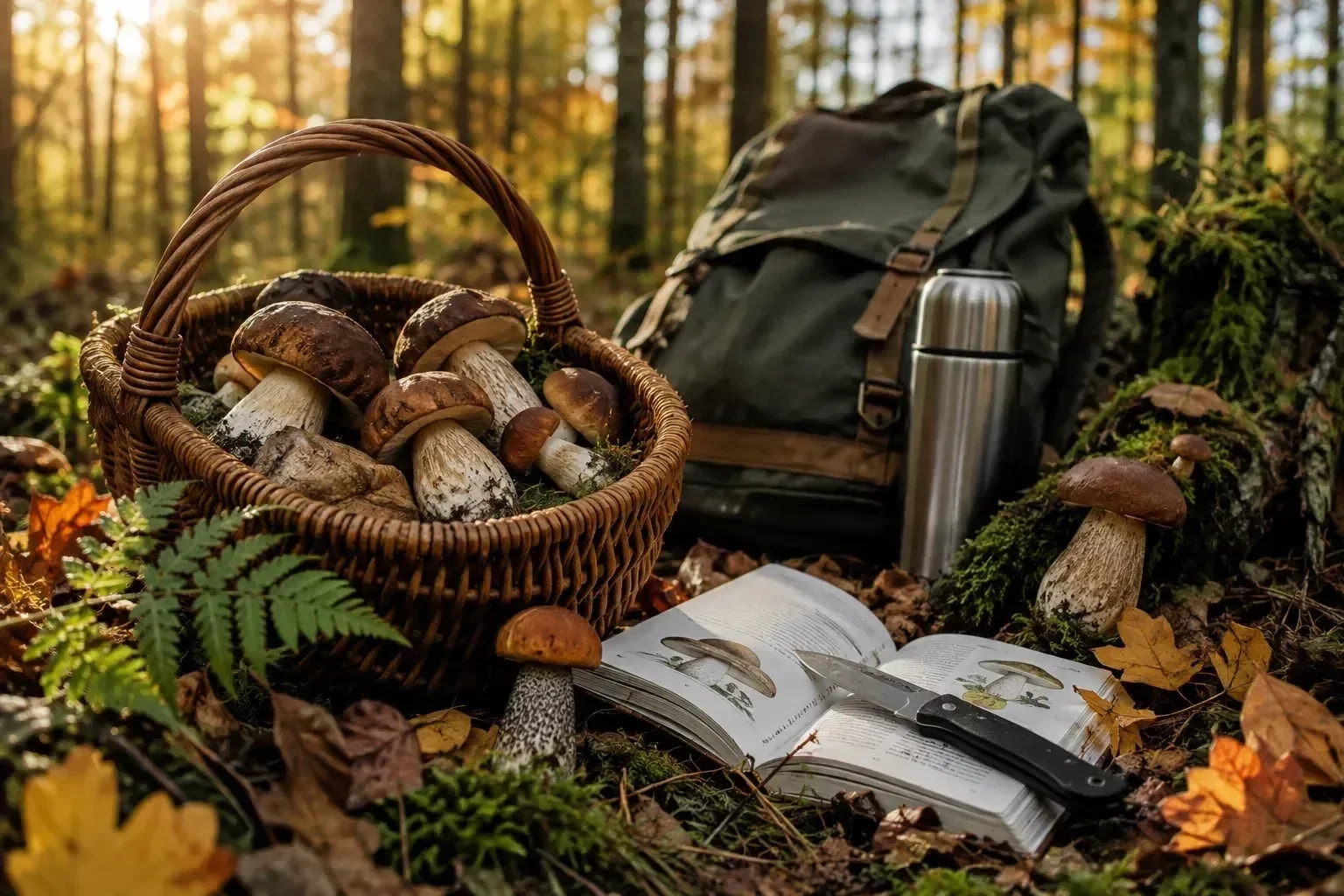
A basket or ventilated container if an expert-led group is collecting known species.
Contact information for the group leader and local emergency services.
Do not rely on a phone identification app as a food-safety tool.
Why Is It Better to Put Mushrooms in a Basket?
A rigid, ventilated basket protects specimens from being crushed and allows airflow. Plastic bags trap moisture and heat, which can accelerate deterioration and turn mixed mushrooms into a damaged mass that is harder to examine.
A basket is not a safety guarantee. It is simply a better transport container when known mushrooms are being collected in a permitted area.
Keep unknown specimens separate from anything intended as food, and do not mix mushrooms that have not been independently identified.
Cut or Twist the Mushroom
There is debate among foragers about cutting versus gently removing the whole fruiting body. For ecological impact, the bigger issue is avoiding unnecessary disturbance of the surrounding soil and litter.
From an identification perspective, removing the complete specimen can matter because structures near the base may be important to an expert. That is another reason beginners should not trim away features and then rely on a partial photo.
If you are participating in an expert-led educational outing, follow the guide's method and the rules of the site.
Why Not Collect Everything You Find
Collecting every mushroom is poor practice for safety and conservation. It increases the chance of mixing unknown species into the same container and removes organisms you do not need.
A better principle is minimal collection:
Leave unidentified mushrooms in place.
Leave rare or protected species untouched.
Leave old, damaged, or waterlogged specimens.
Take only the amount an experienced adult group can identify, process, and use promptly.
Photography is often the better choice when the goal is learning rather than eating.
Can You Take Very Young Mushrooms?
Very young mushrooms can be harder to identify because key features may not yet be developed. That makes them a poor choice for beginners.
Do not assume that a small, clean-looking mushroom is safer than an older one. Age does not remove the risk of misidentification.
For learning, observe and photograph rather than treating immature specimens as food.
Can You Taste a Mushroom in the Forest?
No. Never use taste as a general test of edibility. A small bite is not a reliable identification method, and some toxic mushrooms may not taste obviously unpleasant.
Do not eat raw wild mushrooms as an experiment. "It tastes normal" is not evidence that a mushroom is safe.
Can an Edible Mushroom Cause Poisoning
Yes. Even correctly identified edible mushrooms can cause illness if they are old, contaminated, stored badly, undercooked when cooking is required, or poorly tolerated by an individual.
Wild mushrooms can also accumulate contaminants from the environment. That is why collection beside roads, industrial areas, dumps, and other polluted places is a bad idea.
When several people eat the same dish and symptoms begin, everyone who ate it should take the situation seriously rather than waiting to see whether symptoms pass.
What to Do With Mushrooms Immediately After Returning From the Forest
If the mushrooms were collected during an expert-led outing and are intended for food, do not leave them sitting warm for hours. Keep species separated, discard anything uncertain, and follow reliable food-safety guidance for the specific confirmed species.
Do not process an unknown mixed basket as if cooking will solve identification mistakes. It will not.
If any specimen is uncertain, the safe decision is not to eat it.
Does Boiling Neutralize a Poisonous Mushroom?
No general cooking method can be trusted to make a poisonous mushroom safe. Boiling, frying, drying, freezing, salting, or changing the water does not provide a universal detoxification method.
This is one of the most dangerous myths in wild-mushroom cooking. Correct identification has to come before preparation.
If a mushroom may be toxic, do not experiment with cooking methods.
To Whom Wild Mushrooms Are Not Recommended
Wild mushrooms are a difficult food from a safety perspective, and the safest public-health advice is to be conservative. Children should not be given wild mushrooms based on informal identification, and people with digestive or health vulnerabilities should follow medical guidance.
For families, commercially cultivated mushrooms from regulated production are the much safer option. No online guide can account for every toxic lookalike, local restriction, contamination source, or individual health factor, so a general article should never be treated as clearance to eat a wild specimen.
Why You Shouldn't Buy Wild Mushrooms "From Hand"
Buying unidentified wild mushrooms from an informal roadside or street seller transfers the identification risk to a stranger whose expertise you cannot verify. You may also have no reliable information about the collection location, storage conditions, or whether different species were mixed.
If you want mushrooms for cooking, commercially cultivated products from normal retail channels are the lower-risk choice.
Is It Possible to Photograph an Unfamiliar Mushroom?
Yes. Photographing is often the best option when the goal is learning. Take pictures without disturbing the habitat unnecessarily.
For educational review, useful context can include the whole mushroom, underside, surrounding habitat, and what it was growing on. But even a detailed photo set should not be treated as permission to eat the specimen.
Use photographs for learning, documentation, and expert discussion—not as a substitute for verified identification.
How Not to Get Lost While Picking Mushrooms
The safest approach is to avoid wandering alone in unfamiliar forest. Go with an organized group, tell someone where you are going, stay on permitted routes, and set a return time before entering.
Keep navigation conservative:
Start in daylight.
Stay within the planned area.
Keep the group together.
Maintain phone battery.
Do not chase "one more mushroom" away from the route.
Turn back before light or weather deteriorates.
In Ukraine, never improvise a shortcut across terrain with uncertain mine status.
What to Do if You Get Lost in the Forest
If you realize you are lost, stop making random direction changes. Contact emergency services if needed, share your location from a safe place if the phone has coverage, and follow the instructions you receive.
Do not enter marshes, steep terrain, restricted zones, or unverified areas in an attempt to find a faster way out. Conserving battery and staying in a safe visible location can be more useful than continuing to wander.
If you are part of a group, do not split up to search in different directions.
What Clothes to Choose for Mushroom Hunting
For an organized outing in a safe, legal area, choose clothing for weather, ticks, scratches, and visibility rather than fashion.
Use closed sturdy footwear, long trousers, a weather layer, and clothing that makes you visible to the group. After returning, check clothing and skin for ticks according to local health guidance.
Avoid camouflage-like clothing that makes it harder for companions to see you in dense vegetation.
Do You Need to Take Children for Mushrooms?
For children and teens, the safest version is an educational walk with responsible adults in a verified safe area, focused on observing nature rather than collecting food. Wild-mushroom identification should not be treated as a game or challenge.
Do not let a child taste, handle-and-eat, or independently collect unknown mushrooms. Commercially cultivated mushrooms are a safer food choice.
In regions with mine risk, forest access must follow official restrictions without exception.
How to Collect Mushrooms Without Harming the Forest
Low-impact behavior matters even when collection is legal:
Take only what you genuinely need and can use.
Do not rake or dig through large areas of forest floor.
Leave unknown and protected species alone.
Do not damage nearby plants.
Carry out all litter.
Do not light fires where prohibited.
Stay on permitted routes in sensitive areas.
A forest is an ecosystem, not a storage shelf. Learning to leave things untouched is part of responsible foraging.
Mushroom Season as an Autumn Vacation in the Carpathians
The Carpathians are associated with mushroom traditions, but tourism should not be built around the assumption that every forest is open for unrestricted collecting. Rules can vary by national park, reserve, local forestry area, and private land.
A safer approach is to choose accommodation or a licensed local guide who can explain where visitors may legally walk and what local restrictions apply. You can enjoy an autumn trip through hiking, photography, markets, local cuisine, and guided nature activities without making wild mushroom consumption the central goal.
What to Do if You Suspect Mushroom Poisoning
Mushroom poisoning can be life-threatening. In Ukraine, if symptoms appear after eating wild mushrooms, seek emergency medical help immediately and call 103 or 112. Do not wait for symptoms to "pass."
Possible signs include nausea, vomiting, abdominal pain, diarrhea, dizziness, altered consciousness, visual disturbances, breathing difficulty, or seizures. Symptoms can begin quickly or be delayed.
Follow the emergency dispatcher's instructions. Do not use alcohol as a remedy. If possible, keep leftovers of the mushrooms or the prepared dish for medical evaluation, but do not delay calling for help in order to collect samples.
This is a medical emergency, not a situation for home experimentation.
15 Rules for a Safe Mushroom Season
Treat unknown mushrooms as unsafe to eat.
Never use a photo or app as proof of edibility.
Learn in person from a qualified local expert.
Check official forest-access and mine-safety information before any outing in Ukraine.
Do not enter restricted, mined, or formerly occupied areas unless officially reopened for public access.
Check the rules of national parks and protected areas before collecting anything.
Do not collect beside roads, industrial sites, dumps, or visibly polluted land.
Do not taste raw wild mushrooms as an identification method.
Do not assume boiling or frying makes a poisonous mushroom safe.
Keep unknown specimens away from mushrooms intended for food.
Avoid informal roadside purchases of wild mushrooms.
Use a charged phone and tell someone your route and return time.
Go with a responsible group rather than wandering alone in unfamiliar forest.
If poisoning is suspected, call emergency medical services immediately.
When uncertain, leave the mushroom in the forest.
FAQ
What Mushrooms Are Considered Edible?
Edible mushrooms are species recognized as suitable for food when correctly identified and properly handled. That label does not remove risks from misidentification, contamination, spoilage, or individual intolerance.
What Edible Mushrooms Are Most Often Collected in Ukraine?
Traditional collections often include porcini, chanterelles, boletes, parasols, and some honey-fungus species. This list should not be used to identify food in the forest; several groups include confusing or unsafe lookalikes.
How to Understand Whether a Mushroom Is Edible or Not?
There is no universal visual trick. Reliable identification is species-specific and should be learned with a qualified expert. If you cannot establish the identity confidently, do not eat the mushroom.
Can You Identify an Edible Mushroom From a Photo?
A photo can support expert discussion but is not reliable enough to guarantee edibility. Important characteristics may be hidden or missing.
Can I Use an App to Identify Mushrooms?
An app can be educational, but it should not be used as a food-safety decision tool. Image-recognition errors are possible, and a wrong result can have serious consequences.
When Does the Mushroom Season Start in Ukraine?
There is no single date. Fruiting varies by region, species, rainfall, altitude, and temperature. Autumn is a common active period, but access and safety restrictions matter more than the calendar.
How Many Days After Rain Do Mushrooms Grow?
There is no reliable fixed number. Weather, soil moisture, species, and temperature all affect fruiting. A timing rule does not help determine whether a mushroom is edible.
Where Can You Not Collect Mushrooms?
Do not collect in restricted or mined areas, protected zones where gathering is prohibited, polluted locations, private property without permission, or places closed by authorities.
Is It Possible to Collect Mushrooms in the Carpathians?
Possibly, depending on the specific land and protected-area rules. Check the local park or forestry regulations and use a knowledgeable local guide rather than assuming all forest is open for collection.
Is It Possible to Collect Mushrooms From the Red Book?
Protected species are subject to special legal protection and should not be collected recreationally. Leave rare or protected mushrooms untouched.
Best of the week — in your inbox
No spam. Only top Gosta stories. Unsubscribe in one click.
Comments