
GLM-5.4 Is Here: What Z.ai Has Confirmed and How to Evaluate It
GLM-5.4 is Z.ai's newly announced model, with an emphasis on coding and a looped architecture.


GLM-5.4 is Z.ai's newly announced model, with an emphasis on coding and a looped architecture. The important distinction for a reader considering it today is between what the developer has announced, what is accessible now, and what is still planned. Those are three different lists.
Before moving a project or paying for access to GLM-5.4, identify the task you want to improve. Faster code generation, better visual understanding, fewer corrections, and lower total cost are separate goals. A launch demonstration can suggest an interesting use, but your own work needs a more specific evaluation.
What has Z.ai confirmed about GLM-5.4?
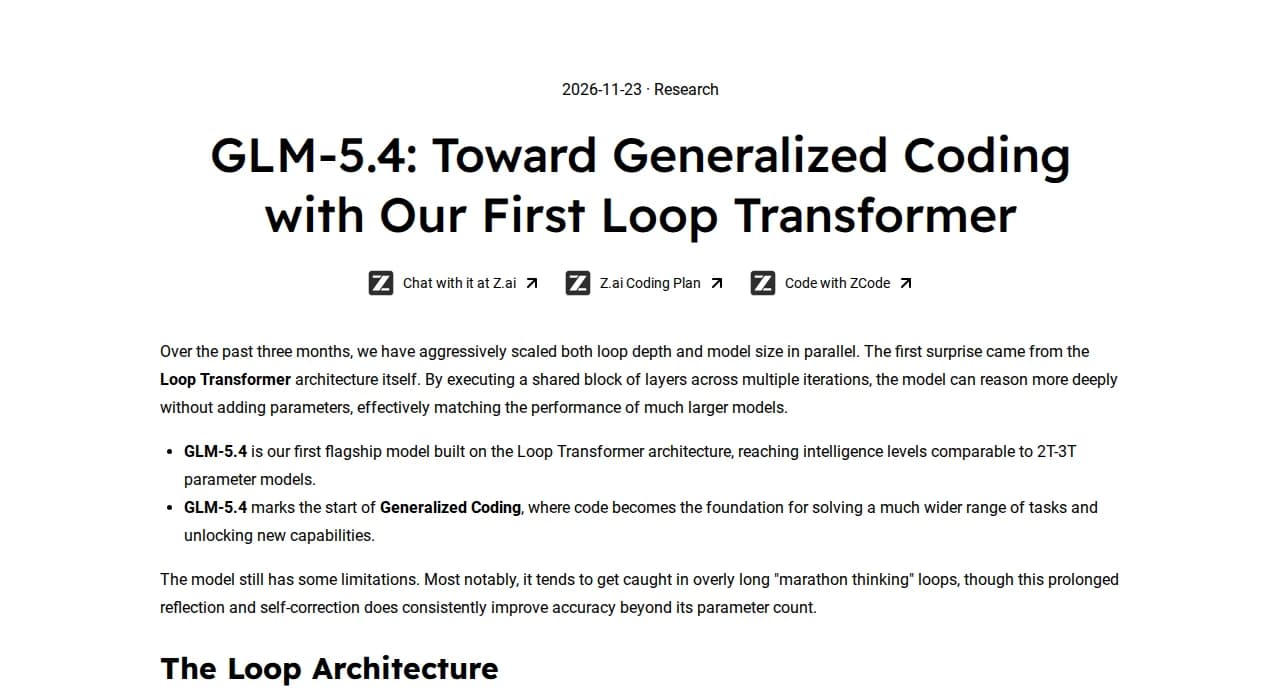
Z.ai's official GLM-5.4 announcement, published on November 23, 2026, describes its first Loop Transformer and positions the model around generalized coding. The developer presents examples extending beyond conventional software, including video, games, engineering-related modeling, and interactive 3D work.
Those are developer-presented capabilities, not results from a Gosta hands-on test. GLM-5.4 should be evaluated against a task and a success condition rather than treated as automatically better for every type of work.
The GLM-5.4 announcement lists the GLM Coding Plan, ZCode, and Z.ai Chat as ways to try the model. It labels the model API as coming soon and says open weights are planned after further safety hardening. Do not turn those future plans into a claim that GLM-5.4 already has a generally available API or published open weights.
Where can you access GLM-5.4?
Access to GLM-5.4 depends on the product you use and the availability stated by the developer. Start with the official links in the announcement, then check the account, plan, and region requirements that apply to you.
GLM-5.4 route | What to check before using it |
|---|---|
GLM-5.4 chat interface | Model availability, account requirements, and the features exposed in chat |
GLM-5.4 coding product | Tool integration, permissions, usage limits, and your current plan |
GLM-5.4 model API | The announcement describes this as coming soon; confirm a later official release before planning around it |
Open weights | The announcement states an intention, not a completed public release |
A GLM-5.4 comparison should name the route tested. A result from a coding tool can include the effects of that tool's context handling and permissions; it is not necessarily interchangeable with a future API call.
What does the GLM-5.4 architecture claim mean for a user?
The GLM-5.4 architecture claim gives technical context, but a user still needs to judge the outcome of a task. An internal design choice does not tell you on its own how many corrections your work will need, how long it will take, or what the complete process will cost.
For a practical GLM-5.4 trial, translate the claim into a question you can observe. Can it handle a longer chain of changes without forgetting a requirement? Does it recover when a test fails? Does it distinguish the current code from an assumption about how the code ought to work?
These questions are useful because they concern behavior you can inspect. Avoid giving an architecture label more weight than evidence from the work you actually need to complete.
How to run a fair GLM-5.4 coding comparison
A fair GLM-5.4 comparison uses the same starting files, task, constraints, and success checks for each candidate. Save a baseline first so every run begins from the same state, and keep unrelated edits out of the comparison.
Choose a GLM-5.4 task with a meaningful outcome: fix a reproducible bug, add a small feature with clear acceptance criteria, or explain an unfamiliar module and verify the explanation. For GLM-5.4, the point is not to create a spectacular prompt but to learn how it behaves under realistic conditions.
Write down the expected GLM-5.4 behavior before starting.
Give the same relevant context to each run.
Record time, interventions, and unresolved problems.
Run checks that assess the behavior, not just whether a file exists.
Review the change for unnecessary edits and unsupported assumptions.
One GLM-5.4 run is a useful observation, not a universal benchmark. Repeat a small number of representative tasks if the decision matters, and distinguish a lucky first result from consistent behavior.
What should you check in GLM-5.4 visual or 3D work?
Check GLM-5.4 visual or 3D work against the requirements of the actual deliverable. A demo that looks appealing can still have incorrect dimensions, missing interactions, inaccessible controls, or an output format that does not fit your workflow.
For a game, test input, progression, failure states, and the devices you plan to support. For a visual artifact, inspect text, geometry, and exported output. For engineering-related work, a convincing render does not establish that a model is safe, accurate, or ready for real-world use.
Keep the role of GLM-5.4 clear: it can be part of a production process without replacing the checks that process requires. A good evaluation records where human review remains necessary rather than treating every intervention as an embarrassment to hide.
How to compare the real cost of GLM-5.4
The real cost of GLM-5.4 includes the access arrangement and the time required to get a usable result. Check current official plan details instead of copying a price from an older article or assuming that a future API will use the same terms as a current coding subscription.
Include GLM-5.4 retries, review time, integration work, and any restrictions that affect your normal task. A lower headline charge can be less attractive if it requires substantial rework; a more capable route can still be poor value for a simple job that does not need it.
For GLM-5.4, keep the comparison specific: the task, the access product, the result, and the total effort. That is more useful than declaring one model cheapest without saying what the user is trying to accomplish.
GLM-5.4 questions
Is GLM-5.4 open-source today?
The GLM-5.4 launch announcement says weights are planned after additional safety hardening. A future intention is not the same as weights already being published.
Can I plan an integration around the GLM-5.4 API?
The announcement labels the GLM-5.4 API as coming soon. Confirm current official documentation and availability before committing an integration to it.
Has Gosta independently benchmarked GLM-5.4?
No. This article separates the developer's announcement from a practical evaluation method. It does not present vendor demonstrations as our own test results. Keep the original task, starting files and resulting changes together so another person can review the same evidence and understand where the tool needed help rather than guessing.
Best of the week — in your inbox
No spam. Only top Gosta stories. Unsubscribe in one click.
Comments