
The Giant Shark Beside the Submersible: The Story Behind OceanX Sixgill Footage
The OceanX footage of a large shark beside a submersible is striking because it shows an animal most people will never encounter directly.

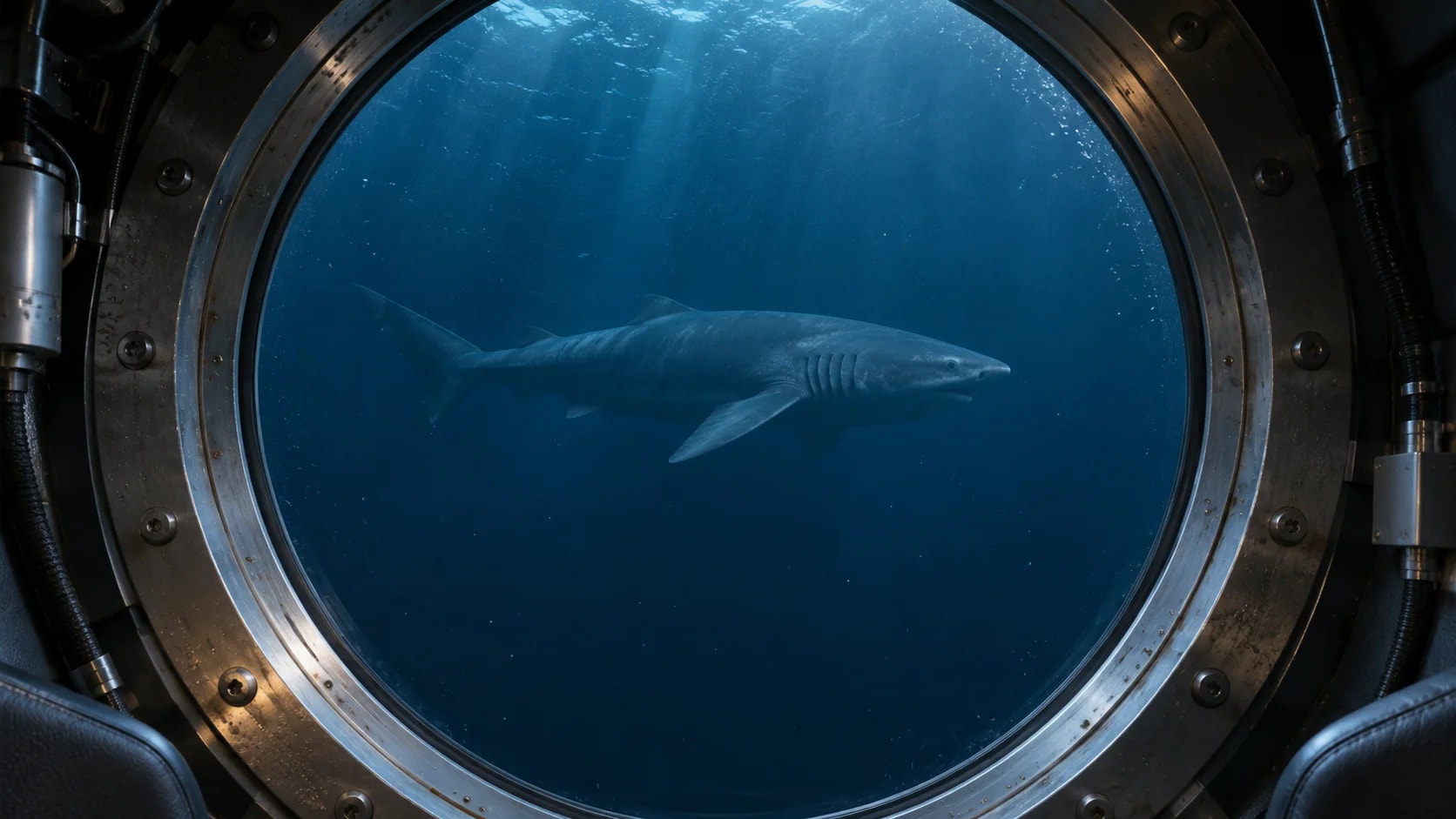
The OceanX footage of a large shark beside a submersible is striking because it shows an animal most people will never encounter directly. The useful story begins with the original context: a research expedition in the Bahamas and a bluntnose sixgill shark, rather than a newly discovered prehistoric monster.
The OceanX video is older footage that has attracted renewed search interest. Its original release dates to 2019. Keeping that date visible does not make the images less interesting; it helps separate the research encounter from the new wave of attention around it.
What does the OceanX shark video show?
The OceanX video shows a bluntnose sixgill shark close to a research submersible during work in the Bahamas. The organization's original upload, Massive Deep-Sea Shark Checking Out Our Submarine, provides the starting point for identifying the footage and its context.
Use the original OceanX description and video rather than a repost that adds a more dramatic title. A close view of a large animal can be fascinating without proving that it attacked a vehicle, threatened a crew, or had never been seen before.
When discussing the OceanX encounter, distinguish what is visible from what would require additional evidence. Position, movement, and proximity can be observed in the footage; an animal's motive cannot be read directly from a few seconds of video.
Which shark appears in the OceanX video?
The shark in the OceanX footage is a bluntnose sixgill, a large deepwater species with the scientific name Hexanchus griseus. The Florida Museum's species profile describes its broad head, large eyes, and single dorsal fin set far back on the body.
Those features are more useful for understanding the OceanX animal than a sensational nickname. The common name refers to the six gill openings on each side, a distinctive feature that differs from the five commonly associated with many familiar sharks.
A species can have an ancient evolutionary lineage while still being a living animal with its own ecology. Avoid interpreting the OceanX clip as evidence of a dinosaur surviving unchanged or a creature outside normal scientific classification.
Why does the OceanX shark look so large?
The OceanX shark looks large because it is a large animal filmed near a submersible, but a precise length estimate needs more than an eye-catching angle. Camera position, distance, perspective, and the visibility of a reliable scale all affect what a viewer can infer.
The Florida Museum describes the species as a substantial deepwater shark, with an average length around 15 to 16 feet. That general species information should not be quietly substituted for a confirmed measurement of the particular OceanX animal in every repost.
If an OceanX repost gives an exact length, ask where the measurement came from. A number repeated in captions can become familiar without becoming better supported. OceanX footage is a good example of why a clear image and a precise measurement are different kinds of evidence.
OceanX video detail | Reasonable conclusion | What needs more evidence |
|---|---|---|
A large shark close to a submersible | The encounter offers an unusual close view | An exact size from perspective alone |
The species identification | It can be checked against the original description and biology references | A claim of a new species |
Renewed online attention | The footage is circulating again | A claim that it was filmed this week |
Movement near the vehicle | The animal's visible behavior can be described | A confident statement about motive |
Why use a submersible for OceanX research?
A submersible can give OceanX researchers access to an underwater environment and a sustained view that is difficult to obtain from the surface. The research question determines which observations and tools are useful, so the vehicle should be understood as part of the scientific method rather than merely a dramatic camera platform.
For a viewer, the important question is what the original OceanX account says the team was studying. Identifying the mission's purpose helps explain why the researchers were there and prevents a short encounter from being turned into a completely different expedition story.
Video can support observation, but research may also depend on measurements, identification methods, records, or other information that a short clip does not show. Enjoy the OceanX images while leaving room for the less visible work that makes an observation scientifically useful.
How to check whether an OceanX clip is new
Check whether an OceanX clip is new by tracing it to the original publication, not by looking only at the upload time of the latest account that shared it. A repost today can contain footage recorded years earlier.
Search the distinctive wording of the OceanX caption.
Find the original OceanX upload or project page.
Compare the visible sequence with the repost.
Read the original OceanX publication date and description.
Separate the filming date from later reporting or commentary.
That routine also helps with edited OceanX clips. A shorter version may remove the context that explains the mission, location, or species. If the dramatic claim appears only in a repost's caption, keep it separate from what the original source establishes.
What can the OceanX encounter teach a curious viewer?
The OceanX encounter can introduce a viewer to deep-sea research, shark anatomy, and the difference between observation and interpretation. It is a strong starting point for questions rather than a reason to stop at a frightening headline.
Try watching the OceanX sequence twice. First, notice what you can actually see: the animal, the vehicle, movement, lighting, and scale cues. Then read the original description and a species reference. The second viewing often becomes more interesting because you have better questions.
For children watching OceanX, keep the language curious and factual. You can discuss how researchers observe animals and why the deep sea is difficult to study without presenting the encounter as a monster story. The animal does not need an invented personality to hold attention.
OceanX questions
Was the OceanX sixgill video filmed in 2026?
The original OceanX video dates to 2019. Renewed interest does not make it a new filming event.
Did OceanX discover a new species in this clip?
The OceanX footage is identified as a bluntnose sixgill shark, an already described species. Do not infer a discovery from a dramatic repost.
Can the OceanX video prove the shark's exact length?
A precise measurement of the OceanX shark needs a reliable method and scale. Camera perspective alone is not enough. Ask whether a claimed measurement comes from the research team or simply from another caption.
Best of the week — in your inbox
No spam. Only top Gosta stories. Unsubscribe in one click.
Comments