
How to Remove Suckers From Tomato Plants: When and Which Ones to Pinch Off
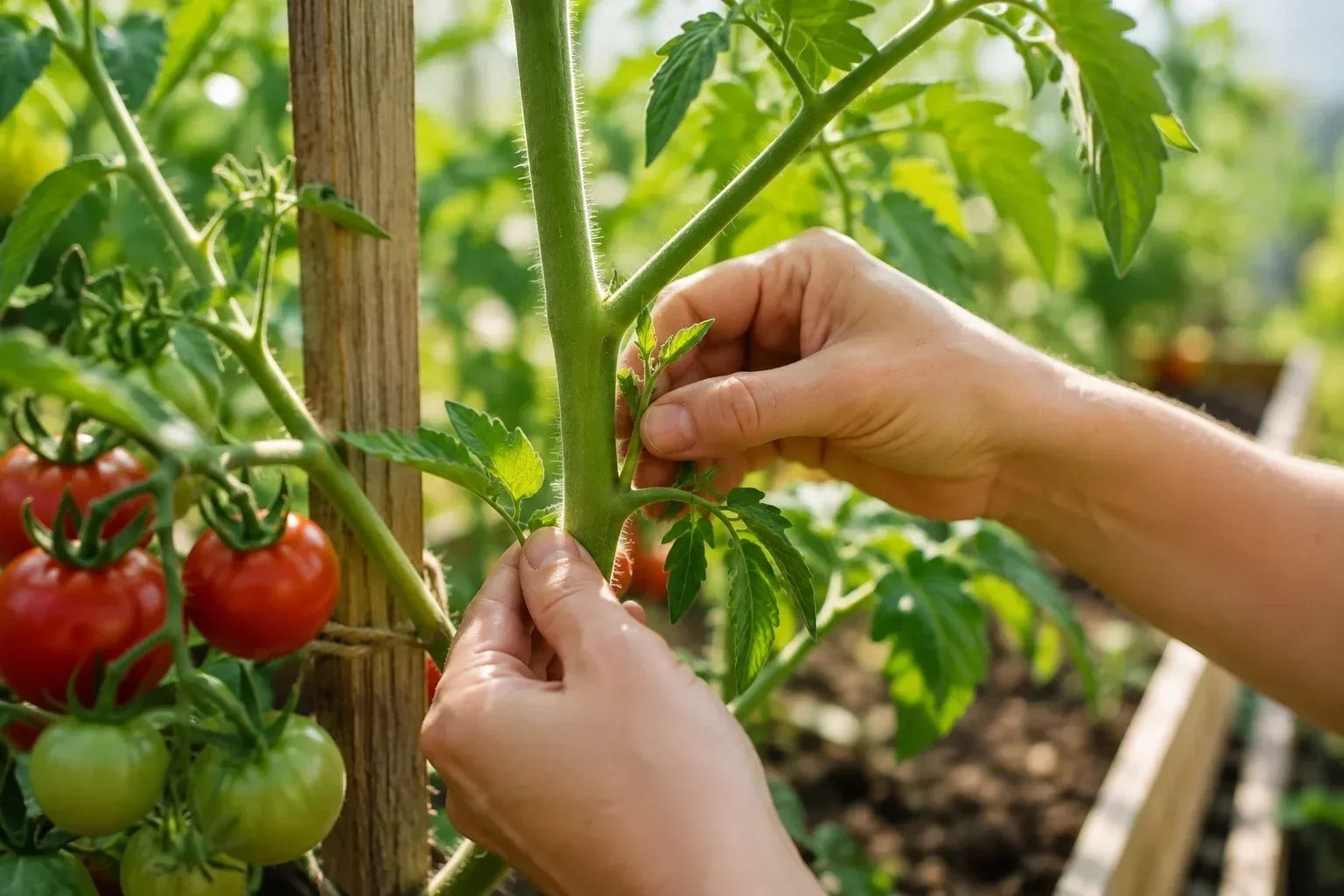
Removing suckers from tomato plants is useful mainly for indeterminate tomatoes that keep growing and producing new stems all season. A sucker is the side shoot that appears in the angle between a main stem and a leaf. If every sucker is allowed to grow, a staked tomato can become a dense thicket. Selective pruning improves access, airflow, and control, but removing every side shoot from every tomato is not automatically better. Determinate and compact varieties often need much less pruning.

Contents11
- Removing Suckers From Tomato Plants: What Are Tomato Suckers?
- When to Prune Tomato Suckers
- How to Remove Tomato Suckers Step by Step
- What Tomatoes Need Sucker Pruning
- How to Grow Tall Tomatoes
- Is It Necessary to Prune Low-Growing Tomatoes?
- Why Prune Tomato Suckers at All
- Do You Need to Remove the Lower Leaves of Tomatoes?
- What Not to Do During Sucker Removal
- How to Prune Tomato Suckers Correctly: Briefly
- FAQ
Removing suckers from tomato plants is useful mainly for indeterminate tomatoes that keep growing and producing new stems all season. A sucker is the side shoot that appears in the angle between a main stem and a leaf. If every sucker is allowed to grow, a staked tomato can become a dense thicket. Selective pruning improves access, airflow, and control, but removing every side shoot from every tomato is not automatically better. Determinate and compact varieties often need much less pruning.
The safest routine is to remove small unwanted suckers on a dry morning and avoid stripping the plant aggressively in one session.
Removing Suckers From Tomato Plants: What Are Tomato Suckers?
A tomato sucker grows from the leaf axil—the V-shaped point where a leaf branch meets the main stem. It begins as a small leafy shoot and can eventually become a full stem with its own leaves, flowers, and fruit.
Do not confuse a sucker with a flower cluster. Flower clusters emerge differently and carry buds or blossoms. If you are unsure, wait a few days until the structure is obvious rather than pinching blindly.
When to Prune Tomato Suckers
Start checking once plants are established and actively growing. Small suckers around 3–8 cm (1–3 in) are easy to remove with fingers and leave a small wound.
Inspect once or twice a week during vigorous summer growth. Choose dry weather so the wound can dry quickly. Avoid major pruning immediately before prolonged rain or when plants are stressed by heat or drought.
How to Remove Tomato Suckers Step by Step
Identify the main stem and each leaf branch.
Look in the angle between them for a new leafy shoot.
Decide whether you need that shoot as a second trained stem or want it removed.
For a small sucker, pinch near its base with clean fingers.
For a thicker shoot, use clean, sharp pruners instead of tearing the stem.
Do not cut into the main stem.
Remove only a manageable amount of foliage in one session.
Tie the retained stems to their support as they grow.
Wash or disinfect tools between plants if disease is a concern.
What Tomatoes Need Sucker Pruning
Indeterminate tomatoes benefit most when grown vertically on stakes, strings, or a narrow trellis. They keep producing new growth until cold weather stops them, so pruning helps control the plant.
Determinate tomatoes grow to a more fixed size and set much of their crop over a shorter period. Heavy sucker removal can reduce leaf area and potential fruiting stems, so prune them lightly—mainly damaged, diseased, or soil-touching foliage unless the cultivar guidance says otherwise.
How to Grow Tall Tomatoes
Install a strong stake, string system, or trellis early.
Choose one main stem, or one main stem plus a strong secondary stem if you have enough space.
Remove competing suckers regularly while they are small.
Tie stems loosely so ties do not cut into growth.
Keep some healthy foliage to shade fruit from intense sun.
Remove diseased leaves promptly.
As the plant grows, continue guiding the retained stems upward.
The objective is not a bare stem. You still need leaves to photosynthesize and protect fruit.
Is It Necessary to Prune Low-Growing Tomatoes?
Usually not heavily. Determinate, patio, and dwarf varieties are bred for compact growth. Removing many suckers can remove flowering sites and reduce the plant's productive canopy.
You can still remove leaves that touch the soil, damaged growth, or crowded shoots that block airflow, but do not apply an indeterminate single-stem system automatically.
Why Prune Tomato Suckers at All
Selective pruning can:
make staking easier;
improve airflow through dense plants;
make fruit easier to see and harvest;
help leaves dry faster after rain;
direct a vertically trained plant into one or two main stems;
reduce tangled growth in a small greenhouse or narrow bed.
It does not guarantee a larger total harvest. An unpruned plant may produce more fruit overall, while a pruned plant can produce fewer but sometimes larger or earlier fruit depending on conditions.
Do You Need to Remove the Lower Leaves of Tomatoes?
Remove lower leaves that touch the soil, are yellowing, or show disease. As the plant grows, creating a small clear zone near the soil can reduce splash from wet ground onto foliage.
Do not strip healthy leaves far up the plant. Leaves feed fruit and provide shade. In very hot, sunny weather, excessive defoliation can increase sunscald.
What Not to Do During Sucker Removal
Avoid these mistakes:
do not prune wet plants if you can wait for dry conditions;
do not tear large woody suckers by force;
do not remove flower clusters by mistake;
do not strip every leaf below each fruit cluster at once;
do not heavily prune determinate tomatoes by default;
do not use dirty blades across diseased plants;
do not remove so much foliage that fruit is suddenly exposed to intense sun.
Moderate, repeated pruning is safer than one severe cleanup.
How to Prune Tomato Suckers Correctly: Briefly
Identify whether the variety is indeterminate or determinate.
Check leaf axils once or twice a week.
Remove small unwanted suckers early.
Keep one or two stems if you are training vertically.
Use clean pruners for large shoots.
Work in dry weather.
Leave enough healthy foliage to support and shade the crop.
If a sucker has already grown large and is carrying flowers, removing it becomes a real tradeoff rather than routine cleanup. On a vigorous indeterminate plant with good support and enough space, you may decide to keep that stem and train it separately. If the plant is overcrowded, remove it with clean pruners on a dry day rather than ripping a thick shoot from the main stem. The best pruning system is the one you can maintain consistently through the season.
FAQ
What Is a Sucker on a Tomato Plant?
It is a side shoot that grows from the angle between a leaf branch and the main stem.
When Should You Start Removing Tomato Suckers?
Once the plant is established and producing obvious side shoots, usually during active early-summer growth.
How Often Do You Need to Check Tomatoes?
About once or twice a week during fast growth is usually enough.
Which Suckers Need to Be Removed?
On vertically trained indeterminate tomatoes, remove the shoots you do not plan to keep as main stems.
Is It Necessary to Prune Determinate Tomatoes?
Not heavily. Remove damaged, diseased, or soil-touching growth rather than stripping productive side shoots.
Do You Need to Prune Cherry Tomatoes?
It depends on the growth habit. Indeterminate cherry tomatoes can be pruned and trained; determinate cherry varieties need less pruning.
Is It Better to Tear Off Suckers or Cut Them Off?
Pinch small tender suckers with fingers. Cut larger shoots cleanly with sanitized pruners.
Is It Possible to Prune Tomatoes After Rain?
It is better to wait until foliage is dry if possible because dry wounds and leaves reduce disease risk.
What Happens If Tall Tomatoes Are Not Pruned?
They can still fruit, but staked indeterminate plants may become very dense, tangled, and harder to manage.
Does Sucker Removal Always Increase Yield?
No. It changes plant structure and can improve management, airflow, or fruit size, but total yield does not automatically increase.
Best of the week — in your inbox
No spam. Only top Gosta stories. Unsubscribe in one click.
Comments