
When to Plant Daffodils in Fall: Timing, Depth, and Best Location
Knowing when to plant daffodils matters more than choosing an exact calendar date. In Ukraine, the best window is usually early to mid-autumn, after summer heat has faded but while the soil is still workable enough for bulbs to form roots before winter. In many regions that means September into October. Farther south, planting can shift later; in colder northern and northeastern areas, it is safer to finish earlier. Soil temperature, drainage, and the forecast are better guides than a single nat

Contents14
- When to Plant Daffodils in Autumn in Ukraine
- At What Soil Temperature to Plant Daffodils
- Why Is It Better to Plant Daffodils Before Tulips?
- Where Is Better to Plant Daffodils
- What Soil Is Needed for Daffodils
- How to Choose Daffodil Bulbs for Planting
- How Deep to Plant Daffodils in Autumn
- How to Plant Daffodils in Autumn
- At What Distance to Plant Daffodils
- Do You Need to Water Daffodils After Planting?
- Do You Need to Cover Daffodils for the Winter?
- Can You Plant Daffodils in October?
- Can You Plant Daffodils in November?
- Can Daffodils Be Planted in the Spring?
Knowing when to plant daffodils matters more than choosing an exact calendar date. In Ukraine, the best window is usually early to mid-autumn, after summer heat has faded but while the soil is still workable enough for bulbs to form roots before winter. In many regions that means September into October. Farther south, planting can shift later; in colder northern and northeastern areas, it is safer to finish earlier. Soil temperature, drainage, and the forecast are better guides than a single nationwide date.
Daffodils are hardy, but they dislike two things at planting time: warm soil that encourages premature growth and waterlogged soil that can rot the bulbs.
When to Plant Daffodils in Autumn in Ukraine
For most Ukrainian gardens, aim for September through the first half of October. In cooler areas, late August to September can be appropriate if the soil has cooled. In the south, October planting is often practical because the ground stays warm longer.
The goal is to give the bulb several weeks to establish roots before the ground freezes hard. If autumn stays unusually warm, waiting a little is usually better than planting into hot, dry soil. If an early cold snap is forecast, plant sooner rather than leaving healthy bulbs in storage until winter.
Treat regional dates as a range, not a rule. A garden in Zakarpattia, Odesa, Kyiv, Chernihiv, or Kharkiv can reach the right soil conditions at different times.
At What Soil Temperature to Plant Daffodils
A useful practical target is soil that has cooled to roughly 8–12°C (46–54°F) at bulb depth and is no longer heating strongly during the day. You do not need laboratory precision. If nights are consistently cool, summer heat has left the upper soil, and the forecast does not show a return to prolonged heat, planting can begin.
Very warm soil can encourage top growth before winter. Extremely cold or frozen soil prevents normal rooting and makes planting physically difficult.
Why Is It Better to Plant Daffodils Before Tulips?
Daffodils generally benefit from earlier autumn planting so their roots have time to establish. Tulips are often planted later, once the soil is cooler, partly because cooler conditions can reduce disease pressure and premature growth.
If you are planting both, do not wait for the ideal tulip date and assume it is automatically ideal for daffodils. Finish daffodils first, then move to tulips as autumn progresses.
Where Is Better to Plant Daffodils
Choose a place with good drainage and at least several hours of light. Full sun is excellent, but many daffodils also perform well in light or dappled shade, especially under deciduous trees that leaf out after spring flowering.
Good locations include:
flower borders;
the front of shrub beds;
naturalized areas in grass;
around deciduous trees;
raised beds with free-draining soil;
large containers with drainage holes.
Avoid low spots where rain or snowmelt stands for days. Daffodils tolerate winter cold far better than prolonged waterlogging.
What Soil Is Needed for Daffodils
The ideal soil is fertile enough to support spring growth but, above all, well drained. Heavy clay can work if you improve the structure and avoid planting in a bowl that traps water. Very sandy soil may need compost to hold moisture and nutrients during spring growth.
Do not put fresh manure directly under bulbs. Mature compost incorporated through the bed is safer. If your soil stays wet in winter, raise the planting area or choose another location rather than trying to solve drainage with a handful of sand in each hole.
How to Choose Daffodil Bulbs for Planting
Choose firm bulbs that feel heavy for their size.
Reject bulbs with soft, wet, moldy, or badly damaged areas.
A little dry outer skin is normal; active rot is not.
Larger bulbs usually have more stored energy and often flower more strongly.
Buy named cultivars from a reliable seller if flower form, height, or bloom time matters.
Keep bulbs cool, dry, and ventilated until planting.
Plant promptly rather than storing them for months after purchase.
Do not worry about minor surface scuffs. The important question is whether the bulb itself is solid and healthy.
How Deep to Plant Daffodils in Autumn
A common garden rule is to plant bulbs at a depth of about two to three times the height of the bulb, measured from the soil surface to the base or sometimes to the top depending on the guide. For many standard daffodils, this results in roughly 10–15 cm (4–6 in) of soil above or around the bulb, though size and soil type matter.
RHS guidance commonly recommends deep planting for daffodils, with general bulb guidance around three times the bulb's height and some cultivar advice around one-and-a-half to two times their own depth. In loose sandy soil or grass, plant slightly deeper. In very heavy soil, avoid making a deep water-holding pocket.
Deep enough planting helps stabilize stems, protects bulbs from temperature swings, and reduces the risk of poor flowering caused by bulbs sitting too close to the surface.
How to Plant Daffodils in Autumn
Loosen the planting area rather than making a narrow hard-sided hole if the soil is compacted.
Mix mature compost into poor soil if needed.
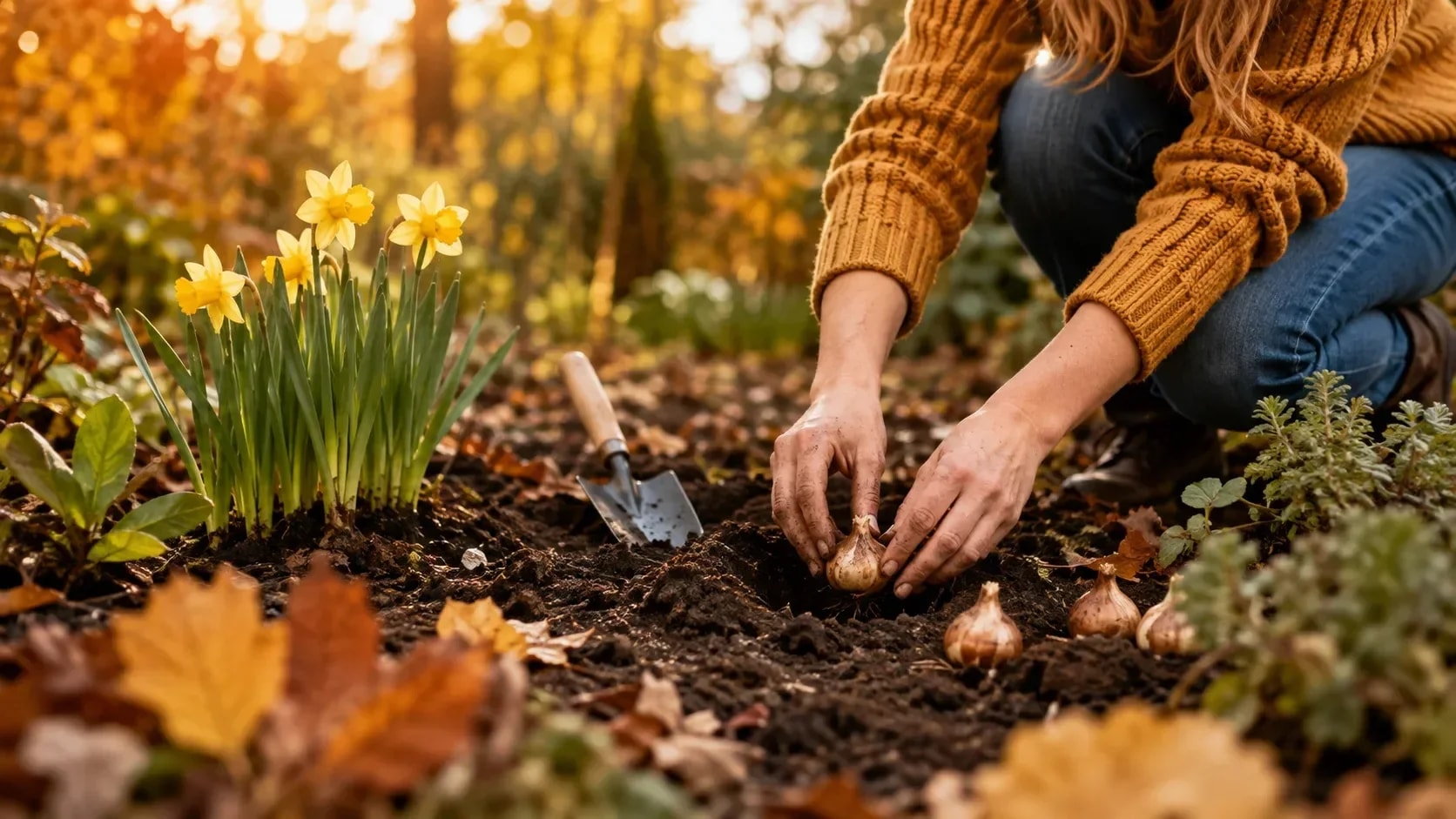
Place each bulb with the pointed end up and flat basal plate down.
Set the bulb at the appropriate depth for its size.
Leave enough space for offsets to develop.
Backfill gently without crushing the bulb.
Water once if the soil is dry so it settles around the bulb.
Mark the area if you are likely to forget where the bulbs are during winter.
For a natural look, scatter bulbs by hand and plant where they fall instead of arranging them in ruler-straight rows.
At What Distance to Plant Daffodils
For permanent garden planting, leave roughly 8–15 cm (3–6 in) between standard bulbs, depending on cultivar size and how quickly you want the planting to fill in. Miniature types can be closer; large naturalizing cultivars appreciate more room.
In containers, bulbs can be packed more tightly for a strong first-year display, but crowded pots need more attentive watering and feeding and may perform less well in later years.
Do You Need to Water Daffodils After Planting?
If the soil is already evenly moist from autumn rain, heavy watering is unnecessary. If it is dry, water once after planting to settle the soil and start root growth.
After that, autumn rainfall is often enough. The danger is not that daffodils must never be watered; it is leaving bulbs in saturated soil with no drainage. Containers need checking more often because they dry out faster but can also become waterlogged if saucers hold rainwater.
Do You Need to Cover Daffodils for the Winter?
Established daffodils are very cold-hardy and usually do not need a thick winter cover. A light mulch can help moderate soil temperature, reduce weed growth, and protect newly planted beds where winters fluctuate between thaw and freeze.
Do not bury the bed under a dense, wet layer that stays soggy. In containers, the bulbs experience more temperature fluctuation because the pot freezes from the sides, so move vulnerable containers to a sheltered place or insulate them in very cold regions.
Can You Plant Daffodils in October?
Yes. October is a normal planting month in many parts of Ukraine, especially during a mild autumn. If the soil is cool, not frozen, and drains well, planting can still be successful.
In a colder region, early October is safer than waiting until the end of the month. In the south, later October may still provide plenty of rooting time.
Can You Plant Daffodils in November?
Sometimes. If the ground is unfrozen and workable, planting healthy bulbs in November is usually better than keeping them indoors until spring and letting them dry out.
The disadvantage is reduced rooting time before winter. Plant promptly, use good drainage, and avoid a frozen or waterlogged bed. Late planting may lead to slightly delayed or weaker first-year flowering, but bulbs can still establish.
Can Daffodils Be Planted in the Spring?
Spring is not the preferred time for ordinary dry daffodil bulbs because they normally need a cold period and autumn rooting cycle. If unplanted bulbs survive until spring, you can plant them as soon as the soil is workable, but flowering that year may be poor or absent.
Potted daffodils bought in flower are different. They can be transplanted after flowering, then allowed to keep their leaves until they yellow naturally.
Why Daffodils Grow, but Do Not Bloom
Daffodils that produce leaves but few flowers are often described as "blind." Common reasons include:
bulbs planted too shallowly;
overcrowded clumps;
cutting or tying foliage too early after flowering;
deep shade;
poor nutrition;
long-term drought during spring growth;
planting small offsets that are not mature enough to flower;
warm storage or poor bulb quality before planting.
After bloom, leave the foliage until it yellows naturally. Those green leaves are rebuilding the bulb for next year.
When to Transplant Daffodils
Divide and replant crowded clumps when flowering declines or the planting becomes too dense. A convenient time is after flowering as the foliage fades, or in early autumn before strong new root growth begins.
Lift carefully, separate healthy offsets, discard rotten bulbs, and replant at proper depth. You do not need to dig up healthy daffodils every year.
When to Plant Daffodils and Tulips: What's the Difference
Both are autumn-planted spring bulbs, but daffodils can go in earlier. Tulips often benefit from cooler soil and can be planted later in autumn. Daffodils are also generally less attractive to rodents and are more willing to naturalize in many gardens.
If you are making a mixed bed, plant the daffodils first at their proper depth, then add tulips according to their own spacing and timing. Do not assume all spring bulbs need identical treatment.
The Main Mistakes When Planting Daffodils in Autumn
Avoid these common errors:
planting in a place that floods after rain;
planting so shallowly that bulbs sit near the surface;
putting the pointed end down;
waiting until the soil is frozen solid;
planting soft or rotting bulbs;
packing bulbs into heavy clay without improving drainage;
using fresh manure directly in the planting hole;
cutting spring foliage immediately after flowers fade;
forgetting that containers need drainage holes;
treating one calendar date as correct for all of Ukraine.
Most failures trace back to drainage, depth, bulb quality, or loss of foliage too early.
When to Plant Daffodils: The Main Thing to Remember
Plant in autumn after the soil has cooled but before it freezes, choose a free-draining location, and set bulbs deep enough for their size. In much of Ukraine, September to October is the core window, with regional and weather-related variation.
If you remember only one rule, use the soil and forecast rather than the date printed on a generic gardening calendar.
A useful way to plan the job is to divide bulbs into three groups before you start: large flowering bulbs for the most visible part of the bed, smaller offsets for a less prominent nursery area, and any questionable bulbs for disposal rather than "seeing what happens." This prevents one soft bulb from being planted in the middle of an otherwise healthy group. If you are making a large naturalized drift, prepare the whole area first so the planting depth is consistent instead of digging dozens of narrow holes into compacted soil.
For containers, use a pot that will not crack easily in winter and make sure the drainage hole stays open. A layer of gravel at the bottom is not a substitute for free-draining potting mix and an unobstructed hole. Bulbs can be set closer together than in the ground for a dense display, but they should not sit directly against each other. Water after planting, then keep the container just moist rather than saturated through winter. In exposed balconies, remember that a pot cools and freezes faster than the same bulbs planted in open soil.
After planting, the next important care happens after flowering, not in winter. Remove faded flowers if you do not want seed formation, but keep the green leaves. Let them remain until they yellow and detach naturally. Mowing, braiding, or cutting the leaves while they are still green reduces the bulb's ability to store energy. If the clump has flowered poorly for several years, feed after emergence according to the fertilizer label, improve spring moisture if the soil is very dry, and consider dividing overcrowded bulbs once the foliage fades.
For mixed spring borders, think about bloom sequence as well as planting date. Early daffodils can be combined with crocuses and other early bulbs, while later daffodil cultivars bridge the gap toward tulips and spring perennials. Planting several cultivars with different bloom times gives a longer display without changing the basic autumn technique. The same fundamentals still apply: cool soil, adequate depth, good drainage, healthy bulbs, and enough light for the leaves to mature in spring.
If you miss the ideal week, do not panic and do not leave bulbs drying in a warm apartment simply because a calendar says the season is over. As long as the ground is workable and drains properly, late planting is often still worthwhile. Plant immediately, mark the spot, and accept that the first spring display may be a little less uniform. Healthy bulbs in cool soil have a better chance than bulbs stored badly until the following year.
For a newly planted bed, label the cultivar and planting month. That small note makes it much easier to judge flowering time and decide later whether poor results came from the variety, the site, or the planting conditions.
FAQ
When Is the Best Time to Plant Daffodils in Autumn?
Usually September to October in Ukraine, adjusted for local climate. Plant once the soil has cooled and before hard freezing.
At What Temperature Should You Plant Daffodils?
Cool autumn soil around 8–12°C is a useful practical guide, although exact temperature is less important than avoiding hot or frozen soil.
How Deep Should Daffodils Be Planted in Autumn?
Use roughly two to three times the bulb's height as a practical rule, adjusting for bulb size and soil type. Daffodils generally perform better with adequate depth than when planted shallowly.
Can You Plant Daffodils in October?
Yes. October is suitable in many regions if the soil is still workable and there is time for root growth before hard winter conditions.
Can You Plant Daffodils in November?
Yes, if the ground is not frozen or waterlogged. It is late, but planting is usually preferable to storing healthy bulbs until spring.
Where Is Better to Plant Daffodils — in the Sun or in the Shade?
Full sun or light dappled shade is best. Deep shade can reduce flowering.
Do Daffodils Need to Be Dug Up Every Year?
No. Healthy clumps can remain in the ground for years. Divide them when flowering declines or overcrowding becomes obvious.
Why Daffodils Do Not Bloom, but Give Only Leaves?
Common causes include shallow planting, overcrowding, cutting leaves too soon, heavy shade, poor nutrition, or immature bulbs.
Do You Need to Water Daffodils After Autumn Planting?
Water once if the soil is dry. If autumn rain has already moistened the bed, additional heavy watering is unnecessary.
Do You Need to Cover Daffodils for the Winter?
Usually not with a heavy cover. A light mulch can be helpful, while containers may need more protection in severe cold.
Best of the week — in your inbox
No spam. Only top Gosta stories. Unsubscribe in one click.
Comments