
Winter Rye and Other Fall Cover Crops: What to Sow After Harvest and Why
Winter rye is one of the most reliable fall cover crops for cool climates because it germinates in cool soil, produces a dense root system, and can protect bare ground through autumn and winter. But rye is not the best answer for every bed. Mustard, phacelia, oats, buckwheat, vetch, clover, and other cover crops solve different problems, and the crop you plan to grow next matters just as much as the season.

Contents14
- What are siderats and why should they be sown in autumn
- Why are ciders needed in the fall?
- What siderata to sow in autumn
- When to sow siderata in autumn
- What siderata to sow in September
- What siderata to sow in October
- Is it possible to sow siderata in November
- What is better to sow in autumn - mustard or phacelia
- Winter rye or oats: what is better to sow in autumn
- What to sow after potatoes in autumn
- What siderats to sow after tomatoes
- What siderats to sow after cucumbers
- What siderats to sow before potatoes
- Which siderats cannot be sown before cabbage
Winter rye is one of the most reliable fall cover crops for cool climates because it germinates in cool soil, produces a dense root system, and can protect bare ground through autumn and winter. But rye is not the best answer for every bed. Mustard, phacelia, oats, buckwheat, vetch, clover, and other cover crops solve different problems, and the crop you plan to grow next matters just as much as the season.
In Ukraine and other temperate Northern Hemisphere regions, fall cover cropping usually starts as soon as a vegetable bed is cleared. The goal is not simply to "fertilize" the soil. Cover crops can reduce erosion, capture nutrients that might otherwise leach away, add organic matter, suppress some weeds, and keep living roots in the soil for longer.
What are siderats and why should they be sown in autumn
"Siderats" is a common Eastern European term for green-manure or cover crops: plants grown primarily to benefit the soil rather than to harvest for food. They are sown between main crops and later winter-killed, mowed, cut, or incorporated depending on the species and garden system.
Autumn is especially useful because vegetable beds are often left bare after potatoes, tomatoes, cucumbers, beans, or early crops are harvested. Instead of exposing the soil to rain, wind, and repeated freeze-thaw cycles, a cover crop keeps the surface protected.
Why are ciders needed in the fall?
Fall cover crops can provide several benefits at once:
reduce soil erosion and surface crusting;
take up leftover nitrogen and other nutrients;
add roots and plant residue that support soil organic matter;
compete with autumn weeds;
improve soil structure over time;
provide winter cover for the ground;
create biomass that can be left as mulch in spring.
They are not an instant repair for poor soil. Results build over repeated seasons and still depend on compost, crop rotation, pH, drainage, and sensible fertilizer use.
What siderata to sow in autumn
Choose by purpose and by how much growing time remains.
Winter rye is strong for late sowing, erosion control, and heavy biomass. Oats establish quickly but usually winter-kill in colder climates. Mustard grows rapidly and can cover soil fast, but it belongs to the brassica family. Phacelia is not closely related to common vegetables and is useful where crop rotation is a concern. Hairy vetch and clovers can contribute nitrogen when they have enough time to establish.
A small garden does not need a complicated seed mixture. One well-chosen species is often easier to terminate and rotate correctly than a mix of five plants with different growth habits.
When to sow siderata in autumn
Sow as soon as a bed becomes available. Every lost week in late summer or early autumn reduces the amount of growth before cold weather.
Fast-growing species such as mustard, oats, and phacelia need time to establish before hard frost. Rye can be sown later than many alternatives, which is one reason winter rye seed is commonly used after late harvests.
In practice, plan backward from your first expected hard frosts and from the growth rate of the species rather than using one national calendar date.
What siderata to sow in September
September offers the widest choice in much of Ukraine. Depending on region and weather, suitable options can include:
oats;
winter rye;
phacelia;
mustard where rotation allows it;
vetch in mixtures or where there is enough establishment time;
some clovers for longer-term cover.
Early September sowing can generate substantial top growth. Late September in northern areas behaves more like October and favors cold-tolerant cereals.
What siderata to sow in October
By October, prioritize crops that tolerate cool germination and can establish with shorter days. Cereal rye seed is a dependable choice. Winter wheat can also be used in some systems. Oats may still be useful in milder regions, especially if you want a crop that is likely to winter-kill rather than survive.
Do not expect October-sown cover crops to produce the same biomass as those sown a month earlier. Their value may be mostly root growth and soil protection until spring.
Is it possible to sow siderata in November
Sometimes. If the soil is not frozen or saturated and your local climate remains mild, rye can still germinate after very late sowing. In colder regions, November sowing may function more like dormant seeding: seed waits for suitable conditions and growth is limited until spring.
Late sowing is not guaranteed. If temperatures are already too low for germination, simply spreading seed on cold mud will not create an effective cover crop.
What is better to sow in autumn - mustard or phacelia
Mustard is fast and inexpensive, but it is a brassica. That matters if you grow cabbage, broccoli, cauliflower, radish, turnip, or other brassicas because repeated crops from the same family can increase rotation problems.
Phacelia is botanically unrelated to most common vegetable crops, so it is easier to fit into diverse rotations. It also grows quickly in early autumn. If you plan brassicas in the same bed next season, phacelia is usually the simpler rotational choice.
Winter rye or oats: what is better to sow in autumn
Choose oats when you want quick autumn growth and likely winter-kill in a cold climate. Dead oat residue is relatively easy to plant through or remove in spring.
Choose winter rye when you need a crop that survives colder conditions, roots deeply and densely, and keeps covering the soil into spring. Rye is tougher, but that strength creates a management cost: if you let it grow too large in spring, it can become difficult to cut and can temporarily compete for soil moisture.
For small gardens where early spring planting is planned, oats can be easier. For late-harvested beds and erosion-prone soil, rye is often more reliable.
A second decision is whether you want the cover crop to survive winter or die naturally. Winter-killed cover is easier for a beginner because frost performs most of the termination. In a cold region, oats often fall into this category. A winter-hardy cereal such as rye gives longer protection, but it also creates a spring task. This trade-off matters more than small differences in seed price.
Think about spring timing before you sow. If peas, radishes, onions, or another early crop must go into the bed as soon as the soil can be worked, a thick stand of overwintered rye may be inconvenient. If the bed is reserved for tomatoes, peppers, squash, or another crop planted later, you have more time to cut rye and let residues settle.
Seed quality also matters. Use agricultural or garden seed intended for sowing rather than grain from the pantry. Proper seed has known germination and is less likely to contain unwanted weed seed. Calculate the bed area and use the supplier's seeding rate; sparse sowing leaves gaps for weeds, while excessive sowing wastes seed and can produce an unnecessarily dense mat.
If you use a mixture, keep it simple and know what every component will do over winter. A mix of rye and vetch, for example, behaves very differently from oats and phacelia. Mixtures can combine root types and nitrogen cycling, but they are not automatically better than a single crop in a small vegetable garden.
What to sow after potatoes in autumn
After potatoes, first remove diseased plant debris and remaining tubers that could become volunteers. Then choose a cover crop unrelated to potatoes.
Rye, oats, or phacelia are practical choices. A cereal cover is especially useful where potato harvest has left loose soil vulnerable to erosion. If the bed will return to potatoes next year, rotation itself is a bigger concern: ideally, do not follow potatoes with potatoes year after year.
What siderats to sow after tomatoes
Tomatoes are in the nightshade family, so cereals and phacelia fit easily after them. Rye is suitable when tomato harvest runs late; oats or phacelia work well when the bed is cleared earlier.
Remove plants affected by serious disease rather than shredding them into a cover crop. A cover crop improves the soil environment but does not erase disease history.
What siderats to sow after cucumbers
After cucumbers, use cereals, phacelia, or a legume depending on timing and your next crop. Oats establish quickly after an early cucumber harvest. Rye is useful after a late one.
If cucumber vines were heavily affected by disease, remove problematic residue first. Do not rely on a green manure to sanitize the bed.
What siderats to sow before potatoes
Before potatoes, cereals, phacelia, and some legumes can be used in the preceding season. The best choice depends on what grew in the bed before the cover crop and on how you plan to terminate it.
If using rye, stop its growth early enough in spring that it does not dry the soil excessively before potato planting. In a small garden, cut it while still manageable and leave time for residue to wilt or break down.
Which siderats cannot be sown before cabbage
Avoid mustard, oilseed radish, forage radish, and other brassica-family cover crops immediately before cabbage and related vegetables. They are close relatives and can undermine crop rotation by sharing some pests and diseases.
Before cabbage, choose a non-brassica such as phacelia, oats, rye, or an appropriate legume instead.
How to sow siderata in autumn
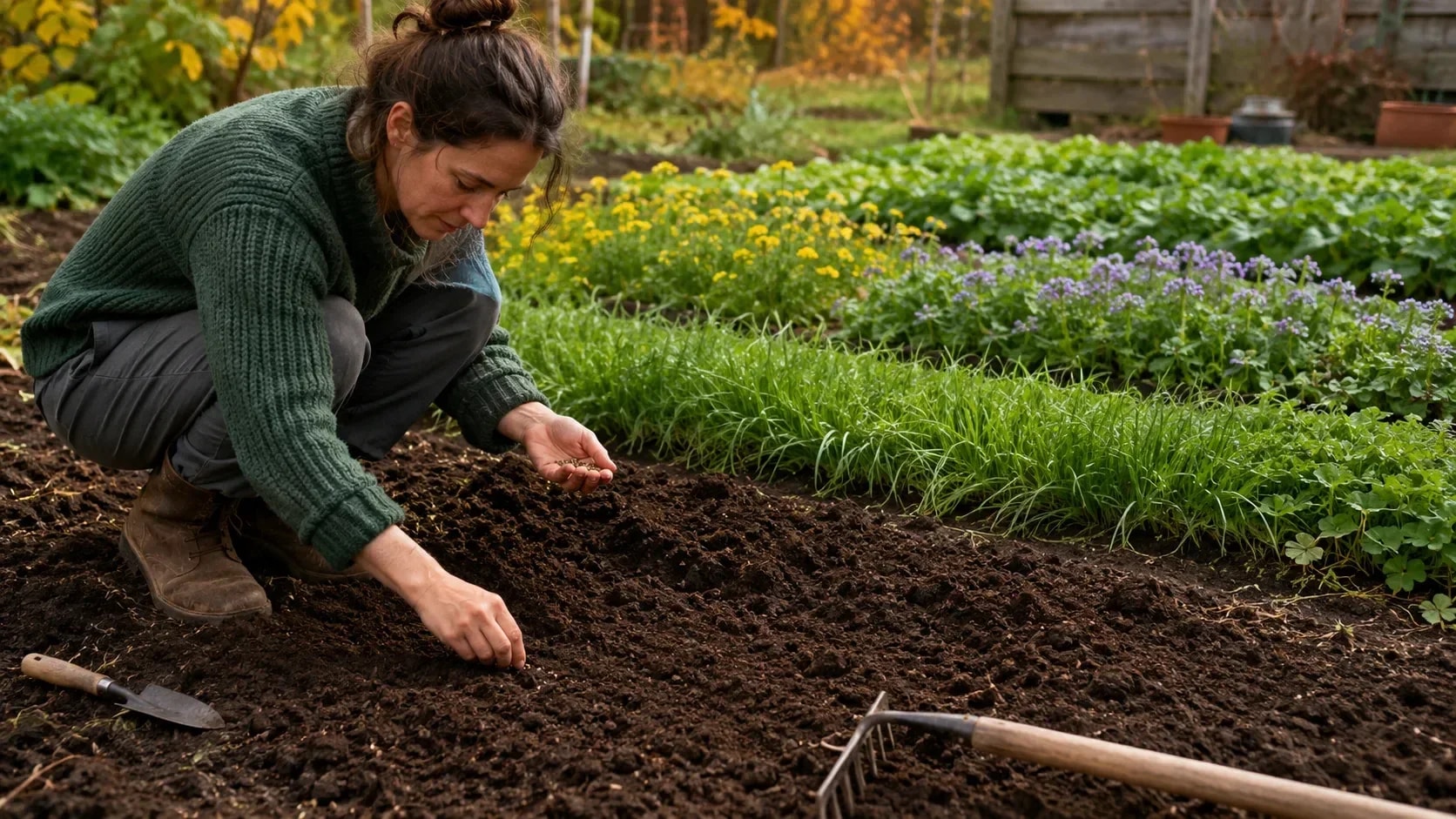
A simple broadcast method works well in garden beds:
Remove the previous crop and major perennial weeds.
Loosen only the compacted surface if necessary.
Rake the bed relatively level.
Broadcast seed evenly at the rate recommended for that species.
Rake lightly so seed has soil contact.
Firm the surface gently with the back of the rake or by walking on a board.
Water if the soil is dry and rain is not expected.
Do not bury tiny seeds deeply. Larger cereal grains can be covered a little more, but the seed packet or supplier rate should take priority.
Do you need to water siderates after sowing?
Yes if the topsoil is dry. Germinating seeds need consistent moisture. A light watering that moistens the seed zone is better than flooding the bed.
In rainy autumn weather, irrigation may be unnecessary. Check the soil rather than watering automatically.
Do you need to mow siderats in autumn?
Not always. Winter-killed crops can be left standing until frost collapses them. Winter-hardy rye is often left intact through winter and cut in spring.
Mow in autumn only if a crop is becoming excessively tall, threatening to set seed, or your management plan specifically requires it. Do not repeatedly cut young rye just to make the bed look tidy.
Do you need to dig up siderats in the fall?
No. Deep digging is not required for most garden cover-crop systems. You can leave plants and roots in place and manage the tops with cutting, winter kill, or shallow incorporation.
Leaving roots undisturbed preserves the channels they create in the soil. In spring, residues can be used as surface mulch or mixed shallowly if your planting method requires it.
When to mow siderats
The ideal stage depends on species. As a general rule, terminate before plants mature and set viable seed. For cereals, smaller spring growth is easier to handle than tall, stemmy plants.
If rye is being used before an early vegetable crop, do not wait until it becomes a dense shoulder-high stand. Earlier termination reduces moisture competition and makes residue management simpler.
Spring management starts before you cut anything. Check soil moisture and the growth stage of the cover crop. Living cereals actively use water once spring growth accelerates. In a wet spring that can be helpful; in a dry spring it can leave the topsoil too dry for the next crop. Termination timing therefore needs to respond to weather, not only plant height.
For a small bed, you can cut cover crops with shears, a sickle, or a mower appropriate to the area, then use the tops as mulch if they are free of mature seed and disease. The roots can remain in the soil and decompose in place. If you prefer shallow incorporation, mix only the upper residue into the surface rather than repeatedly turning the entire soil profile.
Do not sow the next crop into a thick, freshly incorporated mass of green material and expect immediate results. Decomposition temporarily changes oxygen and nitrogen dynamics close to the residue. Giving the bed a little time makes seedbed preparation easier, particularly for small-seeded vegetables.
If rye has already become tall and fibrous, cutting it once may not kill it completely at an early growth stage. Watch for regrowth and manage it before the vegetable crop is established. This is another reason to choose an easier winter-killed cover when you know spring time will be limited.
How long before planting do you need to remove siderats in the spring
Allow roughly two to four weeks between terminating a large cover crop and sowing or transplanting a sensitive main crop when practical. The interval gives residue time to wilt and begins decomposition.
The exact timing depends on cover-crop size, soil temperature, moisture, and whether residue is left on the surface or incorporated. Small winter-killed oats may need very little preparation; mature rye needs more.
Is it possible to leave siderats for the winter?
Yes. That is one of the main reasons to sow them. Winter-hardy species such as rye can protect soil until spring. Winter-killed species such as oats can collapse into a natural mulch.
Which behavior you want should be decided before sowing. A crop that survives winter is useful only if you are prepared to terminate it in spring.
Do siderates replace manure and compost
Not completely. Cover crops recycle nutrients and add organic material, but they do not create unlimited fertility. Legumes can fix atmospheric nitrogen with the help of root bacteria, while grasses mainly capture nutrients already present in the soil.
Compost, manure, mineral fertilizers, and cover crops serve overlapping but different roles. Soil testing and the needs of the next crop should guide fertilizer decisions.
Can ciders do harm
Poorly chosen or poorly managed cover crops can create problems. They may:
become weeds if allowed to seed;
compete for water in a dry spring;
harbor pests that also attack the next crop;
violate crop rotation when closely related species are planted in sequence;
produce more residue than a small garden can manage;
delay soil warming when a thick mulch remains in spring.
The crop itself is not "bad"; the issue is matching species and termination to the next planting.
Which siderates to choose for different tasks
Use this quick guide:
late sowing and winter soil cover: winter rye;
quick autumn biomass with winter kill: oats;
rotation-friendly option for vegetable gardens: phacelia;
rapid early-autumn growth: mustard, where brassica rotation permits;
adding biologically fixed nitrogen: vetch or clover with enough establishment time;
erosion-prone slopes: dense-rooted cereals;
beds needed very early in spring: favor winter-killed species or terminate hardy covers early.
No single species is best at everything.
The main mistakes when sowing siderats in autumn
The most common mistakes are sowing too late for the chosen species, using too little seed, burying small seed too deeply, ignoring crop family rotation, and allowing a hardy cover crop to become huge in spring.
Another mistake is expecting immediate "fertilizer" results. A cover crop is a soil-management tool. Its benefits are strongest when it is part of a rotation that also includes compost where needed, minimal soil compaction, good drainage, and appropriate fertility.
Cover crops also work differently on different soils. On heavy clay, roots help create channels and protect the surface from pounding rain, but no cover crop can compensate for chronic waterlogging; drainage and avoiding traffic on wet soil remain essential. On sandy soil, fast-growing covers help hold nutrients and add residue, yet they need enough moisture to establish. On compacted beds, a cover crop contributes biologically over time, but severe compaction may still require a one-time mechanical correction before a long-term no-dig routine can work.
Do not expect one autumn sowing to solve perennial weeds. A dense stand can suppress annual weed seedlings, but couch grass, bindweed, thistles, and other established perennials can grow through it. Remove or control those weeds before seeding the cover, otherwise you may simply hide the problem until spring.
Rotation deserves the same attention as with food crops. Mustard and radish are useful covers, but they are still brassicas. Peas, vetches, and clovers are legumes. Oats, rye, wheat, and barley are grasses. If a pest or disease is tied to a plant family, repeatedly inserting the same family as a cover crop can shorten rather than lengthen the rotation.
For gardeners who want the lowest-maintenance option, choose by the next crop first: identify what will be planted, decide how early the bed is needed, then pick a cover that fits that schedule. This backwards planning prevents the common situation where a beautiful spring cover crop becomes an obstacle on planting day.
Siderates in the fall: a brief summary of the main points
Sow cover crops as soon as beds are cleared. Use oats, mustard, or phacelia when autumn starts early enough for rapid growth. Use winter rye when the harvest is late or you need reliable cold-weather soil cover. Avoid brassica cover crops before cabbage-family vegetables. Water seed into dry soil, prevent seed production, and plan spring termination before sowing.
The right fall cover crop is not the one with the longest list of benefits. It is the one that fits your planting date, climate, soil problem, and next vegetable crop.
For seed purchasing, distinguish true winter rye (cereal rye, Secale cereale) from perennial ryegrass sold for lawns. They are different plants with different management. Gardeners searching for "winter rye grass seed" can easily end up with turf seed instead of the cereal cover crop they intended. Read the botanical or crop name on the bag and use a seeding rate intended for cover cropping. Also check whether the seed is treated; treated agricultural seed may have handling restrictions and is unnecessary for many small home gardens. In a mixed vegetable plot, clearly label the sowing date and species so spring management is not based on memory.
In raised beds, also remember that cover crops use the same limited root volume as vegetables. A dense winter-hardy stand can dry a raised bed quickly in spring, so termination may need to happen earlier than in open ground. After cutting, check moisture below the surface before planting and water only if the root zone is actually dry. Keep seed labels until spring so you know whether a volunteer grass is your cover crop or an unrelated weed.
The simplest successful plan is often one species, one clear purpose, and one known spring termination date.
FAQ
Which siderata are best to sow in autumn?
Winter rye, oats, phacelia, mustard, and some legumes are common choices. The best one depends on sowing date, winter hardiness, crop rotation, and what you will plant next.
When is it better to sow siderata in autumn?
As soon as a bed becomes free. Earlier sowing produces more biomass; very late sowing favors cold-tolerant cereals such as rye.
What siderata can be sown in October?
Rye is one of the most dependable. Oats, wheat, or phacelia may also work in milder regions and early October, depending on frost timing.
Which siderat is better to sow after potatoes?
Rye, oats, or phacelia are practical because they are unrelated to potatoes and cover the loose post-harvest soil well.
What siderats to sow after tomatoes?
Use cereals such as rye or oats, or phacelia. Remove seriously diseased tomato residue first.
What siderats can not be sown before cabbage?
Avoid mustard, oilseed radish, and other brassica-family covers immediately before cabbage-family vegetables.
Do you need to dig up siderats in the fall?
No. They can remain rooted through winter and be cut, winter-killed, or managed in spring.
Do you need to mow siderats for the winter?
Not automatically. Mow only if they are becoming too mature or setting seed. Hardy rye is commonly left standing.
Is it possible to leave rye until spring?
Yes. That is a major advantage of winter rye, but you must terminate it early enough not to interfere with spring planting.
Do siderates replace fertilizers?
No. They recycle nutrients and build organic matter, but fertilizer needs still depend on soil fertility and the crop you plan to grow.
Best of the week — in your inbox
No spam. Only top Gosta stories. Unsubscribe in one click.
Comments