
When to Plant Tulips in Fall So They Bloom Beautifully in Spring
The best answer to when to plant tulips is: after the soil has cooled in autumn, but before it freezes solid. In much of Ukraine, that usually means October, with earlier planting possible in cooler northern areas and later planting in warmer southern areas. The calendar is secondary to soil conditions.

Contents14
- When to plant tulips in autumn in Ukraine
- At what temperature should you plant tulips?
- Why it is better to plant tulips in autumn
- Where is better to plant tulips
- How to prepare tulip bulbs for planting
- At what depth to plant tulips in autumn
- How to plant tulips in autumn
- Do you need to water tulips after planting?
- Do you need to mulch planted tulips in autumn?
- What will happen if you plant tulips too early in autumn
- Can you plant tulips in November?
- What to do if tulips have sprouted in autumn
- The main mistakes during the autumn planting of tulips
- When to plant tulips in autumn: briefly about the main points
The best answer to when to plant tulips is: after the soil has cooled in autumn, but before it freezes solid. In much of Ukraine, that usually means October, with earlier planting possible in cooler northern areas and later planting in warmer southern areas. The calendar is secondary to soil conditions.
Tulip bulbs need a period of winter cold, but they also benefit from enough time in cool soil to begin rooting before severe frost. Planting too early can encourage premature top growth; planting extremely late can leave bulbs poorly rooted.
When to plant tulips in autumn in Ukraine
A practical regional guide is:
northern and western regions: often late September to October;
central Ukraine: commonly October;
southern regions: often October into November if soils remain mild;
unusually warm autumn: wait for sustained cooling rather than following a fixed date.
The exact window shifts from year to year. If daytime temperatures are still summer-like and the soil is warm, there is usually no advantage in rushing.
At what temperature should you plant tulips?
A useful target is consistently cool soil, roughly around 7–10°C (45–50°F) at planting depth. This is not a magic number; it is a practical sign that active summer warmth has passed while the ground is still workable.
If an early cold snap is followed by warm weather, do not treat one cold night as the start of planting season. Look for a stable autumn pattern.
Why it is better to plant tulips in autumn
Tulips evolved to grow through a seasonal cycle. The bulb rests through summer, roots in cool autumn soil, receives a winter chilling period, and then resumes strong growth in spring.
Autumn planting supports that cycle. Spring-planted bulbs may flower poorly or not at all if they have not received sufficient chilling, unless they were commercially pre-chilled.
Where is better to plant tulips
Choose a site with:
good drainage;
sun or at least strong spring light;
soil that does not stay waterlogged in winter;
enough space for the planned planting density;
protection from repeated standing water after snowmelt or rain.
Tulips tolerate cold much better than waterlogged soil. A low spot that stays wet is usually a worse choice than an exposed but well-drained bed.
Soil preparation should focus on drainage rather than richness. Tulips do not need a pocket of concentrated fertilizer under every bulb. If the bed is compacted, loosen it across a broader area so water can move away from the bulbs. On heavy clay, incorporating well-rotted organic matter into the bed can improve structure, but avoid creating a tiny "bathtub" of amended soil inside impermeable clay where water collects.
If you garden in containers, timing is similar but temperature swings are stronger because pots cool faster than open ground. Use a container with drainage holes, a free-draining potting mix, and enough depth to cover the bulbs properly. Large pots are generally more stable through winter than tiny decorative ones.
Store bulbs in a cool, dry, ventilated place only until planting. Do not keep them for months in a warm kitchen or sealed plastic bag. Tulip bulbs are living storage organs, and prolonged warmth or trapped moisture can reduce quality before they reach the soil.
How to prepare tulip bulbs for planting
Before planting:
Check every bulb and discard any that are soft, badly moldy, or clearly rotting.
Keep only firm bulbs with an intact base.
Sort by size if you want more even flowering groups.
Prepare the bed so the soil is loose enough for roots and excess water can drain.
Mark the planting area if other bulbs are already present.
Plant soon after preparation instead of leaving bulbs exposed outdoors.
Minor dry skin on the outside is normal. The bulb itself should feel firm.
At what depth to plant tulips in autumn
For many garden tulips, a planting depth of about 10–15 cm (4–6 in) is appropriate. Another common rule is to place the bulb at roughly two to three times its own height, measured from the base to the soil surface.
Larger bulbs generally go deeper than small species tulips. In very heavy soil, improve drainage rather than simply burying bulbs more deeply.
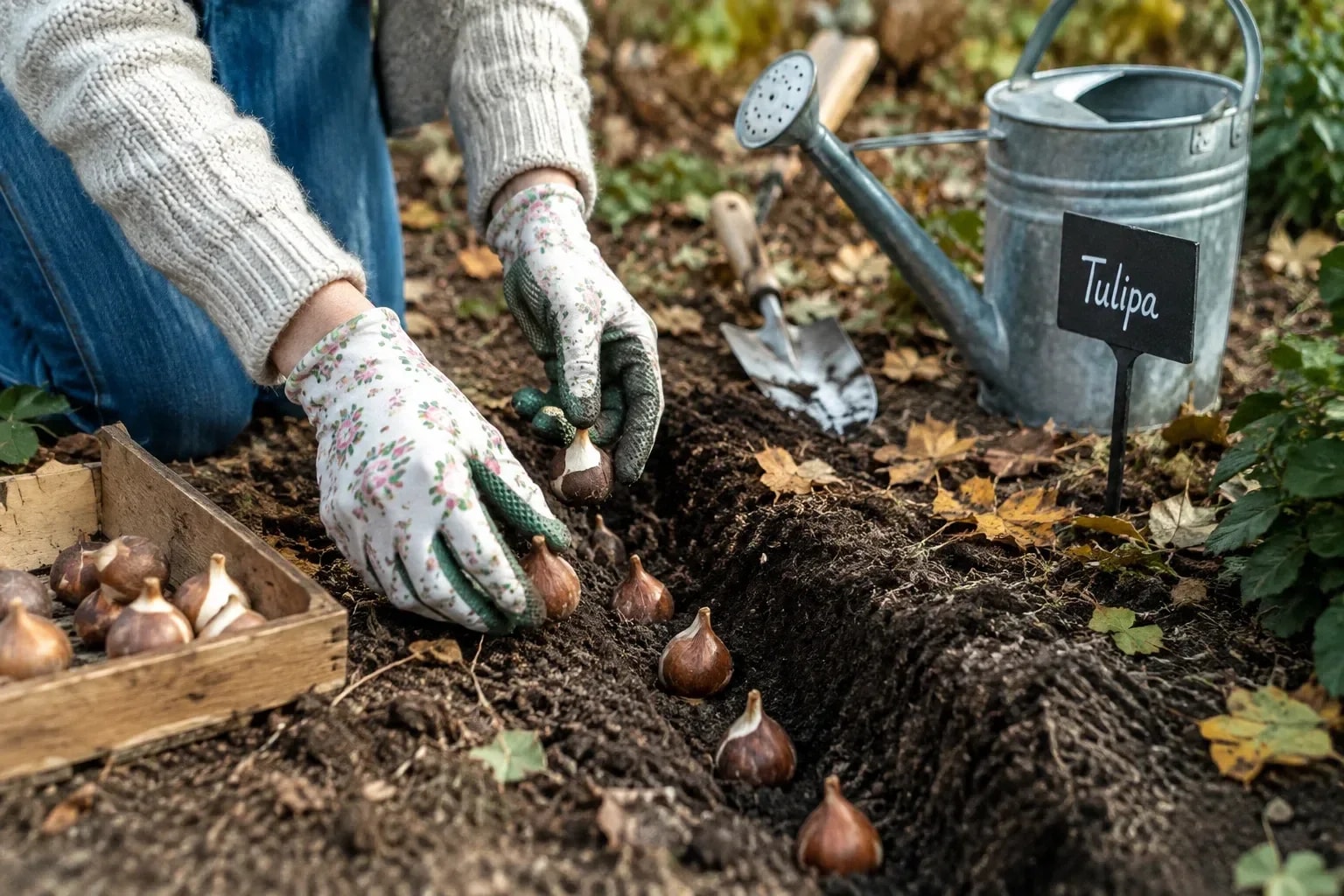
How to plant tulips in autumn
Use this sequence:
Loosen the soil and remove perennial weeds.
Make planting holes or a wider trench at the required depth.
Place each bulb with the flat basal plate down and pointed end up.
Space bulbs according to the effect you want; closer spacing creates a denser display.
Cover with soil without crushing the bulbs.
Firm the surface gently.
Water if the soil is dry at planting time.
Mark the bed so you do not accidentally dig into it later.
If you accidentally place a bulb on its side, it can often still orient its shoot upward, but correct placement gives it the easiest start.
Spacing depends on the display you want. For a natural-looking bed, bulbs can be grouped rather than lined up like soldiers. For a dense spring container, they can sit closer together as long as they are not crushed against one another. In permanent beds, a little more space makes it easier for roots to develop and for you to work around neighboring perennials.
If rodents are a serious problem in your area, physical protection such as a suitable wire barrier over the planting area may help, but do not wrap individual bulbs tightly in material that blocks root growth or traps water. Repellent products are inconsistent, and household chemicals should not be poured into the soil as improvised deterrents.
Label the cultivar and planting date. This simple note becomes useful in spring when you compare which varieties returned well, which flowered too early for local frosts, and which areas of the bed stayed too wet.
Do you need to water tulips after planting?
If the soil is already evenly moist from autumn rain, additional watering may be unnecessary. If the bed is dry, water once after planting so soil settles around the bulbs and rooting can begin.
Do not keep the bed constantly wet. Tulip bulbs are vulnerable to rot in poorly drained conditions.
Do you need to mulch planted tulips in autumn?
Mulch is optional in many established beds. A light layer can moderate temperature swings and reduce weed growth, especially in exposed sites. Avoid a thick, wet layer that holds excess moisture directly over the bulbs.
In very cold regions, mulch is most useful after the ground has cooled rather than while it is still warm.
What will happen if you plant tulips too early in autumn
Warm soil can encourage bulbs to begin active growth too early. Shoots may appear before winter, and warm, wet conditions can also increase disease pressure in poorly drained beds.
A small amount of autumn sprouting does not automatically mean the bulbs are lost, but it is a sign that planting happened during a warm period.
Can you plant tulips in November?
Yes, if the ground is not frozen and you can still prepare the soil properly. In warmer parts of Ukraine and during mild autumns, November can be a suitable planting period.
Late planting is often better than storing bulbs indoors until spring, provided the soil remains workable and not waterlogged.
What to do if tulips have sprouted in autumn
Do not dig up healthy bulbs simply because a small shoot appeared. Avoid encouraging more growth with nitrogen fertilizer. If severe cold is expected and the site is exposed, a light protective mulch can reduce abrupt temperature changes.
The key is not to keep disturbing the bulb. Many tulips can still flower after minor premature growth.
Another common mistake is treating all "tulips" as identical. Botanical species, small early tulips, Darwin hybrids, Triumph tulips, doubles, and late-flowering types can differ in height, flowering time, and persistence. The planting-depth guidance of roughly 10–15 cm fits many standard garden bulbs, but unusually small species bulbs may be planted shallower according to the supplier's instructions.
Do not cut spring foliage immediately after flowering. This is technically a spring-care issue, but it determines whether bulbs have enough stored energy for the following year. Remove the faded flower if desired, then allow the leaves to yellow naturally before cutting them back. If you need the bed to look tidy, plant tulips among perennials that emerge later and hide the fading foliage.
Tulips also vary in how reliably they perennialize. Some cultivars return strongly for several years; others give their best display the first spring and decline. If repeated flowering is important, choose cultivars known for persistence, plant them in a sunny well-drained bed, and avoid summer irrigation that keeps dormant bulbs wet.
The main mistakes during the autumn planting of tulips
The most common errors are:
planting in warm soil too early;
choosing a waterlogged site;
planting rotten or soft bulbs;
burying large bulbs too shallowly;
leaving bulbs sitting in water after planting;
forgetting where the bulbs were planted;
applying excessive fresh fertilizer directly against bulbs;
assuming every region has the same planting date.
Good drainage and correct timing matter more than complicated planting additives.
When to plant tulips in autumn: briefly about the main points
Wait for stable autumn cooling, then plant while the soil is still workable. In Ukraine, October is the central window for many regions, but local weather can move the date earlier or later. Aim for cool soil, a sunny and well-drained location, and roughly 10–15 cm planting depth for standard garden tulips.
The best guide to when to plant tulips is the combination of your local climate, current soil temperature, and the condition of the bulbs — not a single date printed on a calendar.
When planting several varieties, group bulbs by expected flowering period as well as color. Early, mid-season, and late tulips can extend the display for weeks, while a single mixed bag may bloom unevenly. Put taller varieties where they will not shade short species tulips, and keep labels until spring so you can evaluate performance. If a section fails, check drainage and bulb condition before assuming the planting date alone was responsible.
For naturalized plantings, avoid digging deeply in the same area every summer because repeated disturbance can damage dormant bulbs. If you want to add annuals above tulips, choose shallow-rooted plants or mark the bulb positions so later planting does not cut through them.
A small planting map or phone photo also helps prevent accidental digging during late-autumn garden work.
That small record makes spring troubleshooting much easier.
FAQ
When is the best time to plant tulips in autumn?
After the soil has cooled consistently but before it freezes. In many parts of Ukraine, October is a practical main window.
Can you plant tulips in September?
Yes in cooler regions or during a genuinely cool autumn, but avoid planting into hot late-summer soil simply because September has begun.
Can you plant tulips in October?
Yes. October is one of the most reliable planting periods across much of Ukraine.
Can you plant tulips in November?
Yes, especially in milder regions, as long as the soil is not frozen or waterlogged.
At what depth should you plant tulip bulbs?
Many garden tulips are planted around 10–15 cm deep, or roughly two to three times the height of the bulb.
Which side to plant a tulip bulb?
Place the flat basal plate down and the pointed tip up.
Do you need to water tulips after planting in the fall?
Water once if the soil is dry. If autumn rain has already made the soil evenly moist, extra watering may not be necessary.
What to do if you didn't have time to plant tulips in October?
Plant later in autumn if the ground remains workable. Do not automatically postpone until spring.
Can you plant tulips in the spring?
You can plant bulbs in spring, but they may not flower normally unless they have received enough cold exposure. Autumn is the standard planting time.
Do tulips need to be dug up every year?
Not always. Some tulips can remain in well-drained ground for several years, although flowering may decline depending on cultivar, climate, and summer soil conditions.
Best of the week — in your inbox
No spam. Only top Gosta stories. Unsubscribe in one click.
Comments