
Ukrainian Honey Cake: Layers, Frosting, Soaking Time, and Baking Secrets
A classic Ukrainian honey cake is built from many thin honey-scented layers and a generous sour-cream frosting that softens them overnight. The cake is often called medovyk or medovik. The method looks complicated because there are several layers, but each individual step is simple: warm the honey mixture, make a soft dough, roll thin rounds, bake them quickly, cool them, then assemble with cream.

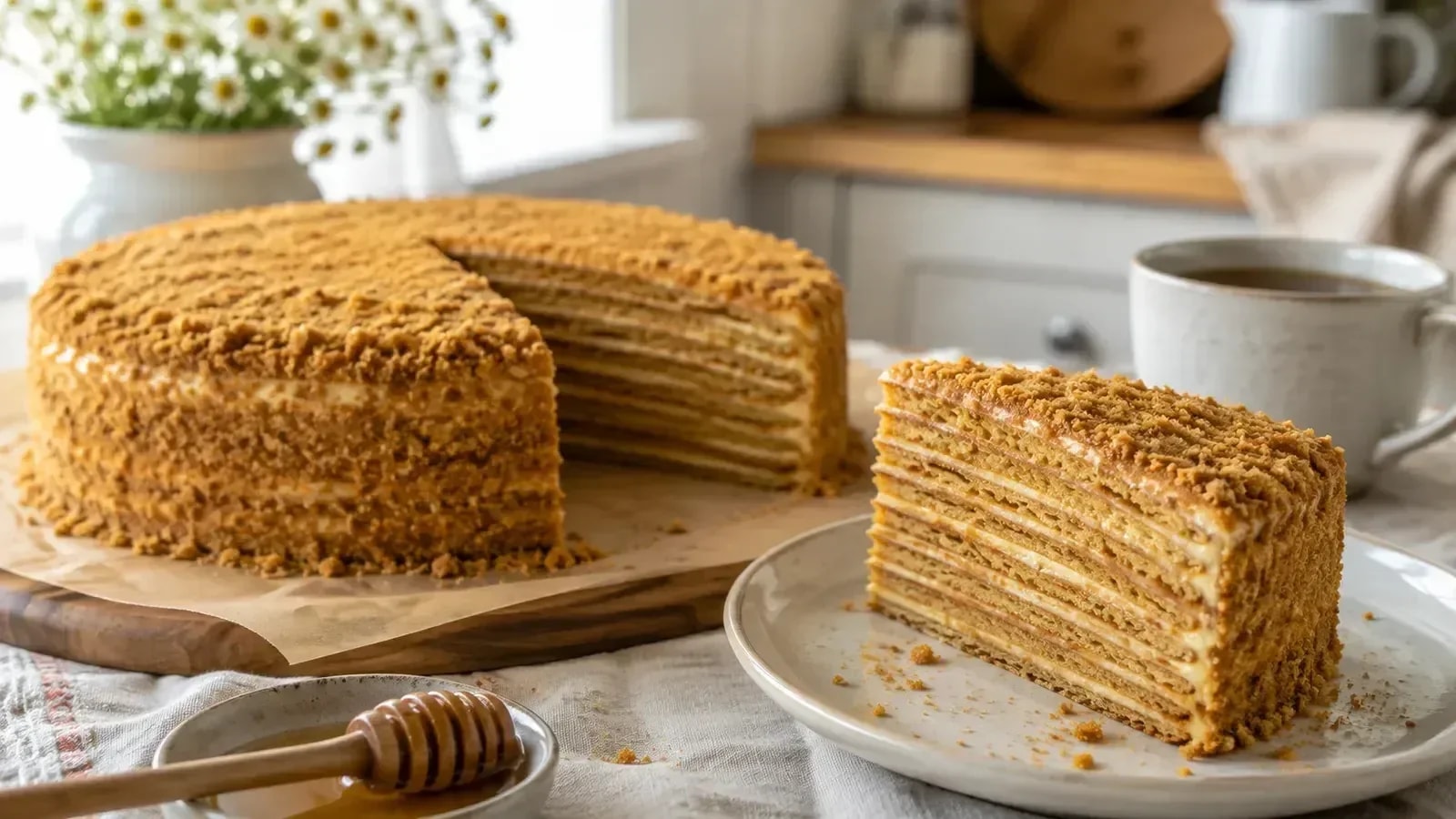
A classic Ukrainian honey cake is built from many thin honey-scented layers and a generous sour-cream frosting that softens them overnight. The cake is often called medovyk or medovik. The method looks complicated because there are several layers, but each individual step is simple: warm the honey mixture, make a soft dough, roll thin rounds, bake them quickly, cool them, then assemble with cream.
The most important rule is not to over-flour the dough. Honey-cake layers are supposed to be thin and fairly firm when they leave the oven; the cream transforms them into a tender cake during the soaking time. Overnight — about 10–12 hours — is ideal.
This recipe makes one 20–22 cm cake with 8 thin layers, enough for about 8–10 modest servings. Bake and assemble the day before you need it.
Ukrainian honey cake (medovyk)
Eight thin honey layers with thick sour-cream frosting. The dough must stay soft; the cake becomes tender only after 8–12 hours in the refrigerator.
Ingredients
Instructions
- Heat the oven to 180°C/350°F. Warm butter, honey, sugar, and salt in a large saucepan over low heat until smooth. Stir in baking soda; the mixture will foam and lighten. Do not burn it.
- Cool 5–7 minutes so it is hot but not boiling. Whisk the eggs in a separate bowl and add them gradually while stirring so they do not scramble.
- Mix in about 350 g flour first, then add more as needed until the dough is soft and only slightly tacky. Do not knead in extra flour just because the warm dough feels sticky. Divide into 8 equal pieces while warm.
- Roll each piece very thinly (about 2 mm) on parchment to a 20–22 cm circle. Keep the scraps. Prick with a fork if you want flatter sheets. Bake 4–6 minutes until even golden. Bake the scraps too for crumb coating. Trim warm layers if you want perfect circles.
- Cool all layers completely. Mix sour cream with powdered sugar and vanilla briefly; do not beat until thin. If the sour cream is loose, drain it in cheesecloth first.
- Spread about 80–90 g cream on each internal layer, then cover the top and sides. Press crumbs over the surface. Refrigerate 8–12 hours, covered, before slicing.
Honey, soda, and flour
Mild acacia or flower honey gives a delicate cake; buckwheat honey is darker and more assertive. Crystallized honey is fine — it melts. You do not need to extinguish baking soda with vinegar; honey contains natural acids, and the heated mixture already provides the reaction. Too much soda leaves an alkaline taste. Foaming after soda is expected; use a saucepan with empty space above the ingredients.
Plan on roughly 380–430 g flour. The correct number is not universal. If you add 100 g extra "for safety," the layers can stay hard even after overnight soaking. It is better to chill a soft dough briefly than to turn it into a stiff bread-like mass.
Rolling, baking, and cream
Roll on parchment so you never have to lift a paper-thin round. Thin layers bake in 4–6 minutes; a layer can go from underdone to overbaked in one or two minutes. Trim while warm if you want perfect circles; cool layers become brittle.
Thick full-fat sour cream, around 20–30% fat, is the easiest frosting. Taste before adding the maximum sugar — the honey layers are already sweet. Custard is another good option and is less tangy; very stiff buttercream alone does not soften the layers as well. Do not leave a sour-cream cake at room temperature for hours; assemble and refrigerate promptly.
Why the cake is dry, bitter, or solid
Too much flour, overbaking, thick layers, too little cream, or not enough soaking time are the usual causes of a dry or solid cake. If layers are firm but not burnt, they can still soften after 12–24 hours with enough moist cream. Bitterness comes from scorched honey, too much soda, or a naturally bitter honey. Small bubbles in the oven are normal; dock the dough if pockets get large.
Medovyk generally means this layered honey cake with cream. Medivnyk more often refers to a single baked honey spice cake, although names vary by family. The traditional finish is baked crumbs over the top and sides. Keep the cake covered in the refrigerator and eat it within about 3–4 days.
FAQ
What ingredients do you need for honey cake layers?
Flour, eggs, honey, sugar, butter, baking soda, and a pinch of salt.
What ingredients do you need for the cream?
The simplest version uses thick full-fat sour cream, powdered sugar, and optional vanilla.
How many layers should be in honey cake?
Eight is practical for a 20–22 cm home cake. Six thicker or ten thinner layers also work if total dough quantity stays similar.
How long do you bake honey cake layers?
Thin layers usually need about 4–6 minutes at 180°C/350°F. Watch color closely because they brown quickly.
How long should honey cake soak?
At least 8 hours; 10–12 hours overnight is ideal for most recipes.
Do you need to extinguish baking soda with vinegar?
No. Add baking soda directly to the warm honey mixture. Separate vinegar is unnecessary.
Why does honey cake come out dry?
Too much flour, overbaking, thick layers, too little cream, or insufficient soaking time are the main causes.
Best of the week — in your inbox
No spam. Only top Gosta stories. Unsubscribe in one click.
Comments